
The Motorcycle That Turns 500-Mile Days Into The Norm

By hour six of a truly long day in the saddle, a rider knows things about their body they never asked to learn. The left hand aches in that specific way that only comes from squeezing a clutch lever a few hundred times since breakfast. Palms buzz faintly, still humming an hour after the bike’s parked. The neck has developed an opinion about wind blast, and that opinion is negative. None of this happened because the destination was 500 miles away. It happened because of everything that stood between the rider and that number. That’s the real story behind long-distance touring, and it’s one most motorcycles quietly ignore.
What Actually Limits A Big-Mile Touring Day

Ask riders what stops them from covering 500 miles in a day, and they’ll probably mention gas stops first. Fair enough, nobody enjoys watching the fuel needle drop with the next station 40 miles out. However, fuel range is the wrong villain. The real ceiling on a big-mile day is fatigue, and fatigue builds from sources that have nothing to do with tank size. Start with the clutch. A rider crossing Nebraska on I-80 might work through a thousand or more gear changes over eight hours.
Then there’s wind. Even a good fairing only blocks so much, and hours of buffeting at 75 mph works on the neck and shoulders in ways that don’t show up until the rider’s off the bike, stretching in a gas station lot. Add a seat that felt fine for the first hour and progressively less fine for the next seven, and it’s easy to see why 500 miles sounds ambitious, even on bikes built specifically for distance.
Fully-Dressed Baggers Have Innovated To Minimize Fatigue

None of this has stopped the fully-dressed touring segment from thriving. If anything, it’s grown, despite being a difficult choice for parking lots, city traffic, or anyone under six feet tall trying to flat-foot at a stoplight. There’s something about the format — the fairing, the trunk, the sheer physical presence — that keeps pulling riders in, generation after generation. These bikes are defined by large fairings and windshields for weather protection, big fuel tanks, torquey low-end engines, and a relaxed, upright seating position.

The current U.S. lineup makes that clear. Harley-Davidson’s 2026 Road Glide Limited starts at $32,999 and pairs a Milwaukee-Eight VVT 117 engine making 106 horsepower and 131 lb-ft of torque with a redesigned Tour-Pak and four-speaker audio. The Indian Pursuit, starting at $32,499, runs a 126-horsepower PowerPlus 112 V-twin. BMW brings an inline-six to the fight with the K 1600 B. As good as these bikes are, they are all trying to beat a well-proven Honda. This takes a different approach, one borrowed less from cruiser culture and more from the automotive world’s playbook on cutting driver workload.
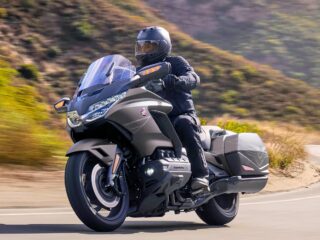
The Honda Gold Wing Tour DCT Turns 500-Mile Days Into The Norm
Base Price: $30,500

That bike is the Honda Gold Wing Tour Automatic DCT. It carries a base MSRP of $30,500, plus a $775 destination charge, positioning it as Honda’s flagship road machine rather than a niche option in the middle of a five-bike Gold Wing lineup. The base Gold Wing starts at $25,500 with a six-speed manual, or $26,500 with automatic DCT. The Gold Wing Tour, which adds the trunk and passenger backrest, runs $29,500 with the manual, $30,500 with DCT, and tops out at $33,800 for the Tour Airbag Automatic DCT.
Every trim shares the same core hardware; what changes climbing the ladder is bodywork, storage, and safety equipment, not the fundamental engineering underneath. That engineering is the actual story. Honda didn’t solve long-distance comfort by throwing more storage or a bigger stereo at it, though the Gold Wing has both. It solved it by borrowing an idea from the automotive world: remove the rider’s manual workload, and the miles stop fighting back.
The Seven-Speed DCT Removes The Real Source of Fatigue

The biggest difference between the Honda Gold Wing Tour DCT and most touring motorcycles isn’t horsepower. It’s what your left hand doesn’t have to do. Honda’s seven-speed Dual-Clutch Transmission eliminates the clutch lever entirely while delivering quick, nearly seamless gear changes. The seventh gear functions as an overdrive, allowing the flat-six engine to settle into relaxed highway revs.
The transmission also includes Walking Mode, allowing the motorcycle to creep forward or backward under power at a walking pace. That may sound like a minor convenience until you’re trying to back an 847-pound touring motorcycle uphill out of a parking space after spending eight hours riding. All in all, that reduced workload becomes surprisingly noticeable. Traffic jams become less frustrating because you’re no longer constantly feathering a clutch. Mountain switchbacks become easier because you can focus entirely on braking and steering.
A Flat-Six That Doesn’t Ask You To Work For It

Behind the transmission sits a 1,833cc horizontally opposed six-cylinder engine with Unicam SOHC architecture, a square 73.0 mm x 73.0 mm bore and stroke, 10.5:1 compression, and PGM-FI fuel injection through a 50 mm throttle body. The flat-six layout isn’t just a nod to Gold Wing heritage; opposing pistons moving in mirrored pairs cancel out a huge amount of the vibration a rider would otherwise absorb through the pegs, seat, and bars.
Honda rates the engine at 125 hp at 5,500 rpm and 125 lb-ft of torque at 4,500 rpm. Four ride modes — Tour, Sport, Rain, and Eco — adjust throttle mapping to conditions, with Tour mode doing most of the work on a long day: relaxed response, low-effort acceleration, nothing that asks the rider to think hard about the right wrist.
Chassis Engineered To Disappear Underneath You

Instead of a conventional telescopic fork, the Gold Wing uses a double-wishbone front suspension with 4.3 inches of travel, paired with a Pro Arm single-sided swingarm and Pro-Link rear shock offering 4.1 inches of travel. The double-wishbone design resists dive under braking far better than a telescopic fork, keeping the bike settled exactly when a tired rider needs predictability most. The flat-six’s low mounting also helps centralize mass low in the chassis. So the Gold Wing should feel lighter than its spec sheet suggests once it’s rolling.
Seat, Windscreen, And Wind Management

Honda dresses the cockpit in a suede-like seat cover with an optional adjustable rider backrest. The electrically adjustable windscreen moves through a 4.9-inch range and changes angle as it rises and falls, automatically remembering the last setting, so there’s no re-fiddling every time the bike gets parked and restarted. Combined with full-coverage bodywork tuned for airflow, it’s the windscreen and fairing, not the engine, doing most of the work keeping wind fatigue off the table.
A Legible Instrument Cluster With All The Necessities

Every Gold Wing comes with a seven-inch full-color TFT display, and since 2025, Apple CarPlay and Android Auto both run wirelessly across the lineup, a change Honda made after concluding most riders would rather use their phone’s mapping apps than the bike’s own aging navigation software, which was dropped as a result. It’s worth knowing if you liked the old built-in GPS, but for anyone already living inside Google Maps or Apple Maps, it’s a clear upgrade.

Elsewhere, heated grips come standard across every trim, with heated seats added on Tour models, a feature that sounds minor until a rider is three hours into a cold morning start. Hill Start Assist and Honda Selectable Torque Control are standard, quietly working in the background on inclines and low-traction surfaces. And the smart key system, which starts the bike with a button press as long as the fob is nearby, includes an answer-back feature to help locate the bike.
Setting Honest Expectations On Range

The Gold Wing Tour DCT carries 5.5 gallons of fuel. Owner-reported fuel economy generally lands in the low-to-mid-40 mpg range during mixed touring, translating into roughly 200 to 225 miles between fuel stops depending on conditions and riding style. Some riders might initially wish for a larger tank. However, that misses the point. Honda never set out to build the motorcycle with the longest range in the segment. Instead, it focused on making every one of those 200-plus-mile stretches feel remarkably effortless.
That’s ultimately why the Honda Gold Wing Tour DCT remains one of the benchmarks in luxury motorcycle touring. It doesn’t magically eliminate fatigue, nor does it make 500-mile days physically easy. It simply removes so many of the little stresses that normally accumulate over the course of a ride that those long days become surprisingly achievable. You still stop for fuel, and you still stretch your legs. The difference is that you arrive at each stop standing upright instead of unfolding yourself from the saddle.
Source: Honda Powersports

Related posts


Latest Post


No Comments