
The Motorcycle That Proves Heritage Still Matters
The motorcycle industry is obsessed with moving forward. More horsepower, bigger screens, smarter electronics, and electric powertrains are increasingly becoming the usual ways manufacturers prove they are still relevant. Yet there is another force at work, and it has nothing to do with chasing the future. Nostalgia still sells. More importantly, when it is handled properly, heritage can create genuine demand rather than simply decorate a brochure. As it turns out, nostalgia isn’t a sentimental afterthought tacked onto a press release. It’s a lever that actually moves product — and one motorcycle just proved it.
Why Manufacturers Keep Betting On The Past

The motorcycle industry’s fascination with the past isn’t new. Manufacturers regularly reach into their archives when they need to create an emotional connection with buyers. Anniversary editions, revived names, classic paint schemes, and modern interpretations of old-school motorcycles have become a familiar part of the product cycle. The reason is fairly simple. Technology can make a motorcycle objectively better, but it doesn’t necessarily make it more desirable.
A rider can understand a horsepower figure. They can compare suspension specifications, screen sizes, and electronic rider aids, but heritage works on a different level. It gives a motorcycle a story before the buyer even throws a leg over it, which is a significant factor in a mature motorcycle market, where many products are already fast, capable, and technologically sophisticated. A manufacturer needs something beyond the specification sheet to make one motorcycle feel special. Harley-Davidson understands that better than most.
The Retro-Cruiser Playbook Isn’t New

Triumph has leaned on this for years with its Bonneville lineup, selling riders on a silhouette that hasn’t fundamentally changed since the 1960s. Kawasaki did something similar with the W800, chasing the same air-cooled, classic-twin nostalgia that never really goes out of style. The pattern is consistent enough that it barely counts as a gamble anymore. What’s rarer is a manufacturer using that playbook to prove something beyond styling — and that’s exactly where this year’s most interesting reissue comes in.

The Harley-Davidson Super Glide Proves Heritage Still Matters
With A Base Price Of $15,999, It’sPriced to Actually Sell, Not Just to Impress

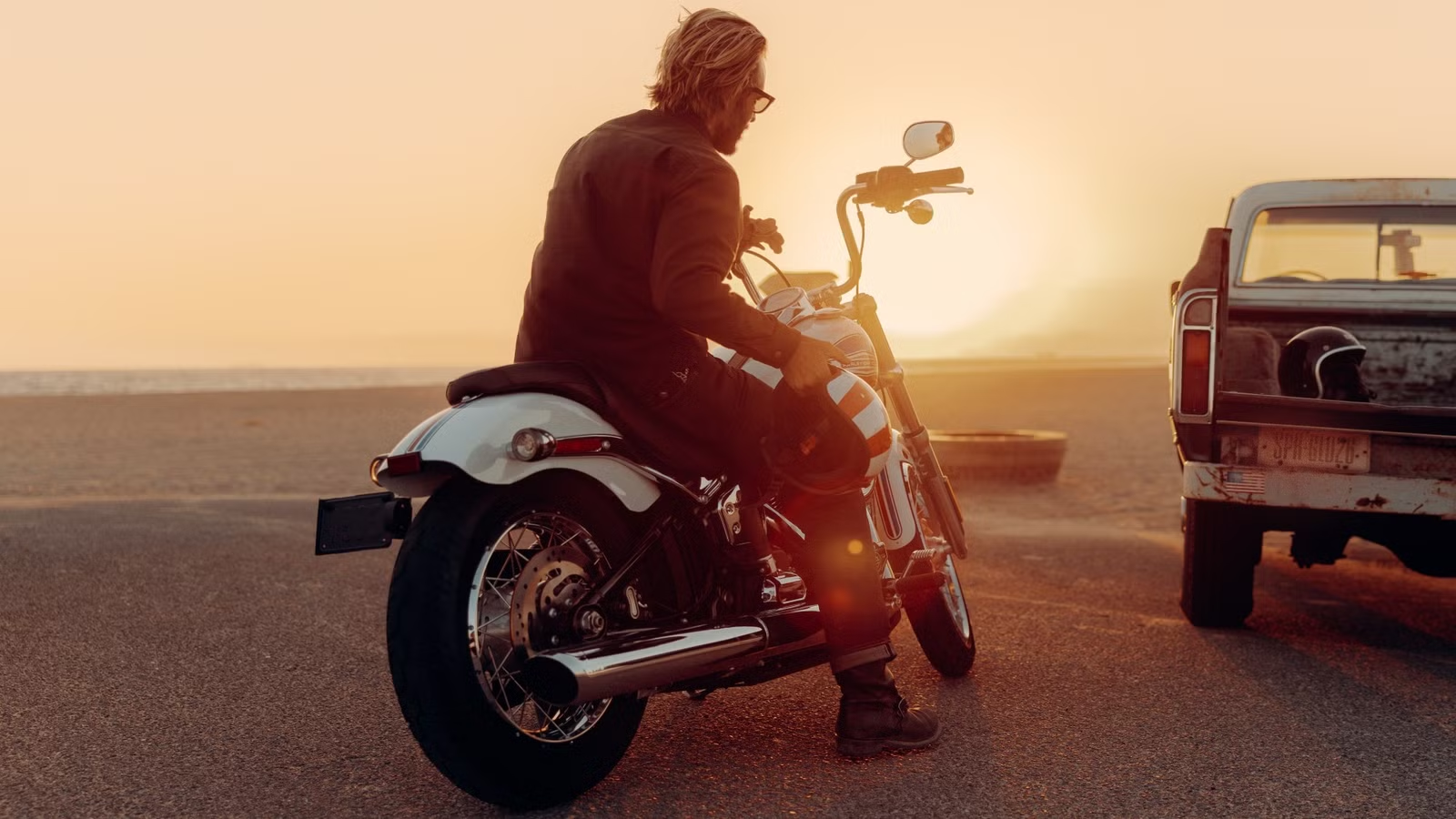
Harley-Davidson brought back the Super Glide nameplate for 2026, and it did so in the most limited way possible: 2,500 serialized units, sold exclusively in the U.S. and Canada, timed to coincide with America’s 250th anniversary. Built on the modern Softail platform, it isn’t a museum piece pretending to run. It’s a fully current motorcycle wearing a 1971 identity, and Harley priced it like it wanted people to actually buy one, not just admire it from across a showroom floor.
In a year when most manufacturers are chasing futuristic gimmicks to stay relevant, the Super Glide leaned in the opposite direction — and it worked. But to understand why this reissue landed differently than a typical anniversary badge, you have to go back to what the original Super Glide actually invented.
The 1971 Original That Invented The Factory Custom

To understand why this bike matters, you have to go back to Willie G. Davidson’s original sketch. In 1971, Harley’s styling boss took the narrow front fork off a Sportster and bolted it onto the frame of a Big Twin FL — a combination nobody at the factory had tried before. It looked lean, a little aggressive, and unmistakably custom, even though it rolled straight off the assembly line.
That distinction set the bike apart. Before the FX Super Glide, customization was a garage activity. Riders bought a stock bike, then spent years making it their own. Davidson’s mashup did something the industry hadn’t really attempted: it sold the finished custom look directly from the factory floor, no wrench time required.
From Rebel Outlaw To Brand Blueprint

That single decision rippled through decades of Harley design. The FXR, the Dyna, and eventually the modern Softail family all trace some piece of their DNA back to that original Big Twin-meets-Sportster formula. None of them are direct engineering descendants in a strict technical sense — Harley’s platform history is messier than a straight line — but the design philosophy the Super Glide introduced never really left the lineup. It’s fair to call the nameplate a founding document for how Harley builds cruisers to this day, even if the badge itself disappeared from the catalog for long stretches in between.
Modern Engineering Underneath A Vintage Silhouette
Muscle Meets Legacy: The Milwaukee-Eight 117 Classic

Heritage styling is one thing, but heritage performance is a different and less flattering story. Harley clearly didn’t want the Super Glide accused of the latter. Power comes from the Milwaukee-Eight 117 Classic, a 1,923cc V-twin tuned for a claimed 98 horsepower and 120 pound-feet of torque, with that torque arriving low and staying flat across the rev range. It’s a low-effort, high-character engine, built to make stoplight-to-stoplight riding feel satisfying without demanding the rider work for it. The exhaust note does its part too, carrying just enough rasp to remind you this isn’t a quiet appliance.
Invisible Safety Nets And Riding Dynamics

Underneath the vintage bodywork sits a stiff, lightweight Softail frame doing a convincing impression of a classic hardtail — a look that used to mean a brutal ride before Harley figured out how to hide a mono-shock under the seat. A 49mm front fork handles the front end, while a single 300mm disc and 292mm rear disc take care of stopping power.
The electronics are even better hidden. Cornering-enhanced ABS, cornering traction control, and drag-torque slip control all come standard, quietly managing lean-angle braking and rear-wheel slip without ever announcing themselves. Three ride modes — Road, Sport, and Rain — let riders dial in how much of that safety net they want engaged. It’s modern engineering doing its job by staying invisible, which is a harder trick to pull off than it sounds.
White Onyx Pearl, Spoked Wheels, And A Serial Number: Every Detail Is Deliberate

Every visual detail on the Super Glide points back to 1971 on purpose. White Onyx Pearl paint carries red and blue fender striping straight out of the original FX playbook, wrapped around a five-gallon teardrop tank topped with a chrome console. Laced wheels — now tubeless, a small concession to modern convenience — echo the spoked look of the original, while mini-ape handlebars and generous chrome trim round out the period-correct silhouette.
The exclusivity is deliberate, too. Limiting the run to 2,500 units sold only in the U.S. and Canada keeps the Super Glide out of reach for most of the world, which does exactly what limited production always does: it manufactures scarcity around a bike that would probably sell well even without it. Each unit carries its own serial number stamped on the tank console, the kind of small detail that turns a production Softail into something closer to a collector’s item the moment it leaves the dealership.
The Numbers That Back Up The Nostalgia

Harley-Davidson’s second-quarter 2026 results showed North American retail sales up three percent and dealer inventory down 17 percent — a sign that bikes were actually leaving showrooms rather than piling up on lots. When Harley raised its full-year sales guidance shortly after, the Super Glide’s early reception was specifically cited as part of the reasoning. That’s not a coincidence tucked into a footnote. That’s a limited-edition heritage model getting credit for moving the needle on a public company’s forecast.
The pricing strategy reinforces the point. At $15,999, the Super Glide sits barely $1,000 above a standard Street Bob — and less than that once you account for what it takes to option a Street Bob up with a pillion seat and spoked wheels to match. Harley could have charged a steep collector’s premium and probably gotten away with it. Instead, it priced the Super Glide like a volume play, not a vanity project, and let a limited run sell itself on merit rather than markup.
How A 2,500-Unit Heritage Bike Changed Harley’s Wall Street Forecast

Heritage didn’t just help the Harley-Davidson Super Glide look good in press photos. It contributed directly to a sales forecast that Wall Street pays attention to. For a company navigating an industry increasingly obsessed with what’s next, the Super Glide is a reminder that what’s already been done — done well, priced fairly, and built on genuinely modern hardware — can still be the smartest move on the table.
Source: Harley-Davidson

Related posts



Latest Post


No Comments