
The Motorcycle That Proves Heritage Can Still Feel Fresh
Retro motorcycles come with a strange contradiction. Riders want the look, character, and emotional connection of an older machine, but very few actually want old brakes, vague suspension, carburetors, or ergonomics designed several decades ago. The hard part isn’t recreating the past. It’s deciding which bits deserve to survive while making everything underneath work like a genuinely modern motorcycle. One Japanese manufacturer has gone back to one of its strongest eras for the answer.
Great Retro Bikes Borrow An Identity, Not Just A Shape

Building a convincing retro-inspired motorcycle takes more than fitting a round headlight and calling it a day. Flat seats, exposed engines, striped fuel tanks, and simple bodywork have become shorthand for “classic,” but they’re much more effective when they actually reference something from a manufacturer’s history. Otherwise, you can end up with a perfectly competent modern naked bike dressed in a costume that could’ve come from almost any brand.
Honda’s CB Era Had More Than Good Looks

The late-1970s CB750F and CB900F weren’t interesting simply because they looked good. They were muscular, practical inline-four roadsters built at a time when Honda was refining the formula that would eventually define a huge chunk of the Japanese performance-bike market. Their long tanks, relatively flat seats, exposed engines, and flowing side panels gave them a strong visual identity, but they were also meant to be genuinely useful motorcycles rather than decorative throwbacks.

Honda specifically points to those machines as inspiration for its latest interpretation of the idea. That’s important because it gives the styling a clear reference point instead of relying on generic nostalgia. The original CB-F bikes combined straightforward ergonomics with serious performance for their time, so recreating their spirit today requires more than copying the graphics. It means building something that can still function as a fast, usable roadster in 2026.

The Honda CB1000F’s Heritage Play Is More Than Just A Costume

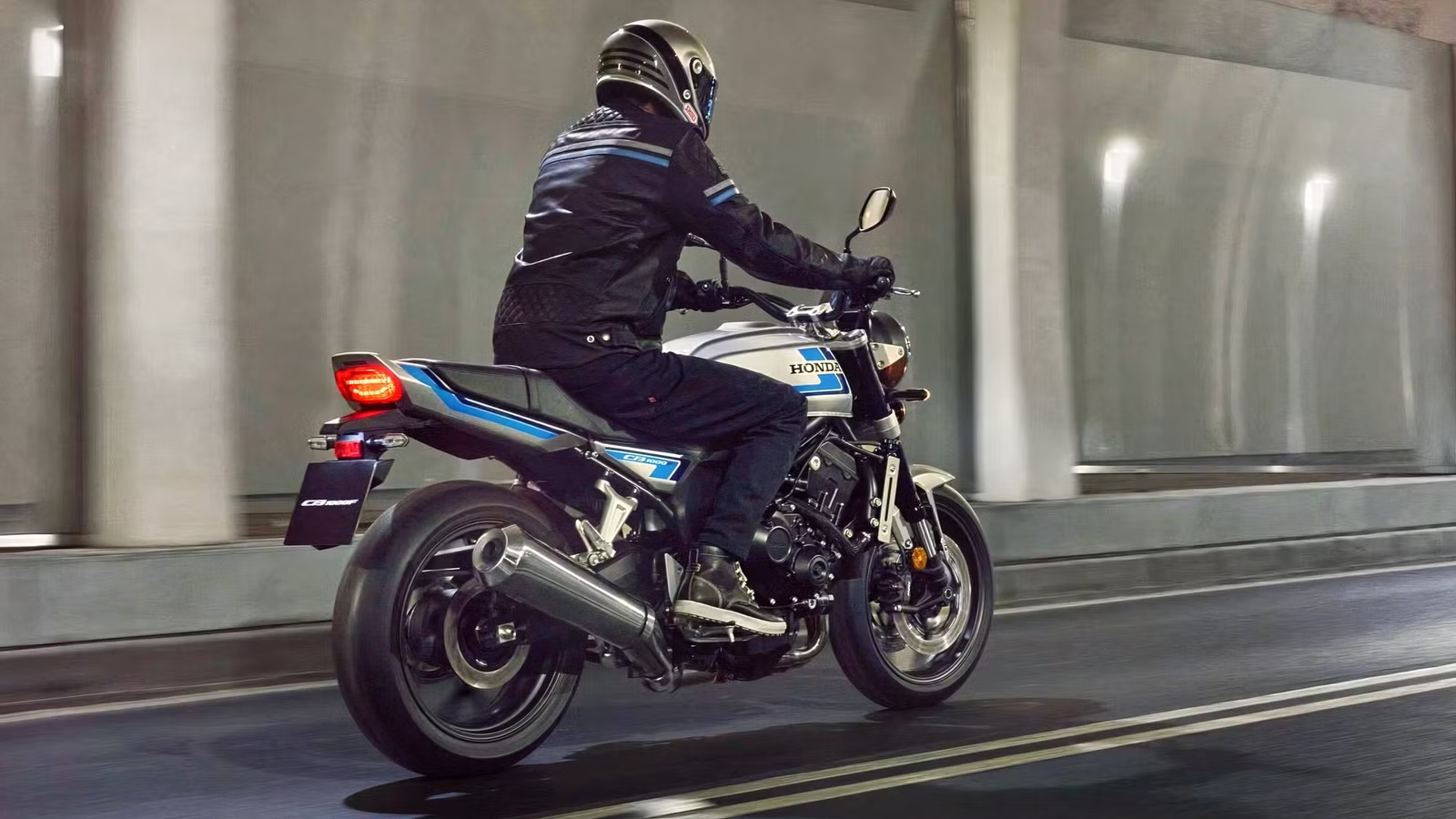
That’s where the Honda CB1000F comes in. The visual connection is obvious in Wolf Silver Metallic, with blue graphics stretched across the tank and side panels, a round LED headlight, a relatively horizontal tank-and-seat line, and a prominently exposed inline-four. Even the four-into-one exhaust contributes to the period influence, while the rear bodywork avoids the aggressively abbreviated tail sections seen on many current naked bikes.
Yet Honda hasn’t tried to reproduce an old CB down to every last detail. The wheels, fork, brakes, lighting, and packaging are clearly contemporary, which keeps the bike from drifting into replica territory. The result is recognizably inspired by Honda’s past without pretending the last four decades didn’t happen. At $10,599, plus a $775 destination charge, it’s also positioned as a normal production liter-class roadster rather than an expensive limited-run nostalgia exercise.

Underneath that bodywork is a steel backbone frame wrapped around a 1,000cc liquid-cooled inline-four. The engine uses a 76.0mm bore and 55.1mm stroke, an 11.7:1 compression ratio, DOHC cylinder heads with four valves per cylinder, and PGM-FI through 44mm throttle bodies. Power goes through a six-speed transmission, an assist-and-slipper clutch, and a #525 chain final drive with 16/45 gearing. In other words, there’s nothing particularly vintage about the mechanical package.
Fireblade-Derived Inline-Four Retuned For The Street

The engine’s roots trace back to Honda’s modern liter-bike family, with architecture derived from the 2017-generation CBR1000RR and also used as the basis for the CB1000 Hornet. For the CB1000F, Honda revised the tune specifically to emphasize low- and midrange response. First and second gears are shorter than the Hornet’s, while third through fifth are taller, giving the bike stronger initial acceleration without making highway riding unnecessarily frantic. Honda rates the engine at 122 horsepower at 9,000rpm and 76 pound-feet of torque at 8,000rpm.

More significant than the peak numbers is where they’re delivered. This isn’t a retro bike chasing superbike-style top-end fireworks. That approach also helps separate it from the CB1000 Hornet SP, even though the two bikes sit remarkably close together in Honda’s US lineup. The Hornet SP starts at $10,999 and leans harder into the aggressive naked-bike formula, while the CB1000F costs just $400 less but takes a very different route. The distinction isn’t simply styling. Honda has changed the gearing, engine character, ergonomics, and overall presentation to make the F its own thing.
There’s Nothing Particularly Old-Fashioned Underneath This CB
That modern thinking continues through the chassis. Up front is a 41mm Showa SFF-BP inverted fork with 5.1 inches of travel, while the rear uses a Pro-Link single shock with 5.5 inches of travel. Honda says the rear is adjustable for preload, compression, and rebound damping. The geometry consists of a 25-degree rake, 3.9 inches of trail, and a 57.2-inch wheelbase, keeping its footprint firmly within modern roadster territory.
Braking comes from dual 310mm floating discs grabbed by radial-mount Nissin calipers, with a single 240mm disc at the rear. ABS is standard at both ends, and Honda adds cornering ABS that accounts for lean angle and wheel speed. The bike rolls on 17-inch wheels wearing a 120/70 front tire and a broad 180/55 rear, so the chassis specification reads much more like a current sport-oriented naked bike than something designed primarily to cruise between coffee shops.

Its basic dimensions make the same point. The CB1000F has a 31.3-inch seat height, weighs 472 pounds ready to ride, and carries 4.2 gallons of fuel. The riding position is intentionally more open and upright than a hardcore sport bike, with Honda emphasizing a relaxed rider triangle and a higher vantage point. It’s a straightforward arrangement, but that’s arguably exactly what a big retro roadster should have instead of low clip-ons or exaggerated rearsets.
Modern Electronics Are Here Without Taking Over The Experience

Electronics are present, but they haven’t been allowed to dominate the bike’s identity. A five-inch full-color TFT handles instrumentation, while Honda RoadSync allows smartphone connectivity for functions such as navigation, weather, calls, and music when paired with a compatible Bluetooth comms system. Lighting is LED throughout, bringing another thoroughly modern feature into a design that deliberately avoids looking overly technical.
Throttle-by-wire enables five riding modes: Standard, Sport, Rain, and two customizable User modes. Honda Selectable Torque Control is standard as well, giving riders electronic assistance when traction drops without turning the CB1000F into a rolling showcase for rider aids. The controls can alter several parameters through the User modes, but Honda’s presentation remains relatively restrained. The technology is there to support the ride rather than become the entire reason for buying the bike.
The CB1000F Blends Classic Styling With Modern Usability

That balance is what makes the CB1000F interesting. Honda could’ve taken the easier route and built something visually old while leaving the mechanical package deliberately simple. Instead, it has given the bike contemporary suspension, radial brakes, cornering ABS, selectable ride modes, smartphone connectivity, and a modern liter-class engine, then wrapped all of it in a shape that clearly belongs to the CB lineage.
The CB1000F ultimately works because it doesn’t confuse heritage with preservation. Its styling is old-school because Honda has something worth referencing, but its performance, chassis, electronics, and usability belong firmly in the present. That’s a much harder trick than simply rebuilding an old motorcycle with fuel injection. Sometimes the freshest way to revisit the past is to leave most of its compromises there.
Source: Honda Powersports

Related posts


Latest Post


No Comments