
Pontiac Built One V8 That Laughed at 1971’s Emissions Apocalypse
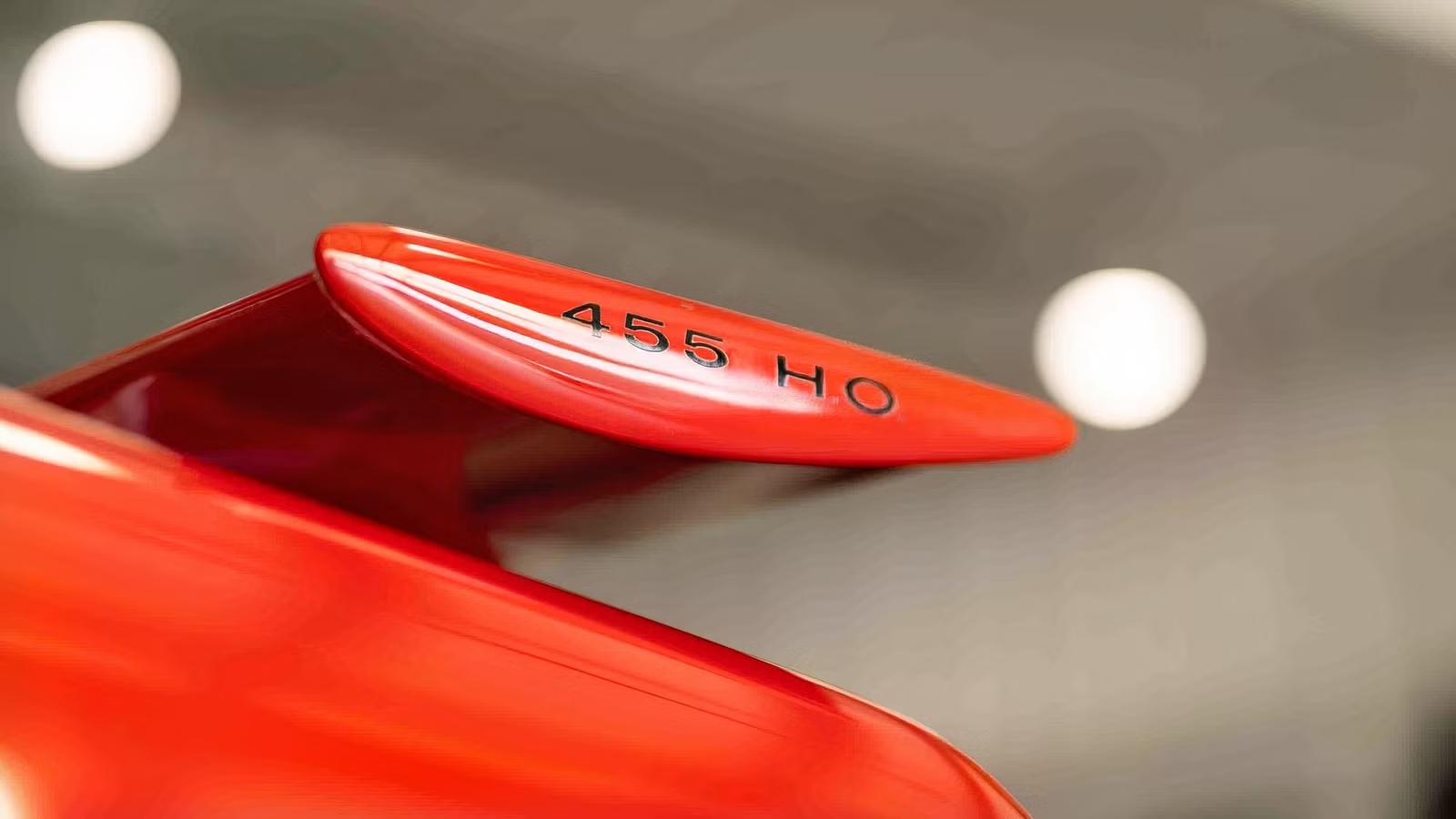
Imagine you’re a Pontiac engineer, proud of 1970’s new 455 cubic-inch “High Output” V8. Then someone walks into your office with an impossible assignment. Build a 455 H.O. again for 1971. But make sure it can run on lower-octane gasoline by absolutely slashing the compression ratio. There’s nothing “High Output” about that recipe. But while other Detroit automakers began killing or detuning some of their hottest V8s, Pontiac found an ingenious way to build one more generation of muscle cars.
GM Slashed Compression Across Its Engines For 1971

By the late 1960s, Detroit had established an honest and simple horsepower recipe. Feed a big V8 high-octane gasoline, then compress the fuel-air mixture as much as possible. When in doubt, add more carburetors or cubic inches and watch output climb. Then General Motors made an unprecedented move. In early 1970, GM president Ed Cole ordered compression ratios cut across the corporation’s 1971 engines so they could live on lower-octane regular, low-lead, and unleaded gasoline. Catalytic converters and the strictest federal emissions standards were still years away, but GM was already engineering toward that future.
The effect was obvious across GM’s performance divisions. Buick dropped its entire 1971 engine line to 8.5:1 compression, including the mighty Stage 1 455. Oldsmobile’s W-30 455 went from 10.5:1 compression and 370 gross horsepower in 1970 to 8.5:1 and 350 gross horsepower for 1971. Lower compression did not erase every fast car overnight, but one of Detroit’s easiest horsepower ingredients was suddenly not available to GM engineers.
Pontiac could have treated that corporate order as the beginning of the end. Instead, its engineers saw an opportunity to build a performance engine around the new fuel reality from the start. If they got it right, Pontiac would have an engine it could keep selling as fuel and emissions rules tightened, instead of scrambling to redesign one later.

Pontiac’s 1970 455 HO Used High Compression To Achieve A High Output

Pontiac debuted its 455 H.O. for the 1970 model year, and the engine doubled down on the familiar horsepower formula. In GTO trim, it had a 10.25:1 compression ratio, 360 gross horsepower, and an incredible 500 lb-ft of tire-burning torque. That traditional recipe was also its Achilles’ heel. Low-octane gasoline was looming, and the very compression helping the 455 make power was about to become a liability.
The 455 H.O. wasn’t some rare NASCAR homologation engine or a one-off project for a halo car. Pontiac offered 455s across its lineup of larger performance/luxury cars and the legendary midsize GTO. The displacement was becoming an important part of Pontiac’s performance strategy. Detuning it meant giving up ground across several of the cars that built Pontiac’s reputation.
At Pontiac, GM’s new low-octane directive effectively meant performance engines had to live at about 8.5:1 compression. Simply dialing the old 455 H.O. back that far would kneecap the recipe that made it work. Pontiac could surrender unconditionally or come up with another way to make power. But it needed its new solution fast.
The 1971 455 H.O. Made 335 HP With Just 8.4:1 Compression

Pontiac’s 1971 brochures must have caused a stir across Detroit. The division unveiled a new 455 H.O. V8 with a compression ratio of just 8.4:1. Then it announced that this engine would make 335 gross horsepower and 480 lb-ft of torque. Had Pontiac completely lost touch with reality?
A period test put a four-speed 1971 GTO Judge with the 455 H.O. on the track. It rocketed to 60 mph in seven seconds, then continued through the quarter-mile in 14.9 seconds at 95 mph. The Pontiac performance flagship had enough low-end grunt to put its money where its mouth was.
Pontiac didn’t have enough time to start with a blank sheet. Instead, engineers reached into the division’s recent performance playbook. The team took lessons primarily from the Ram Air IV, along with proven Ram Air-era hardware such as the 068 cam, and applied them to the new 455 H.O. The result was that Pontiac spread Ram Air-derived technology across its lineup, including some of its cheapest 1971 vehicles.
Pontiac Used An Old Design To Replace Compression With Airflow

No, Pontiac didn’t just bolt old Ram Air IV heads onto a 455 cubic-inch V8 and call it the new “High Output.” For 1971, it developed dedicated No. 197 heads for the H.O. The heads added the round-port exhaust layout designed for the Ram Air IV. The goal was straightforward: improve high-end airflow enough to make up for some of what Pontiac had lost in compression. Pontiac also started with an advantage: the 455’s long 4.21-inch stroke and sheer displacement were already ideal for making huge torque at relatively low rpm.
Motorheads know the valves are just one step in the long journey fuel-air mixture and exhaust gases must take. Pontiac also gave the 455 H.O. an aluminum dual-plane intake topped by a Quadrajet carb, free-flowing cast-iron exhaust manifolds, and larger-diameter exhaust. That 068 hydraulic cam carried 288/302 degrees of duration and .410/.413-inch lift with 1.5:1 rockers.
There was a major upside to Pontiac developing this low-compression engine for 1971: it could keep building it for 1972. Do not be fooled by the factory ratings. Pontiac rated the 1971 455 H.O. at 310 SAE net horsepower in the GTO and 305 net horsepower in the Trans Am, alongside the familiar 335-hp gross rating. For 1972, the engine carried a 300-hp net rating and 415 lb-ft of net torque. The switch from gross to net horsepower explains most of the apparent drop, although Pontiac did make minor head, induction, and ignition revisions for 1972.
Pontiac Put The 1971 455 H.O. In Everything From The GTO To An Entry-Level $3k Car

Pontiac worked hard to engineer a powerful, low-compression engine that could last into the 1970s. It wouldn’t have been surprising if the automaker chose to reserve the powerplant for its most prestigious badges. But the division went in the exact opposite direction. The 455 H.O. came standard in the GTO Judge and powered the Trans Am. But buyers could also order it in much cheaper A-body Pontiacs.
At the bottom end of the midsize lineup, the whole story gets gloriously unhinged. Pontiac offered its entry-level 1971 T-37 hardtop with the same 455 H.O. as its flagships. That meant you could get 335 gross horsepower and 480 lb-ft for $3,206 before destination and other options. Adjusted for inflation, that was cheaper than the original GTO.
The original GTO became famous for putting an unreasonable engine in an affordable midsize. Pontiac’s feat seven years later may be as impressive as inventing the muscle-car segment. While lower compression, high insurance premiums, and tightening emissions regulations pushed other automakers to detune or abandon their performance V8s, Pontiac dug deep and found a solution. Then it made that solution available far down its price ladder. It kept the 455 H.O. alive into 1972. And its successor, the SD-455, fought on into the mid-1970s.
Sources: SAE, Pontiac

Related posts





Latest Post


No Comments