
The BMW That Balances Technology And Character Beautifully
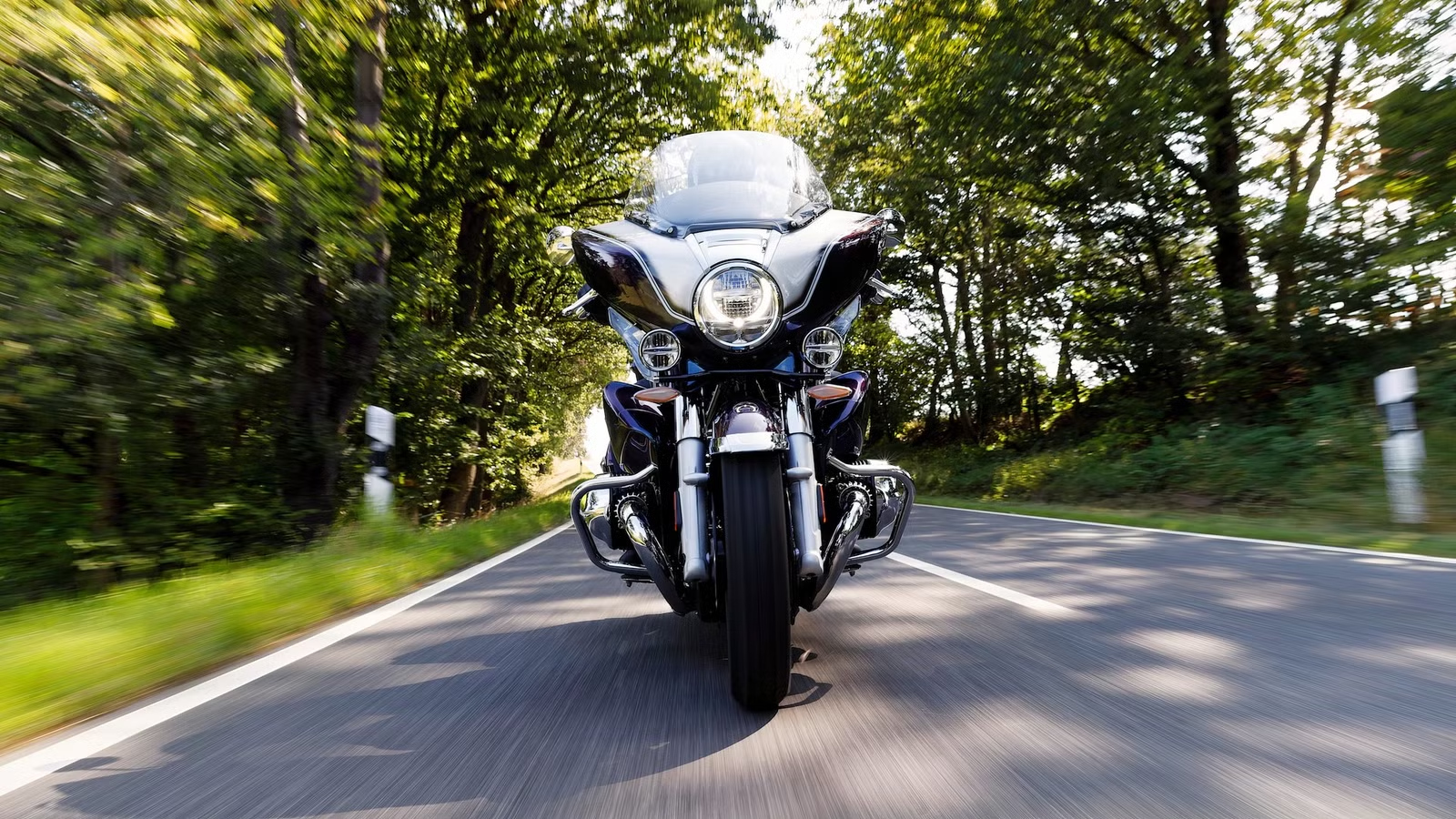
On one hand, luxury touring motorcycles have become rolling demonstrations of the latest motorcycling tech. They prove just how much technology can fit onto two wheels today with TFT displays, electronic suspension, navigation, radar-guided safety assistance, and premium audio. But on the other hand, there’s a distinct tradeoff that some of them can start to feel less like machines and more like very fast lounge chairs, taking away the traditionalism that makes for their primary appeal. Thankfully, BMW seems to have understood this very well and has incorporated the best of both worlds in one of its boxer tourers.
Modern Luxury Tourers Have A Difficult Balance To Strike

That is where old-fashioned character still matters. A touring bike has to make 500-mile days tolerable, and modern touring rigs are more than capable of delivering on that front. But it shouldn’t come at the cost of anesthetizing the engine that carries you for that distance, as its very character is what makes it memorable. There is, however, another route to refinement by keeping the machinery physical for the experience, while using technology to make touring easier.

Full-dress touring has traditionally been dominated in America by large V-twins, with Harley-Davidson and Indian building motorcycles around imposing proportions and engines that are central to the experience. Technology has steadily moved in around that recipe. Large displays, selectable ride modes, advanced ABS, traction control, premium sound systems, and electronic convenience features are now expected by default once prices move beyond the $20,000 mark.

The challenge is stopping that technology from becoming the whole story. Buyers in this category of motorcycle are not shopping purely for transportation. They are buying an engine layout, a visual identity, and a particular rhythm on the road. They’re paying for an experience. BMW approaches this problem differently by enlarging one of its oldest engineering signatures until it becomes impossible to ignore.

The BMW R 18 Transcontinental Gives Old-School Touring A Digital Brain

The BMW R 18 Transcontinental is the fullest expression of the R 18 platform, powered by the company’s enormous boxer twin with a fixed touring fairing, complete with a tall windshield, hard side cases, and a top case with an integrated passenger backrest. The current U.S. model starts at $24,395, placing it below several American full-dress tourers.

It is also enormous. Road-ready and fully fueled, the R 18 Transcontinental weighs a whopping 954.6 pounds, stretches 104 inches long, and carries 6.3 gallons of fuel. BMW did more than just add luggage to the standard R 18, though. The touring chassis uses a 66.5-inch wheelbase and tech that helps to accommodate passengers and luggage better. And there’s even more to make managing the big touring bike easier.
The 1,802cc Big Boxer Is The Source Of Its Character

At the center is BMW’s 1,802cc air- and oil-cooled boxer twin. Dubbed appropriately as the Big Boxer, it’s the largest production boxer engine that the company has ever built. In 2025, its torque increased to 120 lb-ft at 3,000 rpm, while the peak output remained at 91 horsepower developed at 4,750 rpm. BMW also says that at least 110 lb-ft is available from as low as 2,000 rpm, with the torque curve staying flat till 4,000 rpm. On a motorcycle of this size and weight, this translates to getting off the line with the ease of a much lighter motorcycle.

The Big Boxer feeds its torque through a six-speed gearbox and a shaft final drive. Its huge cylinders sit directly in the rider’s peripheral vision, with the exposed pushrod tubes referencing older BMW boxers. Most notably, the longitudinal crankshaft gives the motorcycle a distinct sideways reaction when the throttle is blipped at a standstill, a hallmark trait of the boxer engine. BMW could have engineered more of that behavior out, but it deliberately did not, to remind the rider of its unique mechanical character.
The Chassis Uses Technology Where The Weight Demands It

A 900-pound motorcycle is never going to feel dainty, so BMW has concentrated the R 18 Transcontinental’s chassis technology on making that mass easier to manage. A 49 mm telescopic fork and cantilever rear shock provide 4.7 inches of travel at both ends, while automatic rear preload removes the need to manually adjust the rear suspension and compensate for a passenger or luggage. Full Integral ABS links braking between the front and rear brakes for further confidence and sure-footedness.

Three standard riding modes alter how the Big Boxer delivers its torque. Rain softens the response, Roll handles everyday riding, and Rock sharpens throttle behavior. Automatic Stability Control and engine-drag torque control add another layer of electronic safety without changing the fundamental mechanical experience of the engine.
Its Technology Is Surprisingly Top-Drawer

BMW’s more useful electronics actually become more obvious at slow speeds than at pace. The R 18 Transcontinental gets an electronic reverse assist that uses the starter motor to help back the 954.6-pound motorcycle out of parking spaces, while Hill Start Control holds the brakes temporarily on an incline. Both these features address situations where the Transcontinental’s size and weight would otherwise become hard work for an aging rider. Dynamic cruise control is standard, and optional Active Cruise Control uses radar assistance to maintain a selected distance from the traffic ahead.

The cockpit mixes four conventional analog instruments with a 10.25-inch TFT handling navigation, connectivity, media, and vehicle information. Heated seating, substantial wind protection, and optional equipment such as central locking and the Marshall audio system. The important part is that BMW has used technology mostly to remove inconvenience rather than sensation. Once underway, the electronics fade into the background and the enormous boxer remains the dominant part of the riding experience.
The R 18 Transcontinental Makes Its Case Against The Milwaukee Giant

The 2026 Harley-Davidson Road Glide Limited goes up squarely against the German. Its American-bred Milwaukee-Eight 117 produces 106 horsepower and 131 lb-ft of torque, giving it a clear performance advantage over the R 18’s power output. The Harley is also lighter at 919 pounds, ready to ride, and brings a 12.3-inch Skyline OS display, navigation, selectable ride modes, heated seating, and a four-speaker audio system.

The difference to consider is not only in the prices of the bikes but, more importantly, the philosophy behind the machines. At $32,999, the Road Glide Limited costs a substantial $8,604 more than the BMW’s $24,395 starting price. Harley surely offers more engine performance and the traditional American touring experience, but the BMW packs radar cruise control, automatic rear load compensation, and an engine layout that nobody else in this segment offers, giving it the mechanical uniqueness that the segment overshadows with ever-growing tech. That is the R 18 Transcontinental’s real strength. Its technology solves real-world touring problems, while the 1,802cc boxer engine makes sure that the motorcycle still feels like something more than a collection of dull modern electronic features.
Source: BMW Motorrad

Related posts



Latest Post


No Comments