
The Motorcycle That Makes More Sense For Real Roads Than A Full Superbike
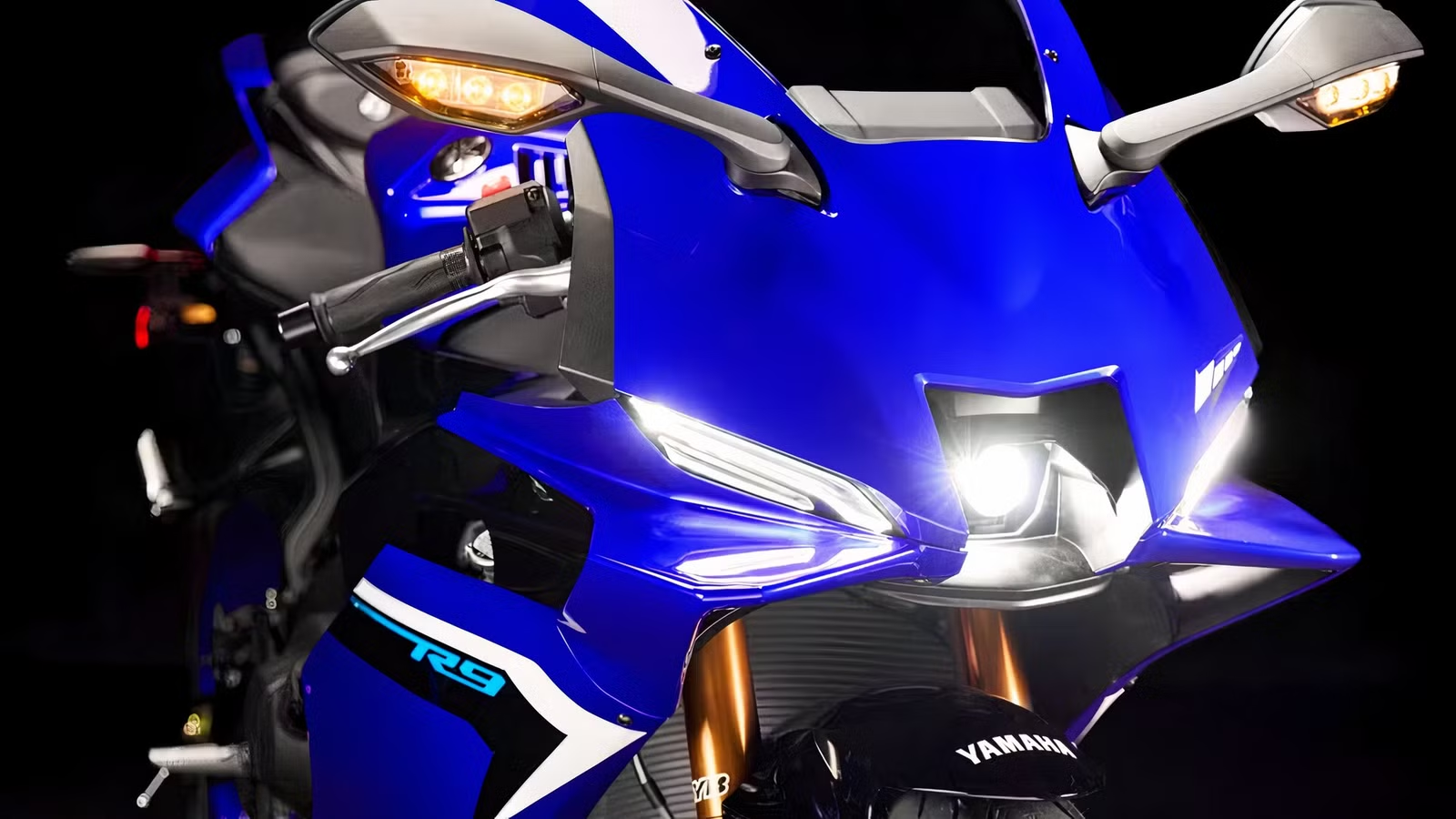
Everyone daydreams about owning a superbike. Two hundred-odd horsepower, MotoGP-derived electronics, a paint job lifted off a factory racer — it’s a heady combination, and it sells plenty of motorcycles every spring. But when the honeymoon wears off, most of that horsepower lives north of 100 mph, a speed you’ll rarely touch legally, and the riding position that looked so aggressive in the brochure starts feeling like a chiropractor’s waiting room twenty minutes into a commute. Owning a liter bike sounds fantastic. Living with one, on public roads, five days a week, is a different story altogether.
Full Superbikes Sound Great On Paper, But Real Roads Tell A Different Story
The Unusable Potential Of Modern Liter-Class Superbikes

Look at the spec sheet of any current 1000cc sportbike and the numbers do a lot of the talking: 180 horsepower, sometimes north of 200, arriving somewhere close to a 13,000–14,000 rpm redline. That’s an astonishing amount of performance, and it’s also almost entirely wasted on the street.
First gear on a lot of these bikes doesn’t run out until well past 90 mph, which means the average rider on public roads spends most of their time in second and third gear, using maybe a fifth of what the tachometer actually offers. Most U.S. highways top out at 70 or 80 mph, a speed that barely gets a modern liter bike out of second gear. The remaining four gears, and the 8,000-plus rpm of usable revs sitting above that, exist for a closed circuit, not a commute.
Challenges Of Owning A Superbike

Power isn’t the only thing that gets left on the table. Race-bred inline-fours can be surprisingly snatchy low in the rev range — fine once you’re already moving, but less fine when you’re trying to pull away smoothly from a dead stop in a parking lot. Add a riding position built for the tracks, radiators designed to shed heat at 130 mph rather than at a red light, and suspension tuned stiff enough for a banked corner at triple-digit speeds, and a highway commute starts to feel like an endurance event instead of a ride.

Ask anyone who’s ridden a modern liter-class sport bike through a July traffic jam how pleasant that is, with exhaust heat baking your legs and a seating position that loads your wrists more than your feet. It’s not something most riders look forward to twice a day. None of that spares the wallet, either. Insurance premiums, tire wear, and parts costsall climb right alongside the displacement and the badge on the tank. So what does a bike designed from the ground up for real roads actually look like? Yamaha’s answer is more complete than most riders expect.
The YZF-R9 Is Yamaha’s New Blueprint For Supersport
A $12,499 Entry Point That Leaves The Panigale V2 Behind

This is where the Yamaha YZF-R9 comes in. It isn’t a stripped-down racer with lights bolted on, and it isn’t trying to be one. Yamaha built it as a “Supersport” in the truest sense of the word — a motorcycle engineered to be genuinely good on the street first, with enough hardware left over to be taken seriously on track day. Priced at $12,499, the R9 slots neatly into Yamaha’s own sport bike lineup, sitting above the entry-level YZF-R7 and well below the flagship YZF-R1, priced respectively at $9,399 and $19,199.
It borrows its 890cc CP3 triple from the MT-09 and XSR900, two bikes already well regarded for how approachable and tractable that engine feels on real roads, not just on paper. That pricing also puts real distance between the R9 and full-size European rivals like the Ducati Panigale V2, which starts closer to $17,000 — while still packing genuine supersport hardware rather than a detuned naked-bike chassis wearing a fairing.
An Engine Tuned For The Street, Not Just The Redline
How A Three-Cylinder Gets To 117 Horsepower And Still Sips Fuel

The numbers are straightforward enough: an 890cc, liquid-cooled DOHC inline-three with 12 valves, making 117 horsepower at 10,000 rpm and 68.5 pound-feet of torque at 7,000 rpm, on an 11.5:1 compression ratio. Power runs through a six-speed gearbox fitted with a quick-shifter, and the throttle is ride-by-wire courtesy of Yamaha’s YCC-T system. These numbers put it roughly on par with, or ahead of, most 600–700 cc inline-four middleweights on paper.
Why A Broad Torque Curve Beats Peak Power On Real Roads

What matters more than those numbers, though, is how they’re delivered. The triple’s firing order hands over usable torque well before redline, so there’s no need to wind the engine out to 10,000 rpm just to feel like the bike is doing something. This should prove to be a real advantage in stop-and-go traffic, as well as when making quick overtakes on a back road.
It gives the engine some character along the way, too — a throatier, more textured exhaust note than the buzzy inline-fours it’s up against, which is a nice bonus on a bike you’ll actually be listening to every day. It pays off at the pump as well. Yamaha’s claimed fuel economy sits around 48 mpg, stretching the miles between gas stops noticeably further than a thirstier inline-four liter bike typically manages.
A Chassis Built To Inspire Confidence At Street Speeds
Frame, Suspension, And Weight Balance

The chassis is where Yamaha makes sure the YZF-R9 still feels like a genuine supersport. The aluminum Deltabox gravity-cast frame is described by Yamaha as the lightest aluminum frame ever fitted to one of its supersport models. The suspension consists of a fully adjustable 43mm KYB inverted fork and an adjustable KYB rear shock, with preload, rebound, and high- and low-speed compression adjustment. Yamaha also engineered the motorcycle around an almost 50:50 front-to-rear weight distribution.
That balance plays a more significant role on a public road than a spectacular lap-time statistic. A motorcycle that changes direction predictably, communicates what the front tire is doing, and remains stable when the pavement gets imperfect is easier to enjoy. You do not need to be riding at 100 percent to appreciate those qualities. The R9 also weighs 430 pounds wet according to Yamaha, which is a respectable figure for a fully-faired motorcycle carrying this much equipment.
Ergonomics That Don’t Punish A Daily Commute

Ergonomically, the R9 splits the difference rather than chasing an extreme. A 32.7-inch seat height keeps it accessible to more riders than a full-size superbike usually is, and while the clip-ons and rear-set footpegs are still sporty, they don’t demand the same wrist-crushing lean angle as an R1 or any contemporary liter bike. A 3.7-gallon tank isn’t huge on paper, but paired with that efficient triple, it stretches fuel stops further than you’d expect.
Wet weight stays competitive for the class, which makes the bike noticeably easier to muscle around a parking lot or a tight U-turn than something built purely with lap times in mind. Small, easy-to-overlook details help as well — cruise control comes standard, a feature that liter bike owners often have to pay extra for, and it matters far more on a three-hour interstate slog than another 20 horsepower ever will.
High-End Superbike Electronics At A Mid-Tier Price Point
R1-Derived 6-Axis IMU And Electronic Rider Suite

The R9 doesn’t cut corners on electronics to hit its price point. It runs the same six-axis IMU architecture developed for the R1, feeding a full suite of lean-sensitive rider aids: a nine-mode traction control system, three-mode slide control, three-mode lift control, and engine brake management. A third-generation up/down quick-shifter comes standard, making clutchless shifts smooth whether you’re crawling through downtown traffic or working through a string of back-country switchbacks.
Riders also get a spread of ride modes — Sport, Street, and Rain presets, two customizable slots, plus additional track-focused modes — so the same bike that’s mellow on a wet commute can be sharpened up for a Sunday canyon run without touching a wrench.
Track-Grade Stopping Power

Braking hardware doesn’t feel watered down, either. Dual 320mm front discs are clamped by Brembo Stylema mono-block calipers with a radial master cylinder — the same class of hardware you’d expect on something wearing a far higher price tag — backed by a 220mm rear disc. Cornering ABS ties it all together, delivering one-finger stopping power and a genuine safety net if the front end starts to load up mid-corner.
None of this means the R9 is trying to replicate the liter bike experience. It’s not chasing a 200 mph top speed or a MotoGP-spec power-to-weight ratio, and it doesn’t need to. What it offers instead is a chassis, an engine, and a set of electronics that actually work with how most people ride, most of the time — through traffic, over broken pavement, on a commute, on a weekend backroad blast, with the occasional track day thrown in. That’s a much harder brief to nail than raw horsepower, and it’s the one that actually matters on a real road. That is exactly why, for most riders, most of the time, the R9 makes more sense than the superbike sitting one rung up on the showroom floor.
Source: Yamaha

Related posts
Latest Post


No Comments