
The World’s Cheapest Twin-Turbo Sports Sedan With 400 Horsepower
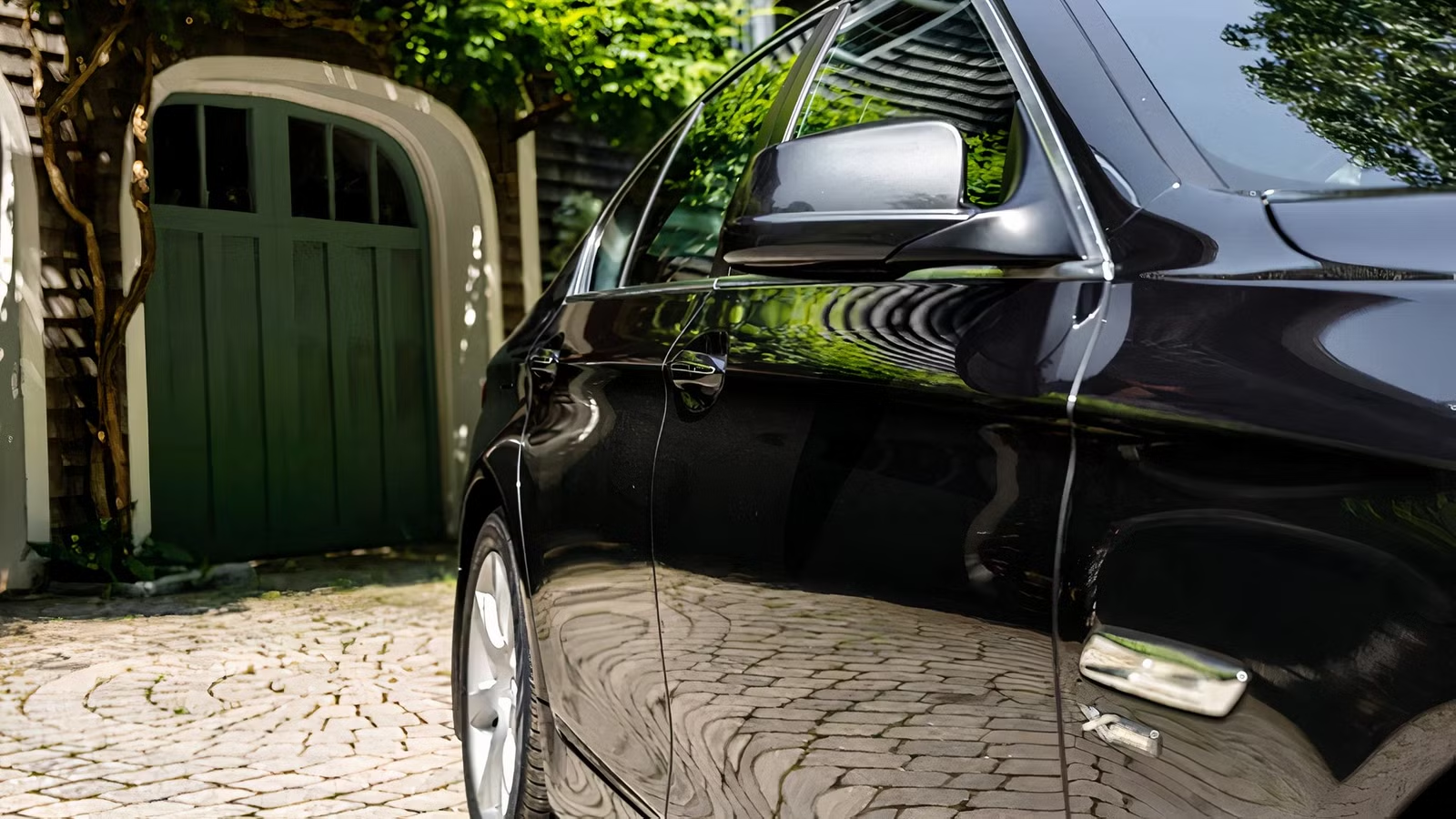
Forget the wing-equipped track weapons and the badge-forward supercars. The most interesting performance cars on the road today are the ones you’d never look twice at in a parking lot — sedans that wear their power like a secret, blending into school-run traffic until the driver decides otherwise. These are the sleeper cars, and right now the used market is quietly overflowing with them.

A wave of early-2010s luxury performance sedans has cratered in value, and the timing couldn’t be better for bargain hunters. Machines that once commanded six-figure stickers — loaded with twin-turbo V8s, adaptive suspension, and genuine supercar-baiting acceleration — are now trading for the price of a base economy car. For the right buyer, that depreciation is an opportunity, not a warning sign.
This isn’t about overhyped performance cars or collector-grade exotics. It’s about the cars that built reputations quietly. And among them sits one twin-turbo V8 sedan that might just be the best performance bargain on the planet. Buckle up, because you’re about to meet the cheapest 400-horsepower twin-turbo sports sedan in the world.
The World’s Cheapest Twin-Turbo Sports Sedan With 400 Horsepower: Meet The 2011 BMW 550i – F10

When the F10-generation BMW 5 Series debuted in 2010, it marked a return to form for BMW’s midsize sport sedan. The F10 gave enthusiasts a car that could cruise like a luxury executive ride one minute and rip through corners the next. Sitting at the top of the non-M lineup was the 550i — a sleeper in every sense of the word. With 400 horsepower on tap, it was quicker than many sports cars wearing far flashier badges.
According to the BMW Blog, the F10 550i represented an evolution in BMW’s performance philosophy. Rather than chasing peak revs with a high-strung naturally aspirated engine, it leaned into the growing twin-turbo trend, delivering brutal mid-range torque and effortless highway passing power. Once the turbos spooled, the surge was immediate and addictive — a genuine step forward in what a luxury performance sedan could feel like.

Nearly 15 years later, this car still hits a sweet spot. It delivers genuine 400-horsepower performance, understated looks that have aged gracefully, and the kind of everyday comfort that makes many modern turbo sedans feel sterile by comparison. And on the used market, the F10 550i has quietly become one of the most affordable twin-turbo 400-horsepower sedans you can buy.
Sure, ownership comes with caveats. Maintenance on that twin-turbo V8 isn’t for the faint of heart, but for drivers who miss the days when BMW built true highway stormers with muscle-car torque and luxury-car manners, the 2011 550i is a forgotten gem worth rediscovering.
Under The Hood Of The 2011 BMW 550i – F10

Pop the hood on the 2011 BMW 550i and you’ll find one of the most influential engines in modern BMW history: the 4.4-liter twin-turbocharged N63 V8. According to N63 Intake, this was the brand’s first production V8 to feature twin turbos mounted inside the “hot-vee.” That layout placed the turbochargers in the valley between the cylinder banks, shortening airflow paths, quickening spool times, and sharpening throttle response. In 2011, it was a cutting-edge arrangement — one that signaled BMW’s full commitment to turbocharging across its performance lineup.
2011 BMW 550i – F10 Specs
|
Engine |
4.4L Twin-Turbocharged V8 (BMW N63) |
|
Horsepower |
400 hp |
|
Torque |
450 lb-ft |
|
Transmission |
8-Speed Automatic |
|
Driveline |
Rear-Wheel Drive |
|
0 to 60 |
~4.8 seconds |
|
Top Speed |
155 mph (Electronically Limited) |
Sources: Kelley Blue Book
With 400 horsepower and 450 lb-ft of torque, the N63 gave the 550i effortless acceleration and a wall of torque that arrived at just 1,750 rpm. It was mated to an eight-speed automatic that could fire off crisp shifts or cruise quietly on the highway. The 0-to-60 mph sprint comes in around 4.8 seconds — figures that put it right alongside the previous-generation M5. But what made it so special wasn’t just the speed; it was the character. The twin-turbo V8 offered that perfect blend of low-end grunt and high-speed composure, pulling hard without sacrificing refinement.
For enthusiasts, this engine marked the moment BMW truly embraced forced induction as a core part of its identity. According to Bimmerworld, the N63 would later evolve into more powerful “TU” (technical update) versions, but the original 2011 setup remains the purest expression of BMW’s early twin-turbo vision.
The engine does have its quirks, most notably excessive oil consumption and poor heat management. Those upkeep demands aren’t for everyone. For enthusiasts who appreciate engineering ambition, however, it remains a fascinating powerplant.
Today, the 2011 550i stands as an attainable gateway into V8-powered BMW performance — the kind of car that rewards drivers who know what they’re getting into. It’s a twin-turbo bruiser from the peak of BMW’s experimentation era, when the brand wasn’t afraid to take risks in pursuit of speed.
How Much Does A 2011 BMW 550i – F10 Cost Today?

Back in 2011, the BMW 550i wasn’t a cheap car by any stretch of the imagination. According to Kelley Blue Book, the sedan’s starting MSRP was $62,475. It sat squarely in luxury performance territory, right alongside the Mercedes-Benz E550 and Audi S6. Buyers paid a premium for its twin-turbocharged V8, advanced technology, and that unmistakable BMW blend of refinement and aggression. Fully optioned examples easily pushed north of $70,000.
Fast forward nearly fifteen years, and depreciation has done its thing. Today, KBB lists a Fair Purchase Price well into bargain territory — making it one of the biggest sleeper deals on the used market, given that it’s still putting out 400 horsepower.

Keep in mind that clean, low-mileage cars with documented service history tend to hover closer to $15,000. According to Classic.com data, this sleeper sedan has averaged $13,934 at auction over a recent five-year span. The lowest recorded sale came in at $6,625, while the top sale reached $20,250. The examples that make it to the online auction circuit are typically the most pristine survivors — low mileage, highly original, and in superior condition — which explains the higher premiums they command.
2025 Market Value: Here’s How Much A 2011 BMW 550i – F10 Costs Today
|
2011 BMW 550i – F10 |
5-Year Auction Data |
12 Months Auction Data |
|
Average Auction Price |
$13,934 |
$9,642 |
|
Top Sale |
$20,250 |
$13,000 |
|
Lowest Sale |
$6,625 |
$6,625 |
|
Sales Count |
15 |
3 |
Source: Classic.com
Still, paying under $15K for a 400-horsepower sedan is a remarkable deal, considering the same car required closer to $60K when new. That said, while the 2011 BMW 550i F10 is the cheapest way into a twin-turbo sports sedan with 400 horsepower, its maintenance requirements should not be overlooked. The N63 engine is a masterpiece of engineering complexity, and it demands care. According to CG Motorsports, oil consumption, heat management, and turbo maintenance can add up fast if you buy a neglected example.
For an enthusiast who does their homework and finds a well-maintained car, though, the F10 550i offers a level of performance and luxury that’s hard to match for under $20K. It’s not just cheap — it’s one of the last truly muscular sedans from BMW’s golden turbo era.
Why Reliability Concerns Sent The 550i’s Value Into Freefall

Luxury sedans like the F10 5 Series are no strangers to steep depreciation, but losing nearly 90 percent of its original value wasn’t normal, even by BMW standards. The biggest reason the 2011 BMW 550i is so affordable today has far more to do with its reliability reputation than its performance credentials. BMW’s first twin-turbocharged V8 — and the first production engine to use a hot-vee turbocharger layout — promised cutting-edge performance and packaging, so most enthusiasts were willing to forgive a few early bugs. Unfortunately, those early engines developed a reputation for failures that proved far more serious than ordinary first-year teething problems.
Ironically, the same hot-vee design that made the N63 so advanced also became one of its biggest weaknesses. The extreme heat generated in the engine’s valley accelerated wear on surrounding components, most notably the valve stem seals. As they deteriorated, oil seeped into the combustion chambers, leading to heavy oil consumption, blue smoke from the exhaust, and repair bills that often landed between $6,000 and $10,000. Owners also dealt with prematurely stretched timing chains that could cause catastrophic engine failure if ignored. Beyond that, early N63-powered cars became known for failing piezo injectors, leaking turbo coolant lines, excessive oil use, carbon buildup on the intake valves, and battery drain caused by the electric coolant pump and radiator fans continuing to run after shutdown.
BMW Didn’t Ignore The N63’s Reliability Problems

BMW couldn’t ignore the problems plaguing the early N63. Widespread engine failures and customer complaints saw many engines repaired repeatedly under warranty, costing the company a fortune while damaging confidence in its new flagship V8. In 2014, BMW responded by rolling out the N63 Customer Care Package (CCP) through Service Bulletin B001314. Rather than waiting for owners to suffer expensive failures, the campaign proactively inspected and upgraded critical engine components at no cost for eligible vehicles, regardless of warranty status.
The CCP went far beyond a simple software update. Dealers inspected timing chain stretch and replaced chains when required, fitted updated piezo injectors, replaced faulty airflow and fuel sensors, upgraded crankcase ventilation hoses, vacuum pumps, turbo fresh-air seals, and installed higher-capacity AGM batteries to better handle the engine’s demanding cooling strategy. BMW also shortened oil service intervals from 15,000 miles or two years to 10,000 miles or one year to combat rapid oil degradation.

Many repaired cars proved far more dependable afterward, which is why buyers today should verify that the CCP was actually completed. BMW issued documentation when the work was performed, and because each eligible vehicle could receive the campaign only once, a documented example is generally more desirable than one with no record of the repairs.
Other High-Horsepower Sports Sedans That Are Surprisingly Affordable
While the 2011 BMW 550i is pretty impressive, it’s not the only high-horsepower machine that can be snagged at a steal of a price today. Many early-2010s luxury performance sedans have taken a hard depreciation hit, which is great news for buyers right now.
You can now get executive-level power for used-Corolla money if you pick carefully and budget for maintenance. Two other high-horsepower sports sedans worth checking out include the 2010 Mercedes-Benz E63 AMG – W212 and the 2008 Audi S6 – C6.
How Much Does A 2010 Mercedes-Benz E63 AMG – W212 Cost Today?

When the W212 E63 arrived, it carried the big 6.2-liter naturally aspirated AMG V8 that made this era of Mercedes so memorable. Output sat at about 518 horsepower and 465 lb-ft of torque — still serious power by any measure.
According to Kelley Blue Book, when new, the 2010 E63 carried an MSRP of $89,125. Today, its KBB Fair Purchase Price has fallen dramatically. More premium examples, however, tend to fetch considerably more.
According to Classic.com data, over a recent five-year period the average auction price of a 2010 E63 has been $24,812. That’s still a solid deal for a sedan that originally cost nearly $90,000.
|
2010 Mercedes-Benz E63 AMG – W212 |
5-Year Auction Data |
12 Months Auction Data |
|
Average Auction Price |
$24,812 |
$20,018 |
|
Top Sale |
$50,500 |
$27,805 |
|
Lowest Sale |
$8,900 |
$15,500 |
|
Sales Count |
25 |
3 |
Source: Classic.com
How Much Does A 2008 Audi S6 – C6 Cost Today?

Audi built the C6 S6 during its V10 era — one of the most gloriously unusual chapters in the brand’s history. Under the hood sits a 5.2-liter V10 producing around 435 horsepower and close to 400 lb-ft of torque.
According to Kelley Blue Book, when new, the 2008 Audi S6 carried an MSRP of $77,050. Today, its KBB Fair Purchase Price has dropped sharply. Naturally, more pristine examples that surface on the online auction circuit often command a premium above that figure.
According to Classic.com data collected over a recent five-year period, the average auction price of a 2008 Audi S6 has been $12,962 — firmly planting it in sleeper sedan territory.
|
2008 Audi S6 – C6 |
5-Year Auction Data |
12 Months Auction Data |
|
Average Auction Price |
$12,962 |
$8,000 |
|
Top Sale |
$21,000 |
$9,500 |
|
Lowest Sale |
$6,600 |
$6,600 |
|
Sales Count |
14 |
3 |
Source: Classic.com
Fifteen years on, the 2011 BMW 550i proves that high horsepower doesn’t have to come with a high price tag. Between the twin-turbo V8 BMW, the howling V10 Audi S6, and the naturally aspirated AMG bruiser, there’s never been a better time to grab a forgotten performance sedan for used-SUV money.
Sources: Bimmerworld, BMW Blog, CG Motorsports, Classic.com, Kelley Blue Book, N63 Intake

Related posts




Latest Post


No Comments