
The Motorcycle That Makes Long Road Trips And Dirt Roads Equally Appealing
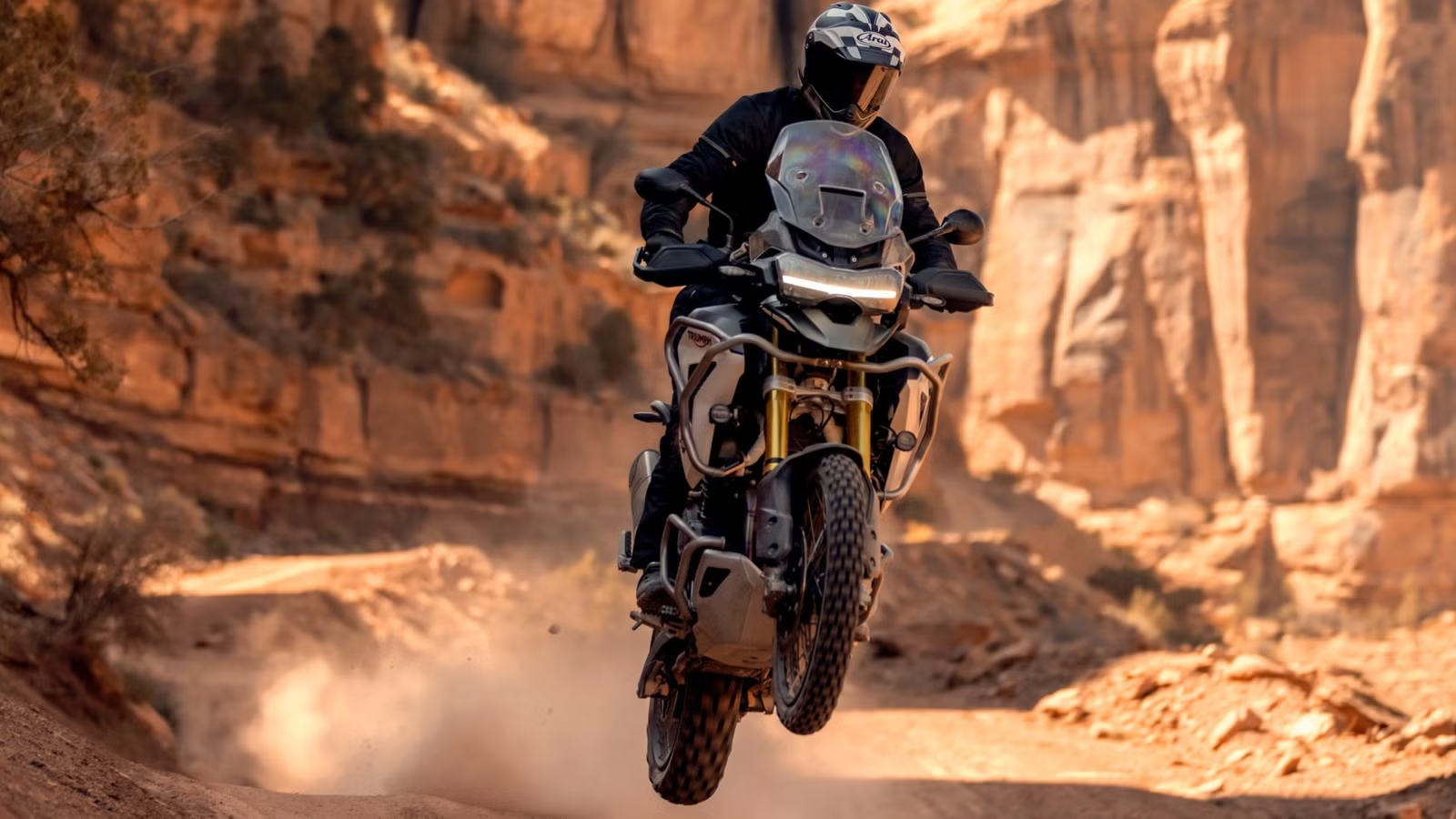
The best road trips rarely stay on perfect pavement. A route can begin with hundreds of miles of smooth highway before turning onto broken mountain roads and gravel tracks. And sometimes the reverse is true: you start in a remote village somewhere, traveling for miles at a stretch on a trail the map barely acknowledges before getting onto a modern street teeming with other vehicles.

Your motorcycle has to be prepared for this changing environment. It should be comfortable enough for hours in the saddle, yet capable enough to keep going when the road underneath disappears under rocks and dirt. The modern adventure motorcycle has been built for exactly this purpose. It combines touring ability with the suspension, ground clearance, riding position, and wheels needed to explore beyond the asphalt.
When The Road Stops Being Perfect
Why Even Carefully Planned Routes Eventually Leave The Pavement
A long road trip sounds simple when reduced to a destination and a mileage figure. In reality, the best routes are rarely that cut and dry. Highways eventually give way to secondary roads, construction zones turn pavement into loose gravel, and mountain routes can become surprisingly rough without warning.

Even a carefully planned trip can throw potholes, broken surfaces, and unpaved sections at the rider. Now, a machine designed purely for smooth pavement can be excellent until the surface deteriorates, while a heavily dirt-focused motorcycle may become tiring after several hundred miles. This is why adventure motorcycles make sense.

Wide handlebars provide leverage when the surface becomes loose, standing on the pegs gives the rider better control over the bike’s balance, and the 21-inch front wheel is useful for dealing with larger rocks and ruts. But the ADV also has serious touring equipment. Cruise control reduces fatigue on long highway stretches, electronic suspension can adapt to changing conditions, and multiple riding modes allow the rider to alter the motorcycle’s response.
The Freedom To Say Yes To Any Road, Regardless Of What It Becomes

There is also something liberating about having fewer limitations on a journey. The appeal is not necessarily riding deep into a wilderness every weekend. It can simply mean knowing that an interesting-looking road does not have to be rejected because the surface changes halfway through. This versatility is a major reason large adventure motorcycles have become such capable travel companions.
They can carry luggage, settle into highway speeds, and remain comfortable for long periods, but they are also designed with enough suspension movement and ground clearance to deal with terrain that would make a conventional sport-tourer uncomfortable.
The Triumph Tiger 1200 Rally Pro Does Two Jobs
Off-Road Ability Without The On-Road Compromise

The Triumph Tiger 1200 Rally Pro feels like one of those motorcycles that understands what a proper road trip is actually like. Long-distance adventures can sometimes mean a rough shortcut, a gravel road, or a wash-out section that could put a dent in your plans, but the Rally Pro doesn’t treat them that way.
Instead, it turns these moments into just another road section. What makes the Tiger 1200 particularly interesting, though, is how little it seems to sacrifice on the road to gain that off-road ability. Reviews have found it comfortable and composed over long distances while also praising its suspension and confidence on broken terrain, and this dual personality is exactly why the Tiger belongs here.
The Tiger 1200 Engine Has Power And Control For Every Surface

At the heart of the Triumph Tiger 1200 sits a 1160cc liquid-cooled inline-triple engine. According to Triumph’s specs page, it produces 147 horsepower at 9,000 rpm and 95 pound-feet of torque at 7,000 rpm. These figures put it firmly into the high-performance end of the ADV world. The defining feature, however, is Triumph’s T-Plane crankshaft concept.
The company designed the triple to deliver some of the low-speed character associated with a twin while retaining the stronger top-end performance expected from a triple. On pavement, this gives the Rally Pro enough muscle to make overtaking and fast highway riding effortless, while off-pavement, the character becomes more useful when the rider needs a controlled drive rather than simply maximum acceleration.

Transmission is handled by a six-speed gearbox assisted by Triumph Shift Assist. The shaft final drive is another thing that makes the Rally Pro particularly interesting. It eliminates the need to think about maintenance and lubrication every few hundred miles. And while it is a concern if it breaks in the middle of nowhere, shaft drives have been engineered to withstand all kinds of abuse, so the chances of that happening are quite low.
The Tiger 1200 Chassis Handles Rough Roads With Ease

The Tiger’s chassis starts with a tubular steel frame with forged aluminum outriggers and a fabricated, bolt-on aluminum rear subframe. At the back sits Triumph’s twin-sided Tri-Link aluminum swingarm. This is a fairly substantial structure on its own, but the important numbers are found in the wheels and suspension. The Rally Pro uses a 21-inch front and an 18-inch rear tubeless spoked wheel that fits Metzeler Karoo Street tires from the factory, which are much more appropriate for mixed surfaces than the GT Pro variant of the Tiger 1200.
As for suspension, the ADV gets a 49mm upside-down front fork from Showa that provides 8.66 inches of travel and semi-active damping. At the back, it gets a Showa monoshock with, again, 8.66 inches of travel and semi-active damping. But it also gets electronic preload adjustment with an active preload reduction feature.

Stopping power comes from twin 320mm floating discs and Brembo M4.30 Stylema monobloc radial calipers at the front, and a 282mm disc and Brembo single-piston caliper at the rear. This is a serious braking package for a motorcycle that can arrive at the end of a gravel road carrying considerable momentum.
The Triumph Tiger 1200 Is Designed For The Journey


As far as design goes, the Tiger 1200 Rally Pro looks purposeful. It gets a tall stance, narrow central bodywork, and exposed mechanical components. The tank doesn’t just look large; it is capable of holding up to 5.2 gallons of fuel, reducing the need to stop for gas frequently. The windscreen is also adjustable, allowing you to tailor airflow during highway riding. Triumph also includes useful protection as standard, such as hand guards, a skid plate, and engine protection bars.
Then you have the seven-inch TFT display that handles instrumentation and connectivity via the My Triumph system. It offers full phone, music, and navigation functionality, plus the ability to control various motorcycle riding aids. Speaking of which, the bike gets a ride-by-wire throttle offering six riding modes, including two dedicated off-road modes. Cruise control, hill hold, cornering ABS, and traction control all come as standard with the bike.
How The Tiger 1200 Rally Pro Stacks Up Against The BMW And Ducati — And Where It Wins
At $23,195, The Tiger Undercuts The Ducati By Nearly $9,000 And Outspecs The BMW At Sticker

The Triumph Tiger 1200 Rally Pro goes up directly against rivals like the BMW R 1300 GS with its 1,300cc boxer twin and the Ducati Multistrada V4 Rally with its 1,158cc V4 engine. Now, while BMW’s $20,395 base price starts significantly lower, configuring the bike to match the Tiger’s equipment level adds another $7,000-8,000. The Ducati is just plain expensive at $31,995.

The appeal of the Triumph Tiger 1200 Rally Pro isn’t that it can simply ride on dirt; the real strength is in making the boundary between touring and exploring feel less important. With its ready-to-go nature straight from the showroom floor, the Rally Pro has the hardware to cover serious distances before tackling rougher terrain and still go farther.
Source: Triumph Motorcycles

Related posts





Latest Post


No Comments