
The Near-500cc KTM Two-Stroke That Hit 123 MPH On A Motocross Track
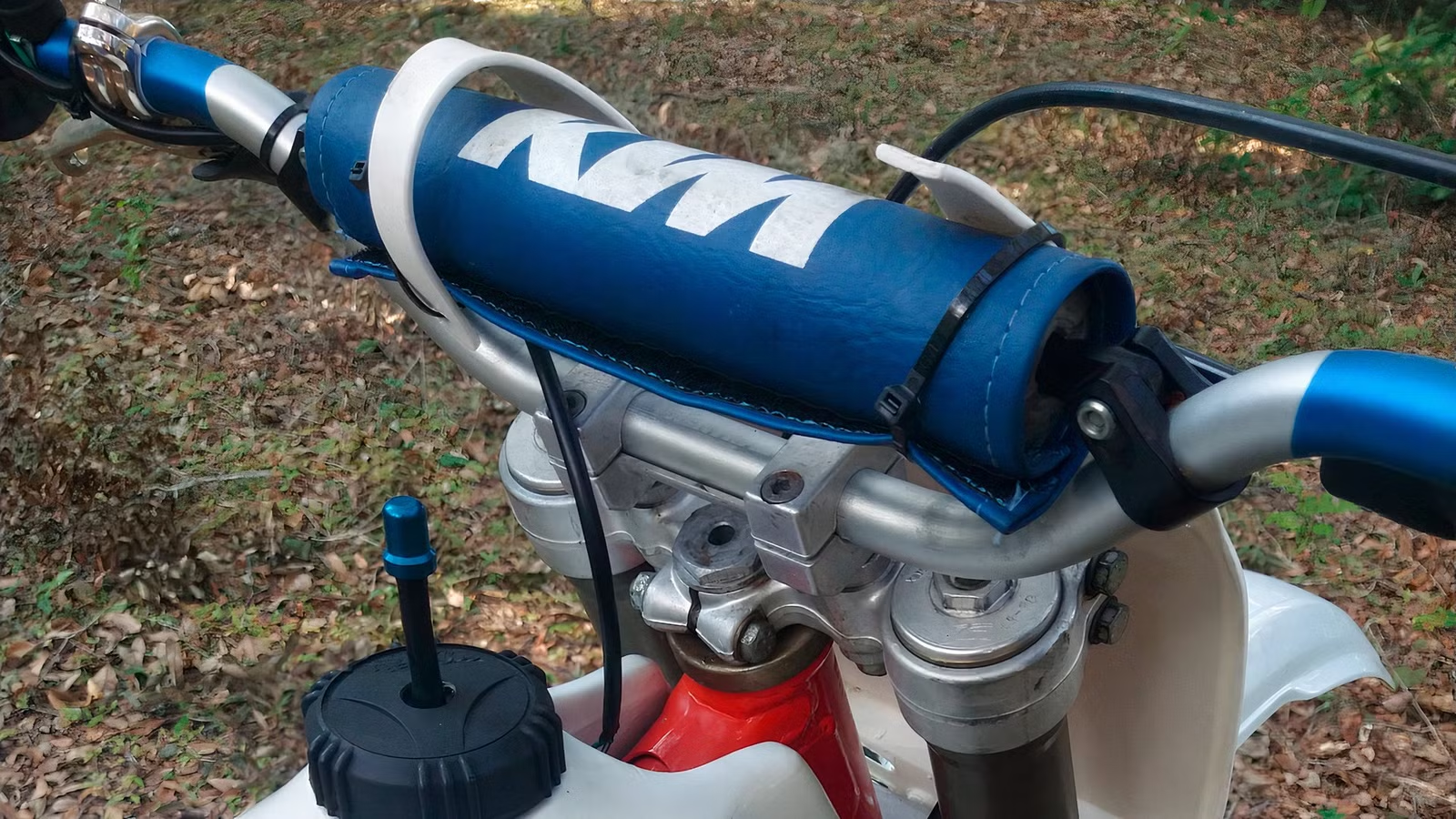
It’s normal to want more power, especially if it’s from something that’s been sitting in a cake of dust in your garage. In a similar vein, most vintage motocross restorations chase more power, too. With this particular early-’80s two-stroke, though, owners have spent decades doing something rather different: finding ways to make the engine a little easier to handle.

That feels appropriate, because the factory reached much the same conclusion when the bike was still new. By then, open-class motocross had reached the point where making horsepower was becoming considerably easier than using it.
Open-Class Motocross Had Reached The Too-Much Point
Early-’80s open-class motocross was a massively unreasonable place. Big-bore two-stroke bikes had become serious competition machines, and engine performance was moving faster than riders could necessarily exploit it. The bike at the center of this story weighed roughly 259 pounds with half a tank of premix, yet its near-500cc engine produced the sort of acceleration that made throttle control a brutally important skill.

A point to keep in mind here about vintage motocross bikes from this era: the biggest machines weren’t beginner-friendly trail bikes that happened to have large engines. Instead, they were purpose-built racers aimed at experienced riders who already understood that grabbing a handful of throttle could blur things beyond recognition pretty quickly.
No Messing About

All this didn’t come cheap, naturally, and American buyers paid accordingly. In 1982, this KTM open-class motocross bike carried a U.S. price of $2,831, putting it hundreds of dollars above some Japanese competition. KTM was still a relatively small player in America, reportedly importing around 2,000 motorcycles a year at the time, so simply matching the established brands wouldn’t have been enough.
The chassis showed where that extra money went, though. U.S.-market versions used a Fox Twin-Clicker rear shock, while the front end relied on Marzocchi forks offering 11.8 inches of travel. KTM also used its Pro-Lever rear suspension and an aluminum swingarm. In essence, the company had built a sophisticated motocross package around a motor that was already threatening to become the dominant character in the relationship.
The Factory Started Slowing Its Own Engine Down

There’s a key element that tells you almost everything you need to know. Some early examples arrived with an internal flywheel that allowed the engine to spin up rapidly. That sounds appealing when you’re reading a specification sheet, but on a motocross track, where traction changes constantly and riders need to meter power between corners, the experience was much more complicated.
KTM responded by fitting an external flywheel to later shipments. The additional rotating mass slowed the rate at which the engine gained revs, making its power easier to feed into the rear tire. Just think about that for a second. In the middle of an era obsessed with quicker engines and harder acceleration, KTM intentionally made its largest two-stroke respond a touch slower.
In Control… Somewhat

The KTM engine also adopted reed-valve induction and worked through a five-speed gearbox. Even after the flywheel change, there was hardly a shortage of urgency. The revised setup simply gave riders a better chance of deciding when the front wheel came up rather than receiving that information after the fact.
Also, taller gearing brought another interesting side effect. A 15-tooth countershaft sprocket could raise top speed substantially for cross-country use while also making the engine feel a little less frantic at speed. That would become especially relevant once someone decided to find out just how fast this oversized motocross engine could really go.
The KTM 495 MX Had It All

The KTM 495 MX, then, was one of the most notorious open-class two-stroke dirt bikes of its era. Its single-cylinder engine displaced roughly 30.1 cubic inches, or 493cc, using an extremely oversquare 3.63-inch bore and 2.91-inch stroke. The bore figure actually works out to 92.25mm, rather than the rounded 92mm figure sometimes associated with the engine. Early versions also ran a lofty 14:1 compression ratio and a dual-spark-plug cylinder head.
Don’t mistake that dual-plug arrangement for decorative engineering. A piston nearly 3.7 inches across leaves a considerable combustion chamber to work with, and the second plug helped manage combustion across that broad bore. What you got was an engine whose architecture looked every bit as serious as its reputation suggested.
Then came the number that turned the KTM 495 MX into motocross folklore. Rod Bush took a re-geared 1981 KTM 495 to El Mirage Dry Lake and recorded 123.75 mph. That is supercar speed by early-’80s standards, coming from a two-stroke dirt bike with knobby-tire ancestry.
For clarity, the 123.75-mph KTM run didn’t happen around a motocross circuit. El Mirage’s open dry-lake surface gave the re-geared motorcycle enough room to stretch its legs in a way no normal MX course could. The achievement remains amazing because the machine underneath all that gearing was still fundamentally an open-class motocrosser. KTM had produced a dirt-bike engine with enough headroom to go chasing triple-digit speed far beyond anything required between jumps.
KTM Spent The Next Two Years Undoing Its Own Work

What happened afterward is what separates the KTM 495 MX story from the usual tale of an old two-stroke being powerful and terrifying. Simply put, KTM kept trying to soften it. The early 1981 and 1982 engines used the high-compression 14:1 dual-plug cylinder head. Things become more complicated in 1983, because the change wasn’t perfectly synchronized across every market. U.S.-spec 1983 KTM 495 MX models could still appear with the earlier 14:1 dual-plug arrangement even as KTM introduced a lower-compression design elsewhere.
The later head dropped compression to 11:1 and returned to a single spark plug. By the 1984 KTM 495, that lower-compression arrangement was part of a broader effort to trade some peak aggression for stronger, more manageable low-end response. However, some liked the earlier character enough to retrofit older heads, which tells you how noticeable the difference could be.
Usability Over Speed

Meanwhile, KTM continued developing the motorcycle around the engine. The 1984 version shed about 15 pounds compared with the previous model, so this wasn’t a case of the company giving up on performance. KTM was making the chassis lighter while simultaneously making the power easier to deploy.
That combination may be the clearest lesson hidden inside the KTM 495 MX. Faster engine response doesn’t automatically make a motocross bike faster around a track. Once horsepower exceeds what the rear tire and rider can regularly exploit, smoother delivery becomes its own performance upgrade. KTM’s heavier flywheel and lower-compression head read less like surrender today and more like an early recognition of something modern performance bikes take very seriously: usable power wins races.
Four Decades Later, Owners Are Still Finishing The Job

Restored KTM 495 MX examples make the story even better because some owners are still modifying them along the same basic lines. One restored 1984 KTM 495 MX received a PVL electronic ignition and Mikuni carburetor as part of its rebuild. Another restored 1982 machine surfaced with an electronic ignition and replacement carburetor, along with a decompression chamber. Needless to say, these aren’t the sort of upgrades you’d expect if the only objective were extracting another few horsepower from an already enormous two-stroke single.
They also underline why the KTM 495 remains such a cool vintage dirt bike in America. While plenty of classic motocross machines are remembered because manufacturers hadn’t yet figured out how to make enough power, the 495 had reached a level of engine performance where delivery became the development target.
Scary Potential

That makes the 123.75-mph El Mirage run even more significant in hindsight. The figure proves how much potential was buried inside the KTM 495 two-stroke engine, but the factory changes tell you what that potential felt like when someone actually had to race the thing. An external flywheel slowed its responses, compression eventually fell from 14:1 to 11:1, and four decades later, restored bikes can still appear with modifications designed to make the experience friendlier.
The KTM 495 MX therefore deserves more than the usual ‘crazy old 500cc two-stroke’ label. All told, there’s probably no better admission that the horsepower war had reached the point where the throttle itself needed a governor.
Sources: MXBikes, Bikeurious, KTM

Related posts



Latest Post


No Comments