
The Range Rover Whose Transfer Case Drops On The Wrong Side
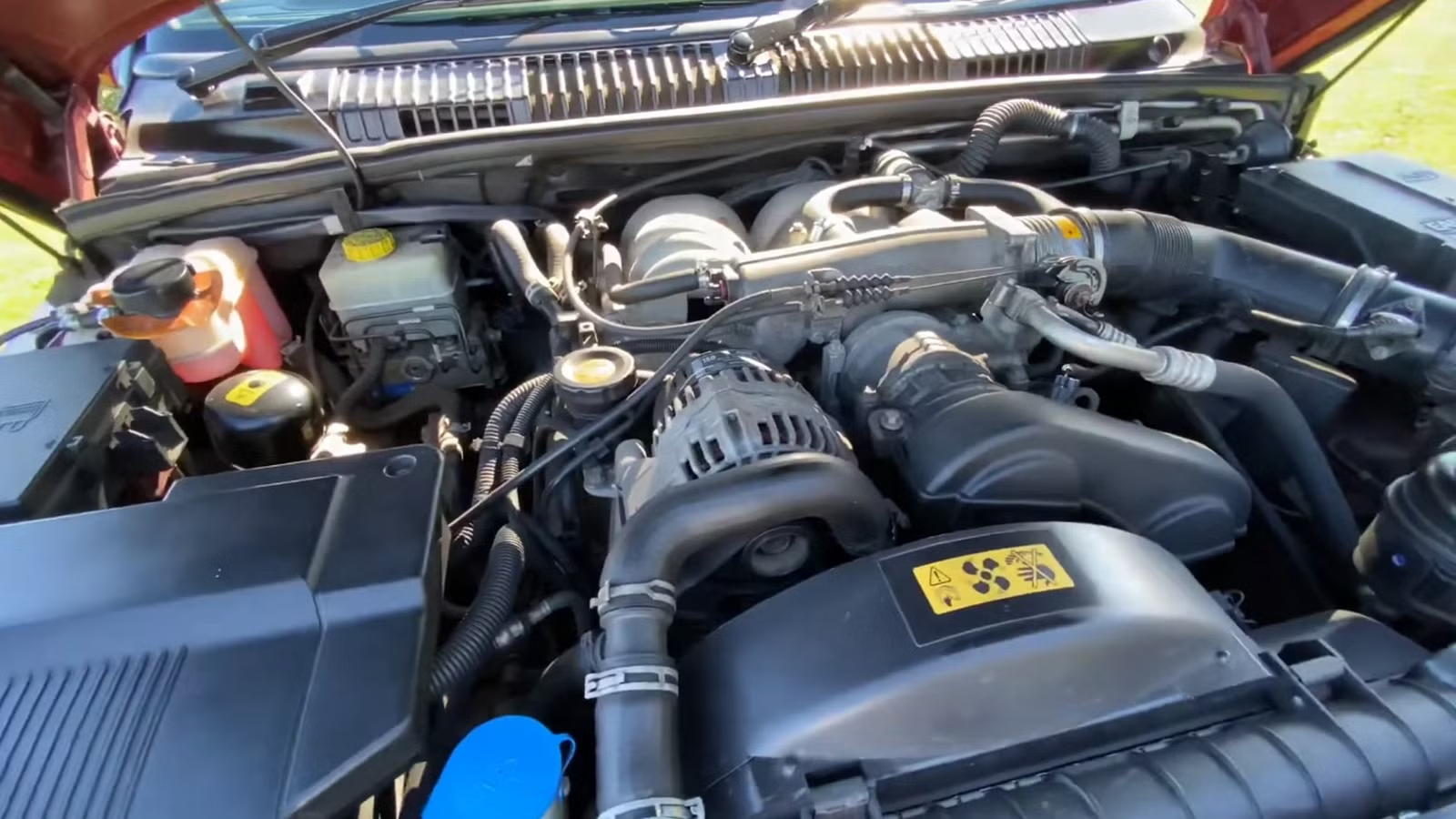
Modern car manufacturing is built with sharing in mind. Cars are built around platforms that can be used for different styles, purposes, and brands, like a big metal LEGO toy that can be customized as a manufacturer wants. It’s a good idea, too, as it helps to keep costs down for both automakers and consumers, and means that parts are far more available. But one Land Rover ignored that philosophy entirely and went down in history because of it.
When Automakers Built Cars As Engineering Statements

Automakers used to let their vehicles develop their own engineering personalities. Cars would be constructed in the way that made most sense, often leading to quirks or inconsistencies in a brand’s choices that simply didn’t appear in other models. That’s understandably gone out of fashion, as manufacturers prioritize shared platforms and cohesiveness to save money and make the construction process easier. But it’s also led to some lost charm.
In the old days, engineers were free to optimize components around the vehicle itself rather than compromising for the sake of compatibility with unrelated models. It produced cars with a bona fide mechanical character, where unusual design or engineering choices were part of a vehicle’s allure. But of course, it wasn’t all positive. Parts designed for one car might have no equivalents elsewhere in a manufacturer’s catalog, effectively making sourcing spares a nightmare.
This was especially common in the 1990s, as manufacturers were starting to realize the advantages of working at scale. Shared platforms became more common, standardized drivetrains were used more regularly, and “borrowing” components from other models could drastically reduce manufacturing and development costs. But while manufacturers hunt for ways to share parts, one went for the complete opposite.

The End Of The Automotive One-Off

Engineering a car from the ground up was just part of the problem; the other part was making sure it was profitable and supportable. And as development costs rose, manufacturers increasingly turned towards a more modular platform that could be tweaked and customized to produce the car they wanted while allowing expensive parts to be spread across a much longer production run.
Automakers like Volkswagen Group (VW, Audi, Skoda, and SEAT) and Stellantis show just how far this philosophy has come. On the VAG front, the same engines can be found in everything from the VW Golf to the Audi S3 and Skoda Octavia, while brakes are also often shared across platforms. Stellantis’ STLA One program, due to launch in 2027, targets up to 70% component reuse across its brands including Peugeot, Citroen, Fiat, and Alfa Romeo, with Stellantis targeting a 20% improvement in cost efficiency. It makes complete sense, too, but you can’t help but feel like it loses a car some of its luster. How disappointing is it when you find out cars like the McLaren F1 used the rear taillights from a VSL Bova Futura tour bus, or the Pagani Zonda used the same control panel as the decidedly un-sporty Rover 45 hatchback?
But where modern manufacturers see modularity as an advantage, one of the most interesting cars went the other way.
The Range Rover P38 Was An Engineering Island

Arriving in 1994 as the successor to the original Range Rover, the P38 looked on the surface like a very similar machine. It had the same boxy proportions, the same commanding presence, and the 4×4 drivetrain you’d expect from something proudly off-road. But things very quickly became different when you looked under the hood.
The P38 used a BorgWarner 4462 transfer case (yes, that’s the same company associated with the Indy 500 trophy) with a viscous coupling to help manage the different rotational speeds of the front and rear axles. It brought a few advantages in the P38’s deliberate move to be more upmarket, one of which related to noise: the new chain-driven system was quieter than the older gear-driven one. The case itself did have an electronically-operated high and low range selection though, and this allowed Land Rover to replace the older mechanical arrangement with a system more suited to the P38’s more sophisticated intentions.
But while these were all positives, there was one drawback: the 4462’s architecture meant that the P38’s propeller-shaft outputs were on the left-hand side of the car, with enthusiasts describing the BorgWarner case as a left-hand-drop unit. It created an engineering compromise: was the 4462 worth it if it meant that some things had to be on the unfamiliar side, and that they would thus need to design the entire car around that singular part? The answer, apparently, was yes.

The 4462’s combination of automatic torque management, quieter chain drive, and electronically controlled range selection fitted the P38’s more sophisticated ambitions, but adopting it also meant accepting its unusual output arrangement. That had consequences beyond the transfer case itself, as the front and rear propeller shafts had to be routed to their respective axles, while the axles, differentials, brackets, and underbody hardware had to accommodate the resulting layout. It was about as far from modular as you could get. But this wasn’t an issue, as owners were buying a new, luxury off-roader and a specific part being a relative engineering oddity wasn’t their concern. This would change later on, though.
As the car aged, this obscure layout presented challenges. Parts couldn’t always be substituted easily as they were so specific to the car, meaning that finding replacements from older or similar cars just wasn’t a possibility. It meant that the car became what enthusiasts called an “engineering island” — something mechanically all on its own, and entirely isolated from the rest of the Land Rover offering.
Why One Strange Packaging Decision Became Such A Big Problem

A car’s lifespan stretches far beyond its time on the showroom floor, and while the 4462 had helped to elevate the P38 above its predecessor in terms of refinement and quietness, the issues with its peculiar layout would only arise long after the sale had already been made. That’s because, as the P38 aged, its lack of commonality with other Land Rovers meant that owners couldn’t rely on older models for parts when something needed replacing.
Repairs were more difficult and more expensive, and specialists became more valuable as they were more adept at identifying just what needed fixing. But this wasn’t exactly Land Rover’s problem as, on their side, the P38 had done what it was made to do: push the brand further upmarket and cement it as a luxury vehicle. It just so happened to do that in a rather unconventional manner.
The P38’s Biggest Flaw Became Part Of Its Legacy

The P38 had some interesting features. It had a fully integrated Electronic Air Suspension (EAS) and a Multiplexed Electrical Architecture (BeCM), and it started Land Rover’s Autobiography customization program. The British royal family even used the second-generation P38A. But these aren’t necessarily what enthusiasts remember it for. They remember it for the odd choice of drivetrain.
Whether that’s right or wrong is your personal opinion. Some people are fascinated by the inner-workings of automotive companies, and the why behind the what of construction. Others simply don’t care so long as it gets them from A to B.
The P38 remains today as an interesting part of automotive history. A car that completely eschewed modularity and continuity in favor of doing the job properly, it may well have been an “engineering island.” But every day, people dream of running away to live on an island. Land Rover just so happened to create one of their own.
Sources: Range Rover

Related posts





Latest Post


No Comments