
The Kawasaki That Belongs In Every Enthusiast’s Garage
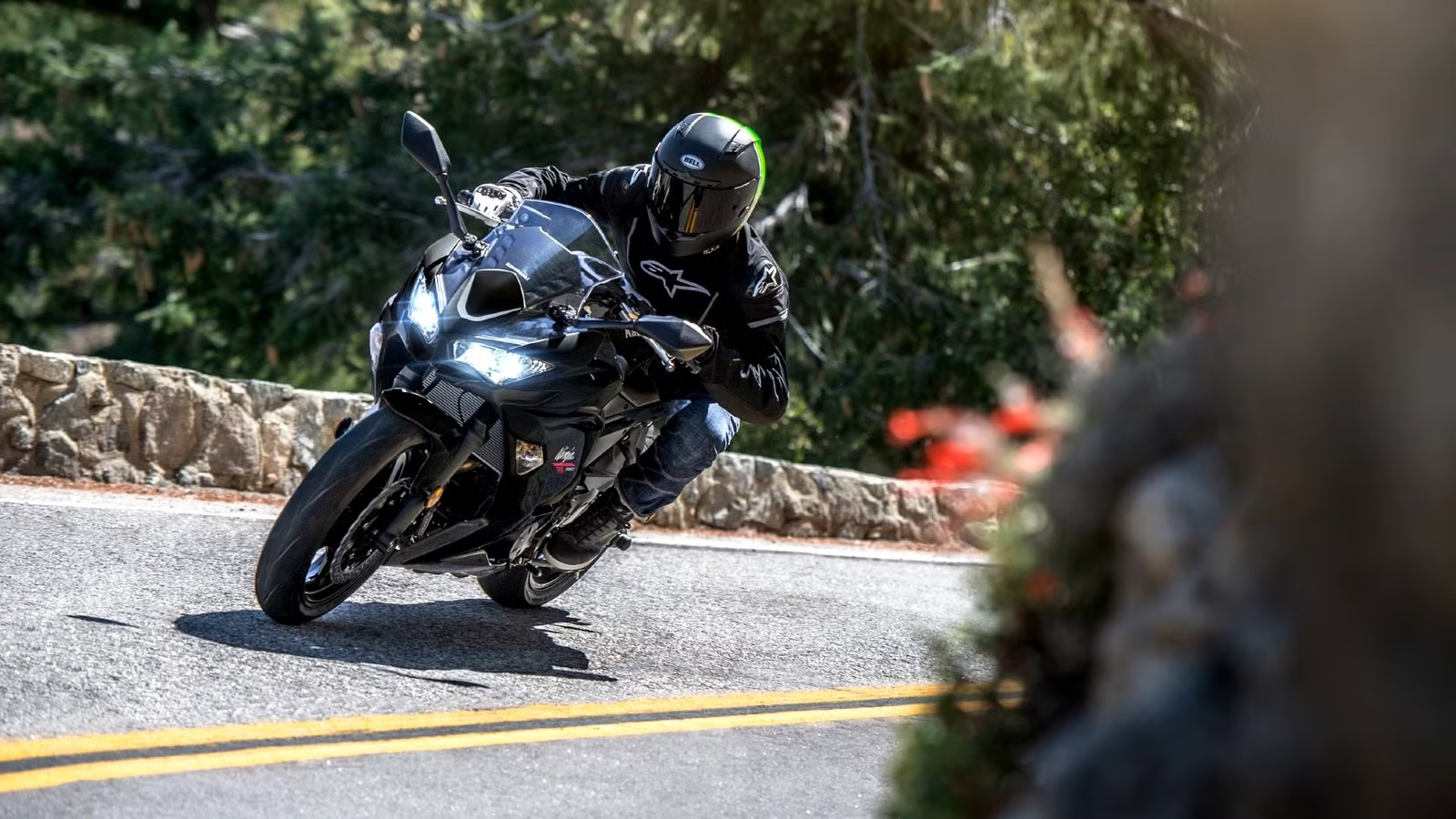
In 2006, Kawasaki birthed two middleweight sport bikes in the form of the ER-6f and the ER-6n, essentially the same bikes in two flavors, with one wearing a fairing while the other being naked. They say there is elegance in simplicity, and Kawasaki seems to have followed the philosophy to make these bikes. Almost a bit too literally. The naked version’s flat handlebar carried straight over to the faired version with no clip-ons, and there wasn’t even a proper fuel gauge. A simple parallel-twin sport bike setup for the daily grind, and two decades on, the core recipe hasn’t evolved much.
While Rivals Stack On Tech, Kawasaki’s Answer Is Deliberate Silence

Such is the nature of the current generation of sport bikes that the middleweight class entrants just keep adding more, almost irrespective of actual requirements. Six-axis IMUs migrated down from liter bikes, and ride modes have become default equipment, too. Bidirectional quickshifters, once track-day specific hardware, are now standard. Given that each addition is meant to solve a problem, somewhere along the way, simplicity has been forgotten, turning what should essentially be a beginner-friendly category into one that increasingly asks a new rider to also learn a menu system.
Thankfully, Kawasaki hasn’t entirely given in and still stands by the original ideology of simplicity in the modern motorcycling world. For instance, it boils bare essentials down to the traction-control system with only two settings, on or off, tuned by wheel-speed sensors rather than a six-axis e-brain. There’s no quickshifter and no ride mode selector. The name got simplified, too, now proudly wearing the Ninja badge and, well, also includes a proper fuel gauge. But two decades of stubbornness raises a real question — has Kawasaki’s simplicity aged into elegance, or just obsolescence?
The Same 649cc Engine, Two Decades Later — And That’s The Point


Today, the 2026 Kawasaki Ninja 650 still carries that same ER-6f-descended parallel twin twenty years on; it still displaces 649cc through an identical bore and stroke that Kawasaki engineered back then. At $7,599 for the non-ABS base model, it’s priced super competitively for the segment, almost like the prices never left their launch year either. Kawasaki has substantially changed the styling since then, thankfully, so the Ninja 650 now looks like its modern siblings sharing the name.
From the saddle, the changes feel more like maintenance than reinvention, but familiarity has a cost. While Kawasaki stood still, every rival shifted gears. Whether that gap now hurts the Ninja 650 or defines it depends entirely on what you actually need from a sport bike.
So Reliable It’s Become Invisible — And That’s Why Riders Overlook It

What gets done right once doesn’t need to be revisited or reinvented, and Kawasaki’s 649cc parallel twin is a prime example. Two decades on, it still makes 67 horsepower at 8,000 rpm and 48.5 pound-feet at 6,700 rpm. Owner feedback on the outgoing generation consistently flags reliability and build quality as its strengths.
That’s the mark of a bulletproof engine that does its job year-on-year to almost ironically make it forgettable. Kawasaki hasn’t had to redesign the crankcases or the valvetrain to keep that reputation intact even today. And two decades is a long stretch for a motorcycle engine to go without a genuine scare story, which is probably why the Ninja 650 is overlooked despite having managed it extremely well.
A Chassis That Feels At Home In Traffic And Canyons Without Asking You To Choose

The underpinnings of the Ninja 650 have remained unchanged too, with a steel trellis frame carrying the engine as a semi-stressed member ever since its inception. Steering geometry is set at a 24-degree rake with 3.9 inches of trail, favoring stability while still being fun and agile over a boring commute or a weekend ride, just one of the reasons why we still love the Ninja 650.
The Ninja 650’s chassis stretches over a 55.5-inch wheelbase to add to the stability. The 41mm conventional telescopic fork and horizontal back-link rear shock have remained unchanged too. With 4.9 and 5.1 inches of travel respectively, there’s enough compliance to shrug off rough roads and maintain chassis composure without the vague, wallowing feel of a softer setup. Dual 300mm petal discs with two-piston calipers up front and a single 220mm disc at the rear handle stopping duty. Dunlop’s Sportmax Roadsport 2 tires are new for this generation, and they cut the effort needed to tip the 425.6-pound curb weight into a corner.
The Ninja 650 Uses Restraint As A Feature

Every part missing from this bike was left out on purpose, and not because Kawasaki couldn’t build it in. There are enough examples in Kawasaki’s lineup, including the latest ZX-6R, that showcase tech in a proper supersport package. But the Ninja fulfills a different purpose, one that makes it highly competent as a daily ride.
Take the throttle, for example, as it makes the clearest point. A cable still runs from the grip to the throttle body, physically linked as it was back in 2006, rather than through the ride-by-wire systems that now dominate the segment. Kawasaki does add a second, ECU-controlled valve set behind it to smoothen the response, but the primary connection stays mechanical.

There are, of course, trade-offs. There’s no cruise control and no selectable ride modes either. But the aim isn’t to take it to track days or compete in club events; it’s to simply perform the duties of a practical sport bike commuter and do it well with just enough tech to keep things rubber-side-up for the rider.
However, this restraint isn’t to be mistaken as blanket neglect. The 4.3-inch TFT dash and its smartphone app connectivity are genuine additions Kawasaki made deliberately, as they are features that solve a daily-use problem. Fewer sensors and control modules mean increased reliability that doesn’t depend on a rider’s maintenance habits. Thus, even over a 10-year ownership, the Ninja 650 doesn’t cost much to maintain.
How $2,100 More Buys You Tech — But Not Necessarily A Better Daily Rider

Many bikes crowd this ever-popular segment now with the Suzuki GSX-8R edging ahead of the Ninja on raw output, with 83 horsepower and 57.5 pound-feet from a 776cc parallel-twin. It’s backed by switchable power modes and a standard quickshifter, on top of four-level traction control. At $9,699 and 452 pounds, it is $2,100 more than the Ninja but justified by the additional tech.

The Yamaha YZF-R7 now comes with a six-axis IMU borrowed from the R1, governing cornering ABS and slide control, while a new quickshifter joins the standard equipment list, too, all for $9,399. A bike that used to be the class’s most stripped-down option is now one of its most loaded.

Both machines are quicker in a straight line and better equipped for an actual track day while still being friendly enough for daily use. The $9,199 Honda CBR650R E-Clutch, however, takes a different route to convenience. It uses a semi-automatic clutch system that manages lever pull at stops and through gear changes, while leaving a manual clutch lever for when the need arises. Its inline-four revs to 12,000 rpm for roughly 94 horsepower, but at 466 pounds, it’s also the heaviest.
Noticeably, all three bikes here are loaded with more and more tech, and follow a trend that may not be applicable to everyone. They follow a maximalist approach, while with the Ninja 650, Kawasaki still firmly believes that “just enough,” built well and reliably, will serve the owner for decades despite being minimal.
Source: Kawasaki

Related posts


Latest Post


No Comments