
10 Sports Cars That Depreciate The Most After 5 Years Of Ownership
Depreciation is the silent tax every new-car buyer pays — and with sports cars, the swings can be dramatic. Some hold their value remarkably well over five years, shedding as little as 25% of their original sticker price; others bleed between 50 and 60% of their MSRP the moment regular buyers start ignoring them on dealer lots. As a rule, the steepest depreciators tend to be luxury models — particularly SUVs and sedans that aren’t purpose-built for performance — but sports cars are far from immune. Sports cars, in particular, vary wildly when it comes to how much value they retain over the years. Rare, iconic, or even notoriously reliable sports cars hold their value a lot better than expensive luxury models that get outdated pretty quickly. That said, accurately predicting which sports cars will go on to become modern classics and which will be dirt-cheap in a couple of years is very difficult.

If you’re in the market for a sports car produced in the last five years, we’ve put together a list of the biggest losers when it comes to depreciation. These models aren’t necessarily bad — they’ve simply recorded the steepest drops in value on the market. That’s welcome news if you’re shopping used, and potentially painful news if you’re planning to sell.
Mercedes-Benz SL-Class
Depreciation After Five Years: 44%
Specs
|
Engine |
 68 autotech 2.0-liter turbocharged inline-4 mild hybrid, 4.0-liter twin-turbocharged V8, 4.0-liter twin-turbocharged V8 with an electric motor) |
|
Transmission |
9-speed automatic |
|
Power |
375 hp (2.0-liter turbocharged inline-4 mild hybrid) – 603 hp (4.0-liter twin-turbocharged V8 with an electric motor) |
|
Torque |
354 lb-ft (2.0-liter turbocharged inline-4 mild hybrid) – 590 lb-ft (4.0-liter twin-turbocharged V8, 4.0-liter twin-turbocharged V8 with an electric motor) |
Source: Mercedes-Benz
The Mercedes-Benz SL is an enduring model in the sports car landscape. While it may fit more into the realms of a grand tourer than an out-and-out sports car, the “S” in the SL name does stand for “sports,” after all. Thanks to its hybridized options, it doesn’t exactly lack in performance either.
The SL suffers from one big problem luxury cars have: depreciation. An SL will lose an average of 44% of its value over 5 years of ownership. While that’s not as bad as many of the other cars on this list, it’s still more than a lot of other expensive sports cars.
Porsche 718 Cayman
Depreciation After Five Years: 44%

Specs
|
Engine |
2.0-liter turbocharged flat-4, 2.5-liter turbocharged flat-4, 4.0-liter flat-6 |
|
Transmission |
6-speed manual, 7-speed automatic |
|
Power |
247 hp (2.0-liter turbocharged flat-4) – 493 hp (4.0-liter flat-6) |
|
Torque |
229 lb-ft (2.0-liter turbocharged flat-4) – 332 lb-ft (4.0-liter flat-6) |
Source: Porsche
The 718 Cayman is one of Porsche’s most popular models, and it’s easy to understand why. Its mid-engined layout delivers sharp, balanced driving dynamics, and reliability is strong enough that many owners use one as a daily driver without hesitation.
The Porsche 718 Cayman loses around 44% of its value after 5 years of ownership. That’s on the lower end of this list, but still high enough to be a bit of a worry. The 718 Cayman is a big seller, so it’ll never hold its value as well as a sports car with lower production numbers.
BMW Z4
Depreciation After Five Years: 44%

Specs
|
Engine |
2.0-liter turbocharged inline-4, 3.0-liter turbocharged inline-6 |
|
Transmission |
6-speed manual, 8-speed automatic |
|
Power |
194 hp (2.0-liter turbocharged inline-4) – 382 hp (3.0-liter turbocharged inline-6) |
|
Torque |
236 lb-ft (2.0-liter turbocharged inline-4) – 369 lb-ft (3.0-liter turbocharged inline-6) |
Source: BMW
The Z4 is a car that helped to revive some of BMW’s credentials as a sporting brand. Customers and journalists alike thought it was much better than the Z3 it replaced, and that translated into a sales success. BMW has kept it as one of its main models to this day, and Toyota used it as a base for the rebooted Supra.
A BMW Z4 will lose an average of 44% of its value over 5 years of ownership — and yes, it loses value more quickly than its Japanese sibling. This isn’t as bad as it sounds, though. Its MSRP is significantly lower than the Mercedes-Benz SL’s and the Porsche 718 Cayman’s, so in absolute dollar terms, you won’t lose as much buying one new as you would with either of those two cars.
Porsche 911
Depreciation After Five Years: 45%

Specs
|
Engine |
3.0-liter twin-turbocharged flat-6, 3.6-liter turbocharged flat-6 with an electric motor, 3.7-liter twin-turbocharged flat-6, 4.0-liter flat-6 |
|
Transmission |
6-speed manual, 7-speed manual, 7-speed automatic, 8-speed automatic |
|
Power |
380 hp (3.0-liter twin-turbocharged flat-6) – 641 hp (3.7-liter twin-turbocharged flat-6) |
|
Torque |
331 lb-ft (3.0-liter twin-turbocharged flat-6) – 590 lb-ft (3.7-liter twin-turbocharged flat-6) |
Source: Porsche
The Porsche 911 is one of the world’s most popular and most famous sports cars, and for very good reason. It has built a reputation since the 1960s for being great to drive, well-engineered, and impressively reliable. You can use a 911 as a daily driver with no problems at all. Thanks to the wide range of engine and transmission choices, there’s a 911 in the lineup for nearly everyone.
The Porsche 911 has been known for solid residuals in the past — but that mainly applies to rarer and more special variants. For standard 911 models, depreciation is very much a factor. You can expect a Porsche 911 to lose around 45% of its value over 5 years of ownership. While that might be great for anyone hunting a used bargain, it’s not brilliant news for anyone who took the plunge and bought one new.
Ford Mustang
Depreciation After Five Years: 48%

Specs
|
Engine |
2.3-liter turbocharged inline-4, 5.0-liter V8, 5.2-liter supercharged V8 |
|
Transmission |
6-speed manual, 8-speed automatic, 10-speed automatic |
|
Power |
315 hp (2.3-liter turbocharged inline-4) – 815 hp (5.2-liter supercharged V8) |
|
Torque |
315 hp (2.3-liter turbocharged inline-4) – 664 lb-ft (5.2-liter supercharged V8) |
Source: Ford
The Ford Mustang is a benchmark when it comes to what a good muscle car should be. It has evolved over the generations, but it’s always been a front-engined, rear-wheel-drive machine with a focus on performance at a relatively affordable price. The recent Dark Horse variant has received a lot of praise, too. The current Mustang lineup offers several engine and transmission choices, and you can have it as a coupe or a convertible — meaning that, much like the Porsche 911, there’s a Ford Mustang out there for almost anyone.
A Ford Mustang will lose an average of 48% of its value over 5 years of ownership. The high-powered GTD, essentially a road-going version of the GT3-class Mustang used in sports car racing, definitely won’t depreciate that much. But if you’ve bought a more regular Mustang new, you’re going to take a significant financial hit.
Aston Martin Vantage
Depreciation After Five Years: 48%

Specs
|
Engine |
4.0-liter twin-turbocharged V8 |
|
Transmission |
7-speed manual, 8-speed automatic |
|
Power |
656 hp |
|
Torque |
590 lb-ft |
Source: Aston Martin
For those who want an out-and-out sports car with genuine class, there’s the Aston Martin Vantage. The latest version of Aston Martin’s dedicated sports car is powered exclusively by a V8 engine — and it’s a strong one. Developed by Mercedes-AMG, it produces 656 hp and 590 lb-ft of torque.
Aston Martins have always had issues with high depreciation, and the Vantage is no different. It’ll lose an average of 48% of its value over 5 years of ownership. If you’re going to buy one of these new, expect to not get that much back when you sell it on.
BMW 2 Series Coupe & Convertible
Depreciation After Five Years: 51%

Specs
|
Engine |
2.0-liter turbocharged inline-4 petrol, 3.0-liter turbocharged inline-6 petrol, 2.0-liter turbocharged inline-4 diesel |
|
Transmission |
6-speed manual, 8-speed automatic |
|
Power |
154 hp (2.0-liter turbocharged inline-4 petrol) – 382 hp (3.0-liter turbocharged inline-6 petrol) |
|
Torque |
184 lb-ft (2.0-liter turbocharged inline-4 petrol) – 369 lb-ft (3.0-liter turbocharged inline-6 petrol) |
Source: BMW
The coupe and convertible versions of the BMW 2 Series probably don’t jump out as being proper, out-and-out sports cars. The M2 is more overtly sporty than the standard 2 Series models, but like all BMWs, the 2 Series coupe and convertible were designed with driver enjoyment as a top priority. Even the lower-powered variants have a genuinely sporty feel, and they’re practical enough to serve as a daily driver.
While a BMW 2 Series can be a very enjoyable daily-driven sports car, its residuals will hurt your wallet quite a bit if you buy new. It’s estimated that the 2 Series coupe and convertible lose an average of 51% of their value after 5 years of ownership.
BMW 4 Series Coupe & Convertible
Depreciation After 5 Years: 52%

Specs
|
Engine |
2.0-liter turbocharged inline-4 petrol, 3.0-liter turbocharged inline-6 mild hybrid petrol, 2.0-liter turbocharged inline-4 mild hybrid diesel, 3.0-liter turbocharged inline-6 diesel |
|
Transmission |
8-speed automatic |
|
Power |
181 hp (2.0-liter turbocharged inline-4 petrol) – 382 hp (3.0-liter turbocharged inline-6 mild hybrid petrol) |
|
Torque |
221 lb-ft (2.0-liter turbocharged inline-4 petrol) – 516 lb-ft (3.0-liter turbocharged inline-6 diesel) |
Source: BMW
The coupe and convertible versions of the BMW 4 Series share the same image challenge as their 2 Series siblings — people don’t typically make the case for them as proper sports cars. But you don’t need full M badges to get a 4 Series that feels genuinely sporty behind the wheel.
After 5 years of owning a BMW 4 Series, you can expect it to lose around 52% of its value. That means if you buy one new, you’re really going to lose out financially.
Jaguar F-Type
Depreciation After Five Years: 54%
Specs
|
Engine |
2.0-liter turbocharged inline-4, 5.0-liter supercharged V8 |
|
Transmission |
6-speed manual, 8-speed automatic |
|
Power |
296 hp (2.0-liter turbocharged inline-4) – 567 hp (5.0-liter supercharged V8) |
|
Torque |
295 lb-ft (2.0-liter turbocharged inline-4) – 516 lb-ft (5.0-liter supercharged V8) |
Source: Jaguar
The Jaguar F-Type reached the end of its production run in 2025 — a real shame, as this car delivered a brilliant, old-school sports car experience for just over a decade. It offered a more analog, driver-focused feel that enthusiasts absolutely loved, and nothing embodied that spirit more than the 5.0-liter supercharged V8 found in the P450 and R variants.
Jaguar doesn’t command the same brand premium as other prestige marques, and that’s reflected in its depreciation figures. A Jaguar F-Type will lose 54% of its value on average over 5 years of ownership. While that’s not great for anyone who bought one new, it means there are plenty of bargains out there for used buyers.
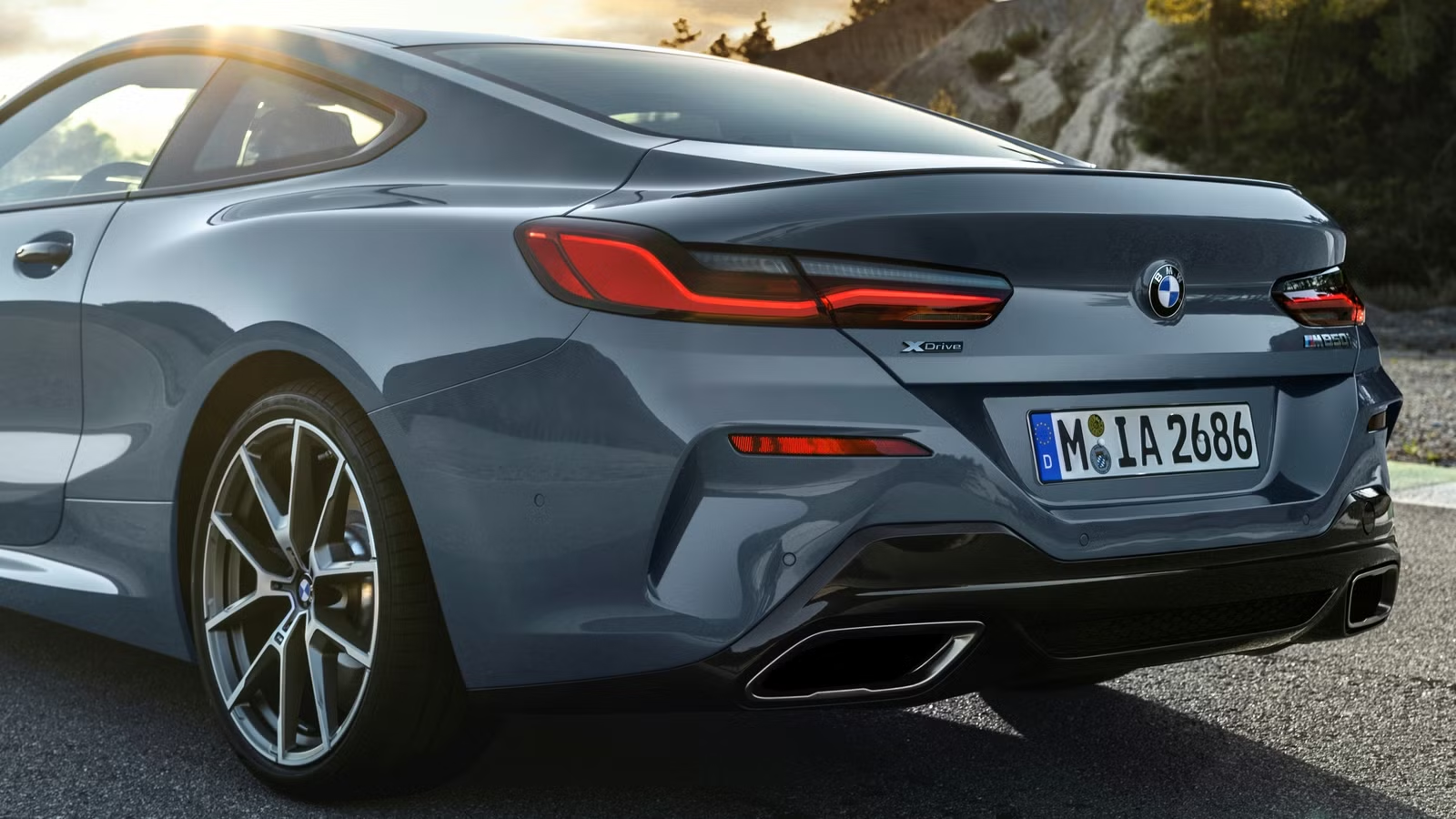
BMW 8 Series
Depreciation After Five Years: 55%
Specs
|
Engine |
3.0-liter turbocharged inline-6 petrol, 4.4-liter twin-turbocharged V8 petrol, 3.0-liter turbocharged inline-6 mild hybrid diesel |
|
Transmission |
8-speed automatic |
|
Power |
335 hp (3.0-liter turbocharged inline-6), 523 hp (4.4-liter twin-turbocharged V8) |
|
Torque |
369 lb-ft (3.0-liter turbocharged inline-6), 553 lb-ft (4.4-liter twin-turbocharged V8) |
Source: BMW
The BMW 8 Series is a reboot of the classic wedge-shaped coupe from the ’80s and ’90s. Like the Mercedes-Benz SL, it sits more comfortably in grand tourer territory than pure sports car, but it is anything but slow — even the 3.0-liter inline-six variant delivers strong acceleration.
If you’ve ever thought about hunting for a bargain 8 Series on the used market, you might be in luck. It loses an average of 55% of its value over 5 years of ownership — more than any other car on this list. That means even the pricier variants of the 8 Series can be had for half, or less than half, of their original MSRP.
Sources: CarEdge

Related posts


Latest Post


No Comments