
The Motorcycle That Ages Better Than Anything Else On The Road
Some motorcycles chase trends. Others transcend them. In an era when most new bikes arrive wearing aggressive bodywork, sci-fi LED clusters, and design language that will feel dated within a decade, a handful of machines manage to look just as right today as they did the moment they rolled off the line. One of them has been doing exactly that for more than three decades — and it still stops traffic without trying.

That motorcycle carries one of the most legendary silhouettes in automotive history, one that belongs as much to popular culture as it does to the open road. It is the kind of machine people photograph even when it is parked. And in its current form, it is better than ever.
A Timeless Motorcycle Design Is Rare These Days
Motorcycle design has come a long way, thanks to technological advancements that allow manufacturers to produce complex components with ease. That has led manufacturers to develop motorcycles whose designs are either optimized for aerodynamic efficiency, futuristic, or simply tracking current automotive design trends.

The problem is that such modern motorcycle designs rarely age well. They stay trendy for a couple of years, but soon enough they are eclipsed by the next wave of trendier machines. That is the reason why newer Ducati Panigale generations are not held in quite the same regard as older Ducati sports bikes, like the legendary 916 and 1098. The Panigale is still a stunning motorcycle, but it lacks the timeless quality of its predecessors.
If you are looking for a motorcycle with genuine staying power today, you are not entirely out of options. MV Agusta has kept the original F4’s timeless spirit alive in the latest-generation F3 supersport, which still draws heavily from the three-decade-old F4. Then there is the stunning Superveloce, a neo-retro sports bike that is unlike anything else on the market. Other timeless motorcycles you can buy today include the Kawasaki Z900 RS, BMW R 12 G/S, and the Indian Springfield. But there is one bike that stands apart from all of them, and it is the Harley-Davidson Fat Boy.
The Harley-Davidson Fat Boy Is Where Beauty Meets Brawn
The Harley-Davidson Fat Boy made its grand debut in 1990, bringing a bold new look and formidable cruiser performance to the segment. As part of Harley’s Softail lineup, it introduced a muscular road presence with its signature Lakester wheels and a massive V-twin engine, eventually earning a place among the most iconic motorcycles ever to wear a Bar and Shield badge.
It is as much a part of the motorcycling world as it is of pop culture, thanks largely to Terminator 2: Judgment Day, which cemented its place in the collective consciousness. The Fat Boy thus became one of the most recognizable motorcycles on the planet. In its current form, it only raises the bar higher. If older Fat Boys are anything to go by, you can bet your hard-earned money that the Harley-Davidson Fat Boy will age as gracefully as a fine wine.
The Fat Boy Starts At $22,599
Starting at $22,599, the Harley-Davidson Fat Boy is not a cheap motorcycle. But you get a great deal for the price. First, you get one of the most legendary silhouettes in automotive history. Then there is the potent Milwaukee-Eight 117 V-twin engine, a comfortable perch for long highway cruises, and Rider Safety Enhancements as standard.
One Of The Most Legendary Motorcycle Silhouettes Meets Modern Touches
The Harley-Davidson Fat Boy has, since its launch, stuck to a simple formula: a larger-than-life road presence inspired by a steamroller stance. It must look planted from every angle. The most iconic element of the bike’s design is the beefy front end, complete with a sculpted chrome nacelle that frames a large 7-inch LED headlamp. This nacelle has been refined through a modern lens on the current generation.
Under the nacelle sit chunky forks, and when viewed head-on, the wide handlebars give the impression of a bull’s horns. Move to the side, and you will see the swooping flyline that screams cruiser aesthetics. At the rear, a custom-style fender is highlighted by a chrome subframe. The large tank houses an old-school analog display and sits atop a massive, chrome-accented V-twin engine.
Of course, no discussion of the Fat Boy is complete without its iconic solid cast aluminum Lakester wheels, shod in thick rubber. Rumor has it that the Lakester wheels were inspired by the B-29 Superfortress bomber, though the Motor Company has always denied it. Regardless, the wheels play a major role in giving the Fat Boy a brutish road presence that is unlike anything else on the market.
The Limited Edition Grey Ghost Takes Things Up A Notch

H-D launched a limited serialized run of the 35th Anniversary Fat Boy Grey Ghost as part of the Icons Collection. It is a stunning limited-edition Fat Boy finished in an exclusive Reflection color scheme with yellow accents throughout. Model code FLSTFI, this Grey Ghost proves that, when executed properly, even a motorcycle dripping in chrome can look mind-blowingly gorgeous.
Proper Big-Twin Performance Adds To The Fat Boy’s Brute Force

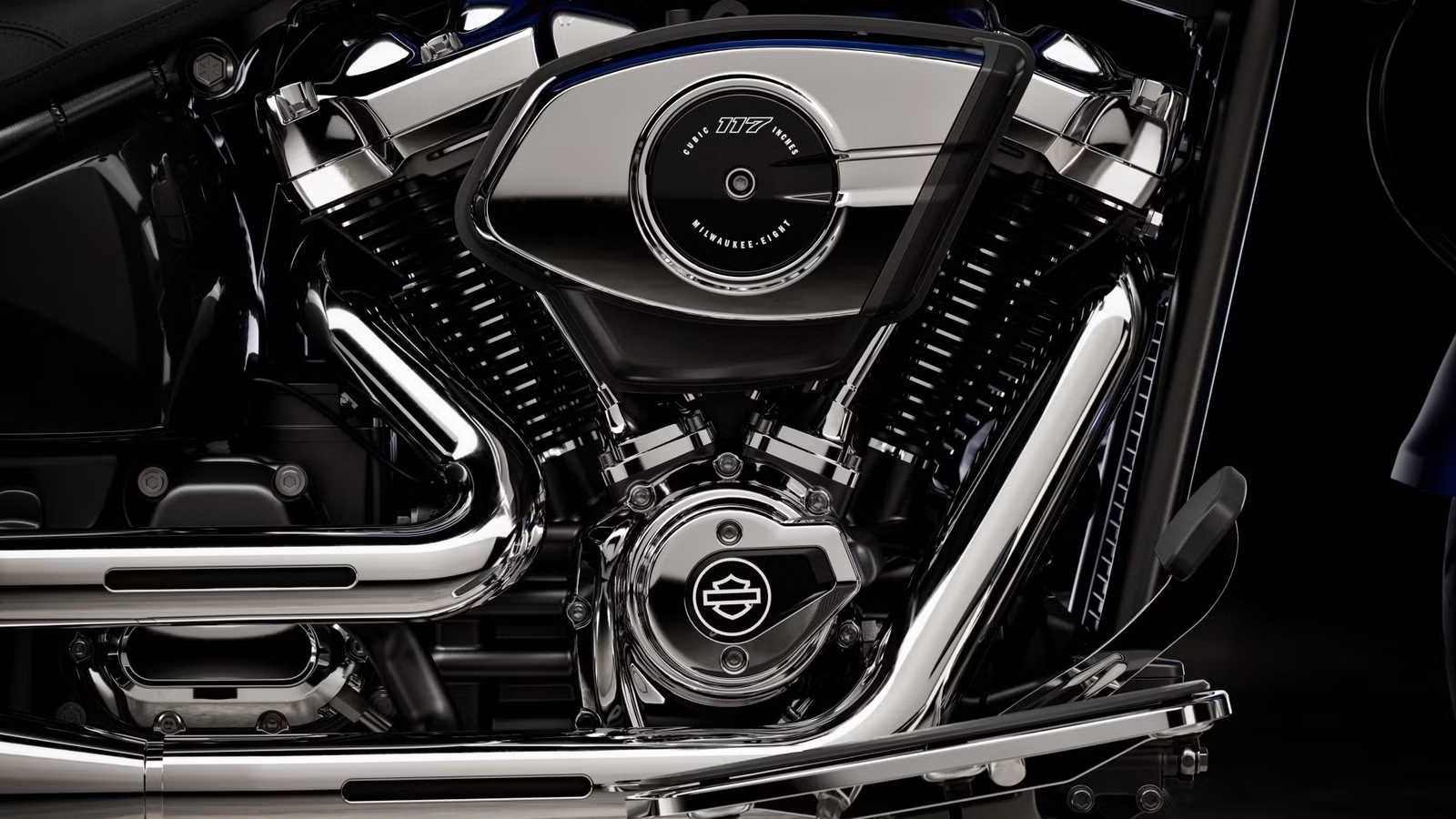
The Fat Boy is powered by the Milwaukee-Eight 117 V-twin engine, producing 103 horsepower and 126 pound-feet of torque. In true Big Twin fashion, this engine delivers the bulk of that torque low in the rev range, which helps this hefty cruiser launch off the line with more urgency than you might expect. It is mated to a six-speed transmission that sends power to the rear wheel via a final belt drive.
The engine is paired with the Touring Intake, which is designed to maintain steady power and offer smooth throttle response on the move. Meanwhile, dual counterbalancers keep vibrations in check. H-D claims a fuel economy of 47 miles per gallon, which should be good for around 230 miles between fuel stops — not bad for a powerful, heavyweight big-twin cruiser such as this one. Completing the package is a two-into-two exhaust system that delivers a deep, throaty note capable of demanding attention even when the bike’s road presence does not.
Softail Frame Tuned For Comfort

While the Fat Boy harks back to the clean lines and classic silhouettes of rigid-frame Harley-Davidsons of the past, it is thoroughly modern underneath. It features the Softail frame — Harley’s take on a double-cradle chassis that mimics the look of a hardtail while concealing a monoshock beneath the rider seat. The frame’s geometry is designed for straight-line stability and cruising comfort, so cornering finesse is not the point here. The Fat Boy is all about confident, composed miles on the freeway.
The frame is suspended on a Showa dual-bending valve telescopic fork up front and a hidden monoshock at the rear. Harley-Davidson says the suspension’s damping rates have been fine-tuned to improve rider comfort, delivering a smooth and composed ride on long stretches of open highway. Combined with the bike’s laid-back ergonomics, the Fat Boy should be a genuinely comfortable long-haul companion — though its hefty weight and wide turning radius will take some acclimatization.
Decent Tech To Go With The Times
The Fat Boy also gets the essentials right when it comes to its feature list. It includes a tank-mounted 5-inch analog gauge cluster, a USB charging port, and three ride modes: Road, Rain, and Sport. Rider Safety Enhancements are also on board, including cornering-enabled ABS, traction control, Drag-Torque Slip Control (DTSC), and TPMS. So not only is this a boulevard bruiser with a massive road presence — it also has the technology to help you keep the shiny side up.
Source: Harley-Davidson

Related posts

Latest Post


No Comments