
The Motorcycle Built For Riders Who Think 300 Miles Is Just The Beginning
The Proclaimers might have been ready to walk a thousand miles, but for most motorcycle riders, 300 miles is a full day in the saddle. At the end of such a day, all your aching wrists and ringing ears want is a hot shower and a comfortable bed. However, dedicated long-haul riders could give The Proclaimers a run for their money, because 300 miles is just a morning warm-up for them before the journey actually begins. This kind of endurance riding needs a motorcycle that eliminates highway fatigue yet does not dull the experience.
Traditional Long-Distance Touring Platforms Demand Serious Dynamic Compromises

Traditional touring motorcycles bring couch-like comfort to the highway experience, but their thousand-pound curb weight turns tight switchbacks and detours over dirt into white-knuckle experiences. It is the same when you look at other styles of motorcycles that you could use for touring: heavyweight cruisers cannot deal with gravel, while lightweight dual-sports are punishing over long highway stretches.
The solution to all these problems is the adventure tourer, yet modern examples have bloated into tech-heavy and just plain heavy behemoths that are not comfortable with dirt or gravel anymore. Covering massive distances across any terrain that might show up requires a motorcycle capable of being comfortable on any surface without punishing the ambitious rider.
Modern Cross-Country Capability Demands Low-Speed Agility And High-Speed Stability

To be able to conquer any terrain while covering massive distances without tiring the rider out, an adventure tourer that aims to replace a traditional tourer must combine high-speed stability with great low-speed balance. It will also need enough performance to make a mountain pass exciting, even with fully loaded luggage, while still concealing its true weight figure. This can only come about through centralizing weight, getting the ergonomics spot on, and offering a chassis and suspension combination that adapts intuitively to whatever terrain rolls under the wheels. If it works well enough, the distance is not an obstacle and becomes the purpose of the ride.
BMW Reengineers Its Iconic Boxer-Twin Platform For Transcontinental Travel


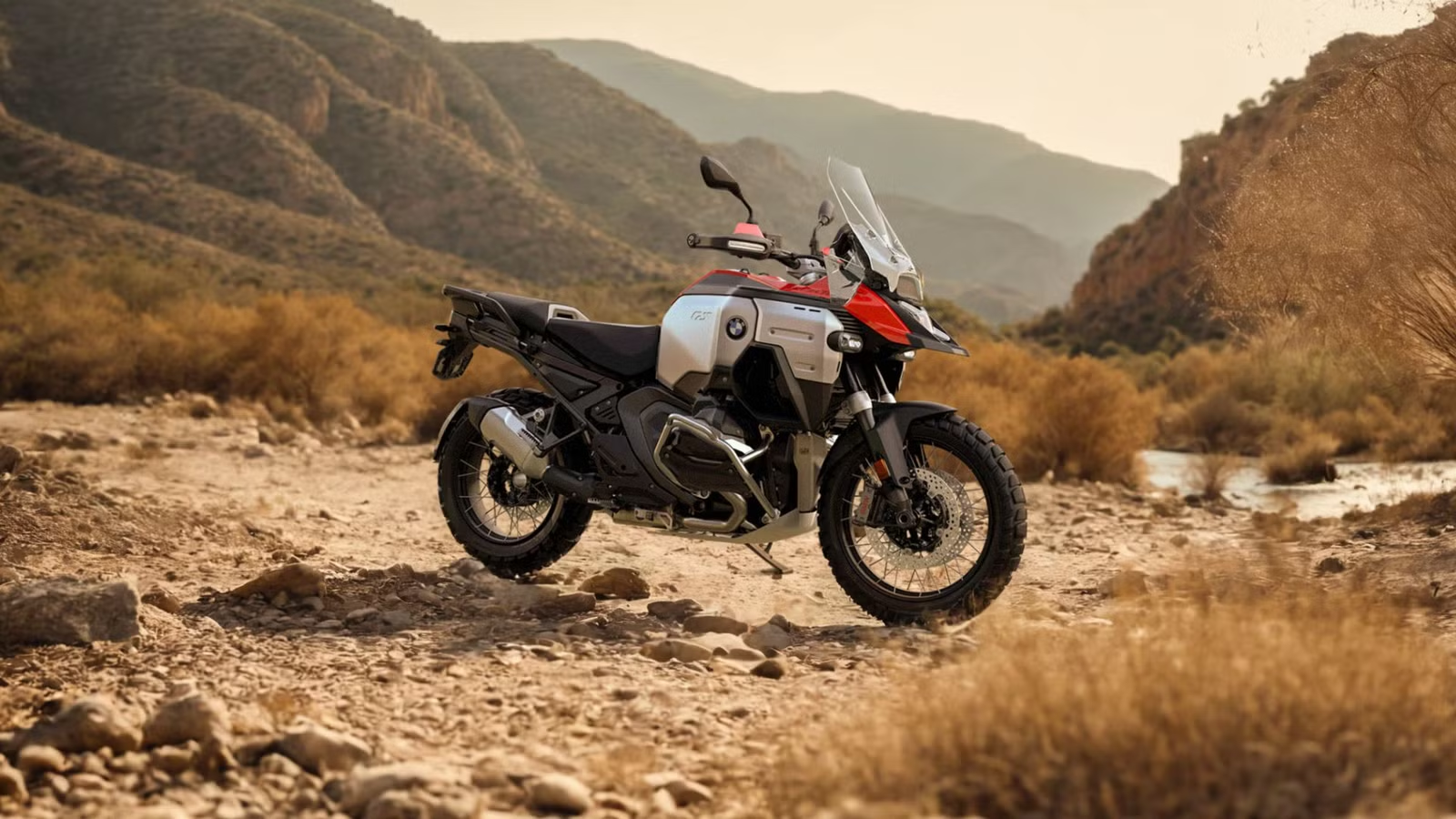
Few manufacturers understand what globetrotting on two wheels needs better than BMW. After all, it is the manufacturer that essentially birthed the adventure-touring segment with the R 80 G/S. It has a rich heritage of iconic boxer-twin engines conquering some of the world’s harshest terrain. Now, it has completely overhauled its flagship adventure-touring motorcycle, offering an experience that is lighter, sharper, and dramatically more refined. But reinventing a legend is only half the story — the real question is whether the R 1300 GS Adventure’s hardware actually delivers on that promise when the pavement ends.
The BMW R 1300 GS Adventure Is Just Getting Started At 300 Miles

The R 1300 GS Adventure was always an intimidating motorcycle, but with this current generation, BMW has relocated its mass, which makes it far more approachable. Its bigger boxer-twin engine has a repositioned gearbox, which makes it more compact and lowers the center of gravity.
With the new R 1300 GS, BMW went back to the drawing board and completely rethought how a flagship adventure tourer should carry its weight, deliver its power, and maintain the capability to keep going endlessly on asphalt—and then keep going when the road runs out. The key to all of it starts with what’s between the rider’s knees — a completely overhauled boxer-twin that changed everything about how this motorcycle moves.
A Sub-$24,000 Starting MSRP Rapidly Inflates With Factory Option Packages
The R 1300 GS Adventure has a base price of $23,795. This is an eminently reasonable price for the kit you get, not to mention the performance and reliability that is standard with a flagship BMW GS. However, if you add any options, the price escalates quickly, because BMW’s packages rarely allow you to add a single item from the options list in isolation. Add the automatic gearbox to it, and the base price shoots up to $28,575, which is very near the most expensive competitor in the segment.
145-Horsepower Boxer Twin Delivers Relentless Low-RPM Pull

BMW’s flagship GS has always been powered by a boxer-twin engine. In the R 1300 GS, it has a 1,300 cc displacement. This is coupled with liquid cooling, four valves per cylinder, a high compression ratio of 13.3:1, and ShiftCam variable valve timing on the intake valves.
The result is 145 horsepower at 7,750 RPM and 110 pound-feet of torque at 6,500 RPM, which makes it the most powerful BMW adventure bike. The engine is smooth, has torque available throughout the rev range, and, thanks to its longitudinal, flat configuration, the heads are easy to work on if you put a lot of miles on it.
An Automated Shift Assistant Option Simplifies Long-Haul Highway Cruising

As standard, the base model has a six-speed manual gearbox with an assist and slipper clutch. However, you can specify it with an automated manual. This is also a six-speed, and not only do you not need to use the clutch while starting or stopping, you do not need to use it to change gears; the bike will do it all for you. No matter what gearbox you choose, a driveshaft transmits the power to the wheel, combining bulletproof engineering with long-distance comfort.
Next-Generation Telelever And Paralever Hardware Maximize High-Speed Composure

The R 1300 GS uses a unique frame that is quite like a diamond frame. It uses the engine as a stressed member, and the rear subframe is bolted on. It uses BMW’s patented Paralever and Telelever suspension setup, which is a wishbone front and a single-sided swingarm with a monoshock at either end. The Adventure variant offers slightly more suspension travel than the standard R 1300 GS, at 8.3 inches at the front and 8.7 inches at the rear. This allows it to handle rough trails as gracefully as city streets.
The brakes are suitably large as well, with twin 310 mm semi-floating front discs grabbed by radial four-piston fixed calipers and a 285 mm rear disc with a two-piston floating caliper. The base model offers tubeless spoke wheels with a 19-inch front and a 17-inch rear, and they are fitted with radial tires.

The unique suspension setup offers feedback that is unusual compared to the telescopic fork setup found on other adventure motorcycles, but it has proven its worth over the decades. Once you get used to it, there is very little that can stop a rider from getting wherever he or she wants to go with a flagship GS.
A 7.9-Gallon Fuel Tank Enables Effortless 350-Mile Touring Stints

The R 1300 GS is a full-size adventure motorcycle and, therefore, its dimensions reflect that: it is 89.8 inches long, 39.8 inches wide, and has a wheelbase of 60.4 inches. Despite its tall stance and long-travel suspension, the seat height is a very reasonable 34.6 inches in the low position and 35.4 inches in the high position.
The unladen weight while road-ready and fully fueled is 593 pounds. The 7.9-gallon fuel tank makes a significant contribution to that figure when full. The beauty of the R 1300 GS is that because of its boxer-twin engine configuration, a lot of its weight is carried really low in the chassis, and as a result, it feels a lot lighter than the weight figure on the spec sheet. The suspension and chassis geometry also allow it to feel effortless at highway speeds.
Standard Tech That Rivals Options Lists, Plus Radar And Adaptive Ride Height On Top
The R 1300 GS is BMW’s flagship touring motorcycle in many ways, which is why BMW uses it to show off its German engineering mastery. It has a 6.5-inch TFT display with Bluetooth and navigation, and the standard features list is extensive: it includes keyless ignition, TPMS, cruise control, heated grips, hand protectors with integrated turn signals, auxiliary lights, and an auto-leveling electronic suspension. The options list is equally long; it includes the Riding Assistant with radar sensors, the adaptive suspension that lowers itself at walking pace and raises itself to make it easier to put the bike on the main stand, and the automatic gearbox.

The accessories list includes a double silencer, alternative handlebars, hard luggage, tank bags, and BMW’s various add-on packages. The Enduro Package Pro, for example, adds items that make the GS more ready for dirt. You can also get a standalone upgrade for off-tarmac use with forged wheels that are lighter than the spoked ones, plus more aggressive tires. The two-way quickshifter is an optional extra for the manual gearbox.
A Six-Axis IMU Safety Suite Unlocks Comprehensive Electronic Rider Aids

A by-wire throttle and six-axis IMU enable a full electronics suite, making rainy days less miserable. You get four riding modes as standard, with three more unlocked with the Riding Modes Pro package. You also get Dynamic Traction Control and engine drag torque control. The brakes are linked, are equipped with cornering ABS, and have hill hold control. The optional radar package enables Active Cruise Control, Front Collision Warning, Lane Change Warning, and Rear End Collision Warning.
Ballooning Option Costs And Heavy Curb Weight Limit Pure Off-Road Agility

No bike is perfect, and that is true of the R 1300 GS Adventure as well despite it being the adventure bike benchmark. We start with the obvious: the styling now has wider appeal, but it is still polarizing. The base price is manageable, but loaded up with options, it quickly balloons so much that it becomes almost a 50 percent increase over the base price.
It is just as heavy as the three-cylinder Tiger and the four-cylinder Multistrada, despite being a two-cylinder machine. When you opt for the automatic gearbox, you lose the clutch lever completely, which means technical off-road work becomes difficult. Ownership costs are traditionally a lot higher than the competition thanks to its extreme electronic complexity and European heritage.
Flagship European And Japanese Rivals Offer Competing Globetrotting Tech

Europe seems to have cornered the market on hyper-premium long-distance adventure touring motorcycles. The most visible one is the Ducati Multistrada V4 Rally, which has a good case for being the ultimate adventure touring bike. It costs $31,995, but it is optioned with all the bells and whistles. It offers 170 horsepower and features a counter-rotating crankshaft, along with rear-cylinder bank deactivation and a two-way quickshifter as standard, but it uses a chain drive, so chain maintenance will be a reality on a long ride.

The Triumph Tiger 1200 Rally Explorer costs a lot less at $24,895. Its inline-three-cylinder engine is quite characterful thanks to the T-plane crank, and it also turns out 147 horsepower and sends that to the wheel via a driveshaft. It sports quality components for the chassis and is usually underrated.

A new entry into the field is the KTM 1390 Super Adventure S Evo, which in many ways redefines what luxury means in its segment. It has an automatic gearbox as standard fitment with a base price of $22,699, which makes it incredible value for money in this segment. Its new V-twin engine produces an impressive 170 horsepower, and the automatic gearbox offers a park mode, which makes this the most dynamic of the group. It also needs to prove its reliability compared to the others.

Last but not least is the Honda Africa Twin Adventure Sports ES DCT, which is possibly the most reliable adventure motorcycle. This is the budget choice at just $18,599, but it needs to be here because it sports pretty much everything that the others do, including electronic suspension and an automatic gearbox. It does not have the performance of the others, with an output of just 100 horsepower and a heavy cradle frame, but if you are practically minded and truly want to take your automatic full-size adventure bike off-road, it is the most versatile of the group.
Source: BMW USA

Related posts
Latest Post


No Comments