
The Middleweight Touring Bike With Yamaha Reliability And BMW Road Manners
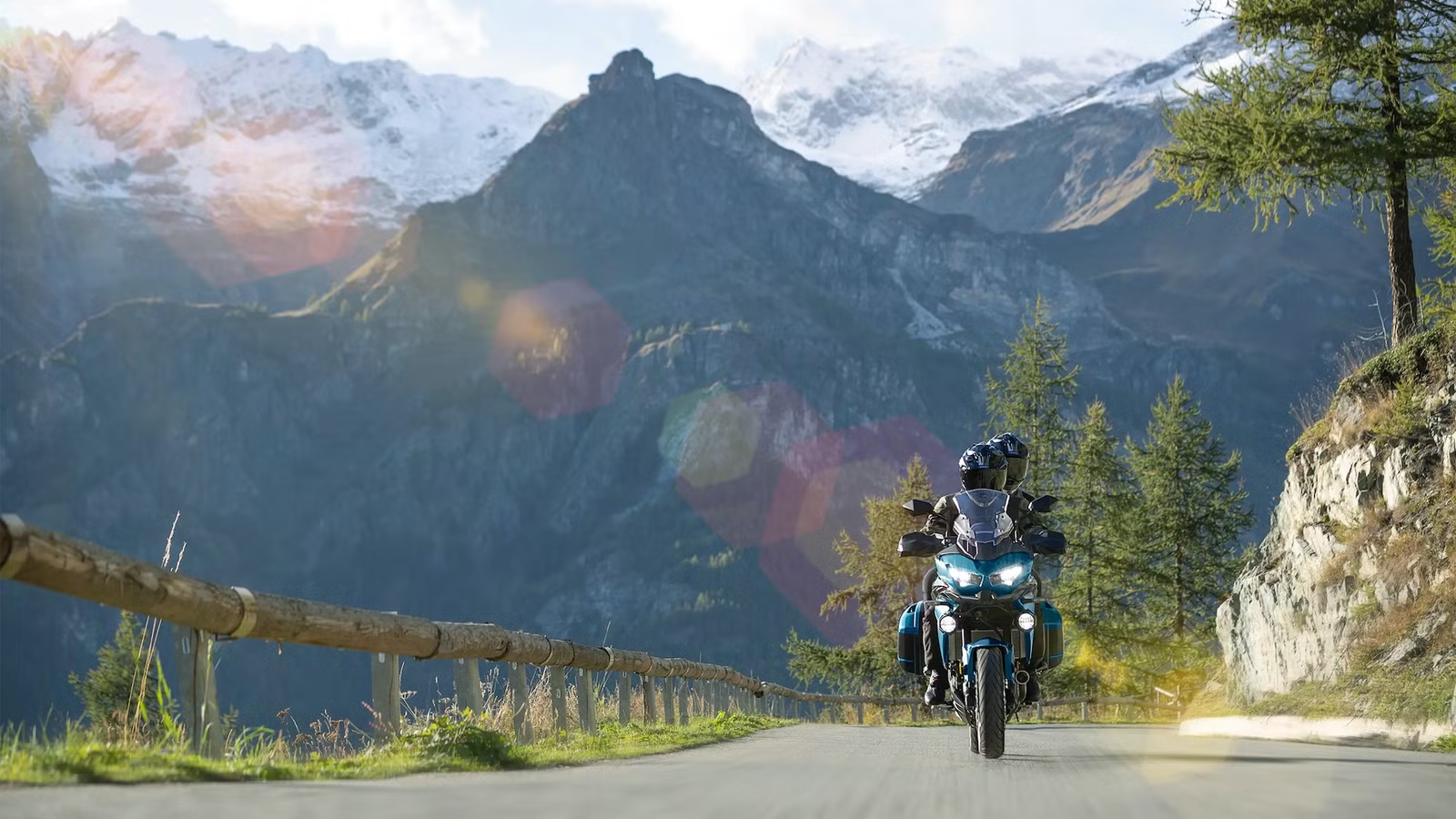
There is a familiar compromise in the middleweight touring world. Buy a Japanese, and you’re buying peace of mind — an engine that’ll outlast the loan, at the price of chassis manners that rarely rise above “adequate.” Buy a BMW, and the trade flips: a bike that steers, brakes, and settles into a corner with a precision few rivals match, backed by a service bill that can rival the down payment. Riders looking for a middleweight touring motorcycle have been quietly making this trade-off for years, assuming no bike could split the difference. One has, for nearly two decades, without ever marketing itself that way.
Why Reliability And Sharp Road Manners Matter For The Midweight Segment
When buying a touring bike, reliability and handling are inevitably the top factors that determine a purchase, right behind price. The two traits get tied to specific brands so consistently that the brand names have basically become industry shorthand. Consumer Reports’ four-year motorcycle ownership survey found an industry-average failure rate of 24 percent. Yamaha came in lowest at 11 percent, with Honda and Suzuki tied just behind at 12 percent. BMW sat at the opposite end of that list, close to 40 percent — bad enough that the magazine’s own deputy editor pointed out that a BMW is roughly four times as likely to need a repair as a Yamaha, with higher repair bills to match.

The brand in this article is actually about as reliable as Yamaha, Honda, and Suzuki, commonly cited at around 15%. Consumer Reports also noted that reliability was only one part of owner satisfaction. That distinction matters since these figures don’t mean every BMW requires repairs or every Japanese motorcycle will run trouble-free. They simply show why Japanese brands acquired such a strong reputation for dependable ownership, while BMW occupied a different position in the survey data.
Where The Road-Manners Reputation Comes From

BMW earned its side of the comparison honestly. The GS and RT families set the bar for planted, predictable handling in the touring world — bikes that stay composed at speed and don’t turn into a chore at walking pace. Riders cross-shop against a BMW even when they have no intention of buying one, because “it handles like a BMW” means something specific in this segment. It’s not a vague compliment. It’s a benchmark other manufacturers get measured against, whether they like it or not.

The Kawasaki Versys 650 LT Has A Reliable Powerhouse And Sports Bike Origins
Base Price: $10,399

This is where the Kawasaki Versys 650 LT enters the conversation, and it does so by quietly pairing the low-stress, bulletproof mechanical nature typical of Yamaha’s own twins with the neutral, long-haul tarmac composure people pay BMW money for. The Versys badge has been around since 2007, built on the same ER-6N-derived architecture also used by the Ninja 650 — an engine platform Kawasaki has relied on for nearly two decades, yet it has never been marketed on lineage or benchmarks.
The 2026 Versys 650 LT starts at $10,399, with a $685 destination charge. For context, BMW’s own small-capacity adventure twin, the F 800 GS, starts around $11k — and that’s before you’ve added the destination and touring accessories like saddlebags, hand guards, and adjustable windscreen that come standard on the Kawasaki’s LT trim.
An Engine Line Built On Kawasaki’s Reliability Record

At the heart of the Versys 650 LT sits a 649cc, liquid-cooled, DOHC parallel-twin, the same basic architecture found in the Ninja 650, Z650, and Vulcan S. Peak output lands around 66 horsepower at 8,500 rpm and 45 lb-ft at 7,000 rpm, numbers that look modest next to a liter-class adventure bike, but the delivery is what actually matters here. According to Kawasaki, power arrives low and linear in the midrange instead of demanding riders chase the tachometer to feel anything happen.
Low Cost Of Ownership Guaranteed

No motorcycle can honestly be called maintenance-free, and the Versys is no exception. Chains, brake components, tires, fluids, and valve-clearance checks are still part of ownership. What stands out is the absence of a widespread reputation for major mechanical failures. Public owner discussions reinforce that picture, although anecdotes should never be mistaken for a controlled reliability study.
A 2026 Reddit discussion featured owners reporting Versys 650s with approximately 70,000 to 170,000 kilometers on the odometer. While some owners mentioned electrical or cooling-system repairs at higher mileages, others reported mostly routine maintenance and continued daily use. That’s arguably more useful than the word “bulletproof.” Kawasaki’s two-year limited warranty on the LT adds another layer of manufacturer backing. Then there is the fuel tank. At 5.5 gallons, the Versys has enough capacity to offer a 200-plus-mile range with a realistic mileage of 45 mpg.
Chassis That Offers European-Like Road Manners
17-Inch Wheels And Sport-Touring Geometry

Unlike most adventure-styled bikes running a 19- or 21-inch front wheel for off-road capability, Kawasaki kept things simple for the Versys with 17-inch cast wheels front and rear, wrapped in street-biased rubber. That choice alone explains a lot about how the bike turns in — quick and direct, more “sport-touring” than “adventure” despite the beak fairing and upright stance. Suspension duty falls to a 41mm inverted Showa fork with 5.9 inches of travel, adjustable for preload and rebound, paired with a laid-down rear shock offering 5.7 inches and a remote preload knob for dialing in a passenger or a loaded tail bag in seconds.
Ergonomics And Back Road Confidence

The Versys’ upright riding position is equally important. Kawasaki lists a 33.3-inch seat height and a 55.7-inch wheelbase, while the bike weighs 482.9 pounds with fluids and a full tank before adding the roughly 20 pounds associated with the LT’s saddlebags and hand guards. Those dimensions give the rider an upright view over traffic without creating the top-heavy feeling that can come with a much larger adventure tourer.
What Makes The LT Trim Genuinely Touring-Ready
Color-Matched KQR 28-Liter Hard Saddlebags

The LT trim’s signature feature is a pair of 28-liter hard saddlebags mounted on Kawasaki’s KQR quick-release system, color-matched to the bodywork and roomy enough to swallow a full-face helmet on each side. The same key that starts the bike locks and releases the bags, which sounds like a small thing right up until you’re standing in a parking lot juggling a separate lock and key just for the luggage.
All-Weather Protection For Long Hauls

A four-way, manually adjustable windscreen lets riders tune airflow across a few inches of travel without having to use any tools, while factory hand guards cut down on wind chill and debris on cooler rides. The combination of fairing, screen, and hand guards makes the motorcycle better suited to cold mornings and long highway stretches than its relatively compact engine might suggest.
Tech Modernization Without Over-Complexity

Kawasaki kept the electronics package useful rather than overwhelming. A two-mode Kawasaki Traction Control system (KTRC), plus an off setting, handles slick roads without constantly second-guessing the rider, and dual-channel ABS comes standard across the board. Braking hardware consists of dual 300mm petal discs up front, gripped by two-piston Nissin calipers, with a single 300mm disc handling things out back.
Modern Cockpit & LED Lighting

A 4.3-inch full-color TFT dash, borrowed from the larger Versys 1000, handles instrumentation duty, with automatic day and night modes and Bluetooth pairing through Kawasaki’s Rideology app for turn-by-turn navigation, calls, and music. Up front, LED headlights replaced the old halogen setup a few model years back, giving the bike a sharper, more current face without touching the mechanicals underneath — the part Kawasaki apparently felt never needed fixing in the first place.
None of this makes the Versys 650 LT the fastest, lightest, or most off-road-capable bike in its class. That was never the pitch. What it offers instead is a genuinely rare combination in the middleweight touring world: an engine with a reputation for outlasting its owner’s patience, wrapped in a chassis that keeps earning comparisons to bikes costing thousands more. Call it the middleweight tourer that never needed a marketing department to make its case.
Source: Kawasaki

Related posts


Latest Post


No Comments