
The Rare Sports Car Honda Built Before The NSX
The world of supercars changed with the Acura NSX. When Honda released its game-changing mid-engined machine in 1990, it single-handedly took Supercars from the dark ages of cramped, erratic Sunday toys to something you might actually want to drive on a regular basis. But the roots of the NSX run a lot deeper than its chaotic debut at the 1989 Chicago Auto Show. And it wasn’t Honda’s first supercar either. In fact, the Japanese company introduced a supercar years before, with the help of a famed Italian design house.
The NSX Changed Everything — But It Wasn’t Honda’s First Supercar

The Honda NSX (sold as the Acura NSX in the North American market) was built to take on Ferrari. It seemed like an ambitious task, but thanks to the involvement of F1 legend Ayrton Senna, it would become a pivotal moment in the timeline of sports and supercars. The 1989 global debut of the first-generation Acura NSX touted it as the first mid-engined exotic without European pedigree, and it was certainly a unique take on the supercar genre.
The NSX was low-slung and mid-engined, but it was also quietly revolutionary. Having the world’s first all-aluminum monocoque and all-aluminum construction, the NSX was light, and didn’t need a big, temperamental V12 to squeeze out maximum performance. Instead, there was a 270-horsepower VTEC V6 with titanium connecting rods, along with a daily driving ease and comfort that was virtually non-existent in exotics of the time. It would go on to influence supercars of the future, with models such as Audi’s accessible R8 following in its footsteps as a practical and usable exotic. But what a lot of people might not have noticed at the Chicago show was that the NSX had been previewed by another Honda supercar half a decade earlier.
The Honda HP-X Signaled Japan’s Entry Into The Supercar World


In the early ’80s, Japanese manufacturers were brimming with confidence. Using clever manufacturing principles to create both reliability and models that could quickly adapt to changing times, the Japanese started to corner a lot of the everyday markets. The Toyota Celica had filled the gap left by muscle cars, for example, and clever Japanese sedans and hatchbacks made perfect sense for everyday use.
However, the supercar world was still the domain of Europe, in particular Italy, and very few dared touch it. But buoyed by a can-do attitude, Honda in particular decided to daringly challenge the status quo. The Honda HP-X Concept was one of the stars of the 1984 Turin Auto Show, wowing visitors with its sci-fi looks. Even more shocking, it was powered by a mid-mounted 2.0-liter DOHC 24-valve V6 engine, which was based on a Honda F2 racing engine, rather than a big V8 or V12. The wedge styling looked like it had lost its way from the stands of one of the Italian design houses. In a way, this turned out to be true.
The HP-X Was Designed By Pininfarina And Had Hints Of Ferrari

Honda didn’t want to do things by halves with the HP-X, and so enlisted Pininfarina to take care of the design. The name of the concept itself is a proud nod to the Italian design house’s involvement, standing for “Honda Pininfarina eXperimental”. The Pininfarina responsible for the designs of some of the best Ferraris, you may ask? Yes, the very same.
In fact, and this is conjecture, but if you look at the HP-X, there appear to be elements of one of Pininfarina’s most famous Prancing Horse designs: the Testarossa, which also just happened to be unveiled in 1984. The rising hip line, the side strakes, and even the low positioning of the front lights — there is a distinct similarity between the two cars, coincidentally or not. But the HP-X wasn’t a Ferrari competitor. In this guise, the HP-X was never intended to be a production car; instead, it was a showcase of the forward-thinking engineering and cutting-edge design of Honda at the time. It would, however, serve as a direct predecessor to the NSX.
The HP-X Was Years Ahead Of Its Time

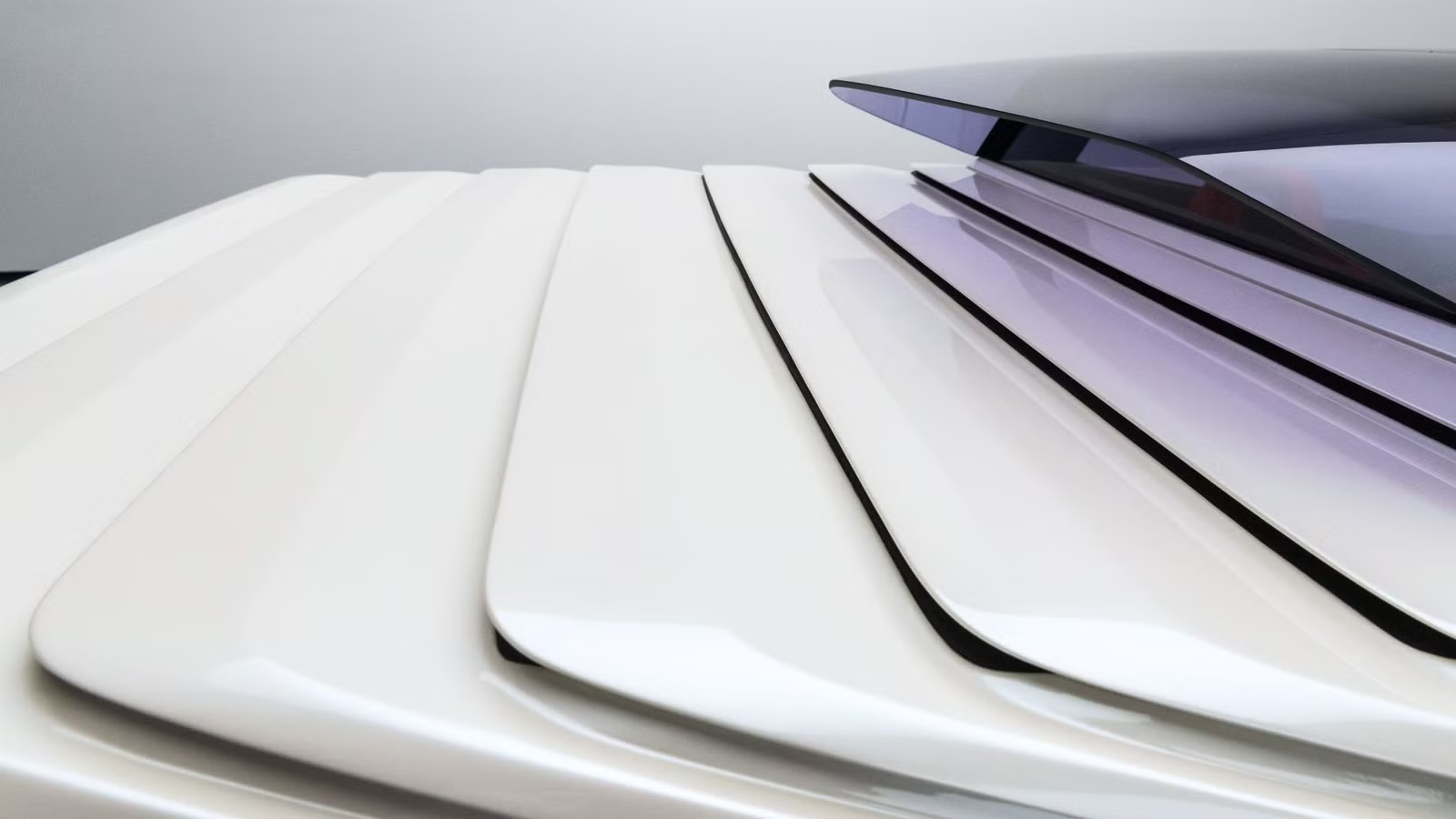
Some of the elements of the HP-X were never going to make it to production. There are no doors, for example. Instead, the car gets a jet-fighter-style removable single-piece Perspex canopy that allows access for the driver. But at the back of this canopy was a driver-controlled air brake — not that dissimilar to the air brakes we see on hypercars today. The use of alternative materials including honeycomb panels, carbon fiber and Kevlar to reduce weight and improve performance was also a very new concept in the ’80s. Then there was the ultra futuristic tech.
The HP-X featured an “Electronic Drive Support System” which previewed advanced features including GPS, real-time telemetry, and even road condition warnings via “special sonar.” These are systems we take for granted now. There was also advanced aerodynamics including “ground effects” and innovative cooling solutions for its mid-mounted engine. The HP-X was a showstopper and provided the perfect foundations for Honda to forge ahead with the NSX.
How The HP-X Influenced The NSX

Even though it arrived five years earlier, the influence of the HP-X on the NSX can be clearly seen. Honda officially says: “Designed and developed in Japan, the first-generation NSX embodied many of the ideas and innovations first explored in the HP-X, firmly cementing the concept’s place in automotive history.” Firstly, there was the compact V6 in both cars. Early prototypes did test the idea of a 2.0-liter C20A V6 engine, but in the end Honda chose a larger, more powerful 3.0-liter VTEC V6. But the principle was the same: make the car light (around 3,000 pounds) and you don’t need more than six cylinders.
The simple, functional cockpit is carried over in concept, too, and while the NSX didn’t have a huge Perspex canopy, it very much borrowed the idea. The production NSX is famed for the canopy-shaped greenhouse that provides excellent rear and rear three-quarter visibility. These are the kinds of elements that helped it become the first true daily driver supercar.
Here’s What Happened To The HP-X

After the NSX took the world by storm, it seems that a lot of people had forgotten about its grandfather, the HP-X. The car disappeared from the spotlight, but in 2024, Honda decided to celebrate its first concept car in dramatic fashion. The car was sent to the Pininfarina workshop in Italy for an extensive restoration, readying it to star in the Wedge-Shaped Concept Cars and Prototypes Class at the 73rd Annual Pebble Beach Concours d’Elegance in August 2024. The HP-X was the first Japanese vehicle entry at the Pebble Beach Concours in over 50 years.
The HP-X Then Went On To Be Shown In LA
Following its entry to Pebble Beach, the HP-X then ended up going on show in a California museum. The HP-X took pride of place in the lobby of the iconic Petersen Museum in Los Angeles. The NSX, meanwhile, went on to become two generations, with a follow-up to the original arriving in 2016, although it never quite got the fame it deserved. Whether or not Honda will create another NSX remains to be seen, but definitely keep an eye on the company’s concepts at upcoming motor shows for clues.
Source: Honda

Related posts



Latest Post


No Comments