
Chrysler’s 426 Street Hemi Was Race Hardware Sold By Accident
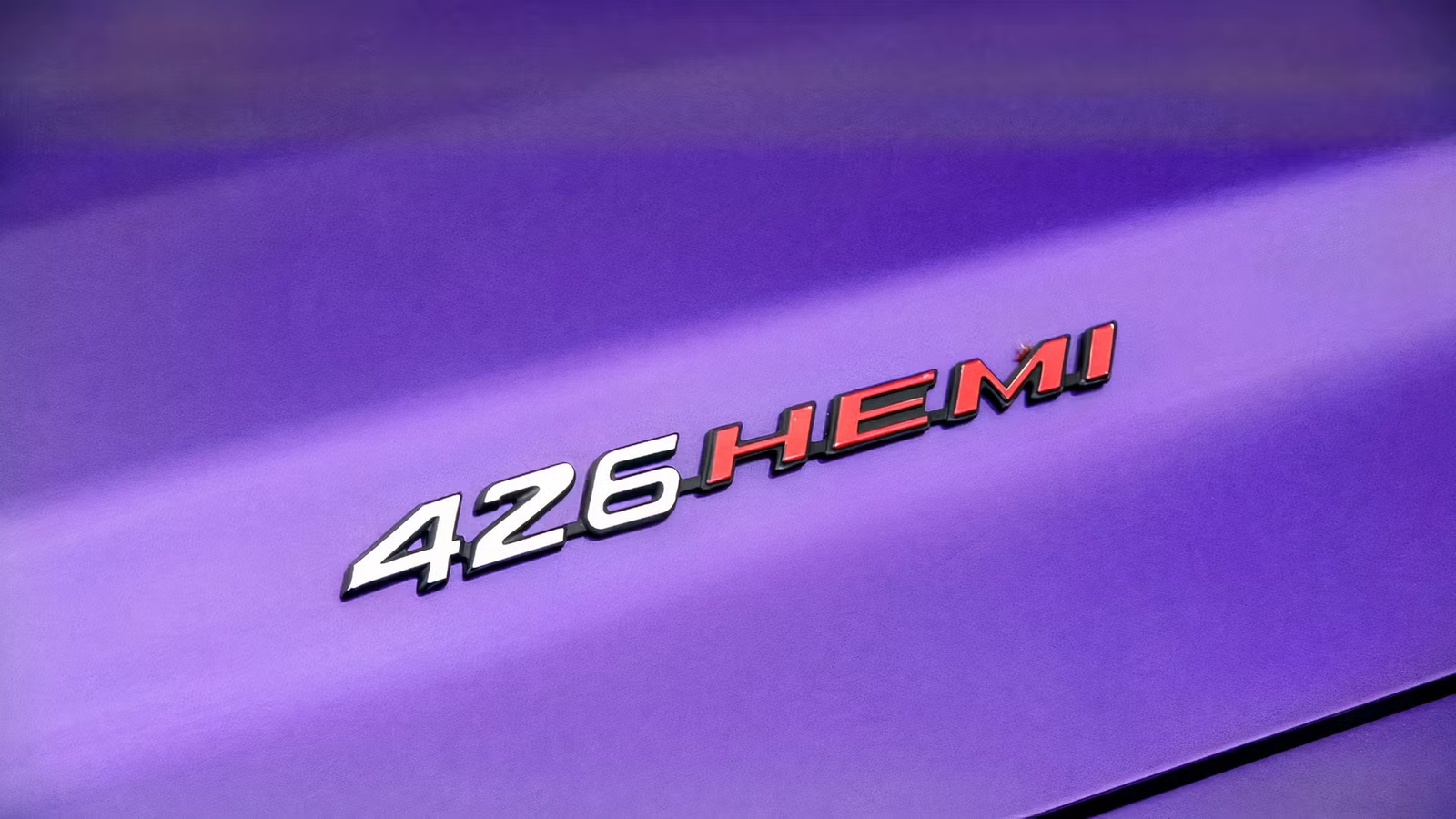
Some of America’s greatest performance engines started with a showroom brief. The legendary Hemi, however, happened because a rulebook left engineers with nowhere else to go.

The engine was engineered for racing first, then adapted for people who needed license plates. That unusual path gave American muscle car history one of its defining V8s, along with a reputation that still makes Mopar collectors reach for their wallets.
Daytona Made The 426 Hemi An Overnight Problem
The Chrysler 426 Hemi story really begins in competition. Chrysler’s engineers were working within NASCAR’s 7.0-liter displacement ceiling when they developed a 426 racing V8 around the company’s hemispherical combustion-chamber philosophy. The goal wasn’t smooth commuting or friendly cold starts. Instead, Chrysler wanted an engine capable of living at high rpm while hammering around superspeedways for hours.

What they came up with had all the subtlety of a bar fight at the 1964 Daytona 500. Richard Petty won the race in a Hemi-powered Plymouth, while Chrysler-powered cars swept the first three finishing positions. For an engine making its major NASCAR debut, that was about as convincing an introduction as Detroit could’ve asked for.
How Hemi Combustion Chambers Rewrote NASCAR’s Rulebook

Much of the 426 Race Hemi’s advantage came from its ability to breathe at high engine speeds. Its cylinder-head layout used opposed valves in hemispherical combustion chambers, helping airflow through the engine, while the bottom end was strengthened for the kind of sustained punishment NASCAR racing demanded. Chrysler had essentially created a big-block V8 that was happiest when treated miserably.
That Daytona performance instantly turned the 426 Hemi engine into a problem for Chrysler’s rivals. It also attracted the attention of NASCAR officials. A competition engine that effective was never going to exist in a regulatory vacuum for long, and the rules were about to become as important to the Hemi story as the engineering.
NASCAR Forced Chrysler To Put Its Race Engine On The Street

For the 1965 season, NASCAR tightened its position on engines that weren’t available as regular production equipment. That left Chrysler’s specialized Race Hemi on the wrong side of the rulebook. Rather than compete in NASCAR’s Grand National series without its strongest weapon, Chrysler withdrew its factory effort and focused more of its racing attention elsewhere.
That decision is often simplified into Chrysler boycotting NASCAR until officials gave in. The full story, though, is a touch more tasty. NASCAR’s homologation requirements were the biggest catalyst behind the eventual 426 Street Hemi, but Chrysler also had NHRA competition to consider, while the market for high-performance American cars was becoming impossible to ignore.
One Engine That Solved Chrysler’s Problems at Once

Pontiac, Ford, Chevrolet, Dodge, and Plymouth were fighting for the same performance-minded buyers across the USA. Naturally, then, a production version of Chrysler’s race-winning Hemi could therefore solve more than one problem. It could strengthen Chrysler’s position in sanctioned racing while giving Dodge and Plymouth dealers one of the most intimidating engines available in an American muscle car.
Work on the A102 Street Hemi program began in 1965 for the 1966 model year. Chrysler’s engineers now faced an unusual assignment: make a racing engine civilized enough for public roads without removing the characteristics that had made it so formidable. By 1966, Hemi-powered Dodge and Plymouth B-body models could be ordered from dealerships, and Chrysler was back at Daytona. Richard Petty won the Daytona 500 again that year.
The Street Hemi Barely Learned Any Street Manners

The 1966 Chrysler 426 Street Hemi was anything but a regular passenger car V8 wearing racing-inspired badges. It retained a remarkably close relationship with the competition engine. Its bore and stroke measured 4.25 by 3.75 inches, giving the famous 426ci displacement, while the basic block and cylinder-head architecture stayed closely tied to the Race Hemi.
Chrysler did make concessions to real-world driving. Compression fell from the Race Hemi’s 12.5:1 to 10.25:1, helping the Street Hemi tolerate the high-octane gasoline available at American service stations. The race engine’s induction arrangement also gave way to an aluminum dual-plane intake carrying two Carter AFB four-barrel carburetors.
Street-friendly hardware included a heat-riser system for improved cold-weather operation and cast exhaust manifolds that were easier to package in regular Dodge and Plymouth models. Even with those changes, the 426 Street Hemi was hardly turning into a grocery-getter engine. Two four-barrel carburetors sitting on top of 426 cubic inches still sent a fairly clear message.
Chrysler officially rated the Street Hemi at 425 gross horsepower at 5,000 rpm. That figure has become one of the most famous numbers in classic muscle car history, partly because the engine could make more power if allowed to rev beyond Chrysler’s quoted peak. Its physically huge cylinder heads and valve covers also helped earn the 426 Hemi its enduring ‘Elephant Motor’ nickname. There was no place for subtlety under the hood here.
425 Horsepower Came With Some Very Expensive Fine Print

Don’t think of buying a Chrysler 426 Street Hemi as a casual upgrade. The engine package cost roughly $900 during an era when that represented a substantial percentage of a new car’s total price. A buyer walking into a Dodge or Plymouth dealership had to really want Hemi power, because checking that option box could transform the economics of the entire purchase.
At least Chrysler wasn’t charging all that money for an engine alone. Hemi-equipped cars received heavy-duty drivetrain hardware suited to the V8’s output, including appropriately strong manual or automatic transmissions and upgraded rear-axle equipment. In that sense, it was closer to ordering a factory performance system.
All Part Of The Deal

The mechanical upkeep also reflected the Hemi’s racing roots. Early Street Hemi engines used solid lifters, which meant valve-train adjustment was part of ownership. High valve-spring pressures could accelerate camshaft wear, and anyone expecting the maintenance schedule of a basic American V8 was going to receive an education rapidly. Hydraulic lifters didn’t arrive until 1970.
That’s part of what makes living with a genuine 426 Street Hemi so different from owning a modern performance car. Today’s high-horsepower engines can idle smoothly, start instantly, and largely disappear into everyday life. A classic Hemi asks its owner to understand carbs, mechanical adjustment, and old-school tuning. The maintenance is part of the relationship, whether the owner likes it or not.
A $900 Option Became Muscle Car Royalty

That roughly $900 Hemi option looks very different with more than half a century of hindsight. The cost discouraged plenty of new car buyers, helping make genuine factory Hemi cars relatively scarce. The Street Hemi was offered from 1966 through 1971, a short window that now carries enormous weight in the classic Mopar collector market.
The Chrysler 426 Hemi sits at the center of American muscle car history because its reputation came from real competition. Its family tree runs directly back to NASCAR, Daytona, and Chrysler’s determination to build something capable of winning at the highest levels of American stock car racing.
The Golden Age

That lineage explains why Hemi-powered Dodge and Plymouth Muscle Cars occupy such rarefied territory among collectors in America today. Buyers aren’t simply paying for 425 gross horsepower. They’re buying one of the clearest links between NASCAR race engineering and the cars ordinary Americans could order from a dealership during the golden age of Detroit performance.
Owning the real thing today still means accepting the quirks that came with that bargain. Twin carbs need knowledgeable tuning, vintage valve-train hardware expects attention, and old-school performance machinery rewards owners who understand how it works. That involvement, though, is part of the appeal. The 426 Street Hemi was never engineered to feel anonymous.
Sources: On All Cylinders, Mac’s Motor City Garage.

Related posts





Latest Post


No Comments