
The Manual Transmission Isn’t Dead Yet, These Are The Automakers Fighting Hardest To Keep The Stick Alive In 2026
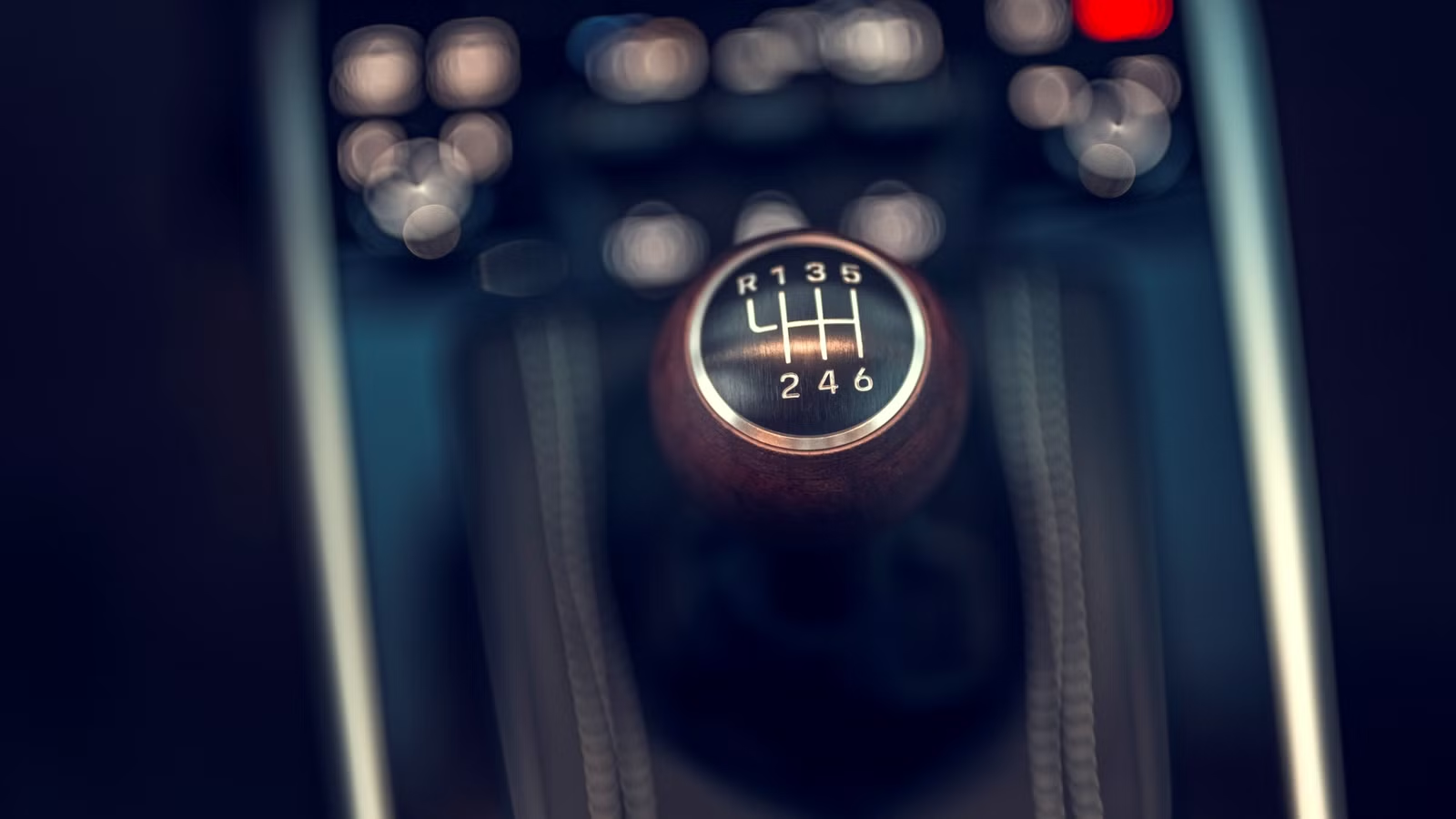
Two announcements this week made it clear the manual transmission still has a pulse. Porsche confirmed an MT Package for the 911 Carrera S — bringing back the six-speed manual after dropping it from that trim at the end of the 2025 model year — and McLaren revealed its McL 6GT supercar will be offered with a manual, the first McLaren production car to feature one since the F1 of the early 1990s. Together, they signal something the numbers alone wouldn’t suggest: enthusiast demand is loud enough to move manufacturers.

Those two headlines are the most dramatic, but they’re part of a broader pattern. A small group of automakers — Porsche, McLaren, Subaru, Toyota, Ford, and BMW — are actively committing to the stick shift in 2026 and beyond, even as Volkswagen, GM, and others quietly phase it out. Here’s where each brand stands.
Porsche and McLaren Make the Biggest Statements
The Porsche 911 Carrera S with MT Package, announced in August 2026, costs over $167,000 — roughly $20,000 more than the PDK-equipped Carrera S. That’s a steep premium, but the alternative for buyers who wanted a manual 911 was either stepping down to the less powerful Carrera T or spending considerably more on a GT3. The MT Package fills that gap, and its existence confirms that Porsche is paying attention to what its customers are actually asking for.

McLaren’s move is arguably even more striking. The McL 6GT is designed as a celebration of old-school supercars, and offering a manual transmission is central to that brief. It ends a roughly three-decade stretch without a manual in any McLaren production car. Whether you view it as nostalgia or genuine product philosophy, it’s a meaningful commitment from a brand that could easily have leaned on its existing dual-clutch setup.
Subaru Goes All-In With the TY85 Gearbox

In June 2026, Subaru announced a trio of new manual-equipped vehicles, headlined by a resurrected TY85 gearbox for the WRX — the same heavier-duty unit that once underpinned the Impreza WRX STi. For a brand that spent much of the past decade leaning into CVT-equipped SUVs, the move is a deliberate pivot back toward driving enthusiasts. One of the three announced models is believed to be an all-new vehicle based on the WRX platform, though Subaru hasn’t confirmed specifics.
The TY85’s return matters beyond the spec sheet. It signals that Subaru sees its performance identity as something worth protecting, not just a legacy footnote.
Toyota and Ford Are Holding the Line

Toyota’s commitment runs across its entire GR lineup. The GR Corolla, GR Yaris, and GR86 all continue with manual transmissions, and the brand’s track record suggests that won’t change anytime soon. The GR Supra may be winding down, but Toyota has an all-new MR2 in development — and given the audience that car is intended for, a manual option seems likely.
Ford’s position is equally firm. Mustang global chief engineer Laurie Transou told Australian outlet The Drive that the Blue Oval is committed to the manual for as long as customers want it. “The pure enthusiast loves the manual transmission,” Transou said, “so [we] continue to offer it. As long as our customers are desiring manual transmission and there’s a market for it, we will continue to offer manual transmission.” That’s not a hedge — it’s a direct pledge.
BMW Remains One of the Last European Holdouts

BMW’s M2, M3, and M4 all offer a manual gearbox, making the M division one of the few European performance lineups where the stick shift is still a genuine option rather than a niche special edition. Given how central driving engagement is to the M brand’s identity, BMW is expected to be among the very last manufacturers to move away from it. There are also reports of additional M2 variants in development, with speculation around a potential M2 CSL that could offer a manual as a final send-off for the current generation.
The Brands Walking Away

Not every manufacturer is fighting this fight. Volkswagen dropped the manual from the Golf R in 2024, and the Jetta GLI is set to follow at the end of 2026. Honda is axing manual versions of the Civic Si and Acura Integra A-Spec after 2026, though the range-topping Civic Type R and Integra Type S will keep their sticks for now. GM has removed the manual option from its Cadillac Blackwing models entirely, a decision that stings given how much of the Blackwing’s enthusiast reputation was built around that gearbox.
The contrast is stark. On one side, brands actively investing in manual development. On the other, brands treating it as a line item to eliminate.
The manual transmission’s survival in 2026 isn’t an accident — it’s the result of a specific group of buyers making enough noise that manufacturers decided the cost of keeping it was worth it. Porsche, McLaren, Subaru, Toyota, Ford, and BMW have all done the math and landed on the same answer. Whether GM and Volkswagen eventually reconsider probably depends on whether that answer keeps proving right.

Related posts




Latest Post


No Comments