The Luxury Sedan That Quietly Holds Its Value Best
7 minutes reading
Monday, 24 Aug 2026 17:00 0 57 autotech
It’s becoming more and more clear that cars are getting far more complex, whether that be a reliance on electrification or endless interior features. As important as it is to innovate, some manufacturers are so keen to showcase their latest gadget-focused wizardry, despite the fact that the long-term durability of these features is questionable.
Yet, within this segment, there is one manufacturer that is able to create a luxury vehicle that is serene, comfortable, and well-equipped while still viewing reliability as its number one priority. Let’s discover what that car is and why the rest of the luxury-focused brands are struggling to give consumers confidence in their reliability.
3/4 shot of 2021 Land Rover Range Rover P360 in blue driving on roadLand Rover
Luxury flagship models usually act as the testing ground for bleeding-edge tech, often introducing hugely advanced driver assistance systems, augmented reality, and several screens. The issue is that each of these systems requires extra wiring and sensors, meaning there is simply more to go wrong with them. On top of that, add in that a lot of this technology is newly introduced, and you have a situation where it is common to have glitches, bugs and system failures.
This isn’t as much of an issue for the first owner within the warranty period, despite trips to the garage being irritating after having spent top dollar on an expensive cocoon of a car. It really becomes an issue for the second or third owners who have to spend thousands of dollars on bespoke parts – some of which standard garages may not be able to service.
The Worst Offenders For Poor Resale Value Named
Front 3/4 action shot of 2024 Maserati Ghibli in silver driving on roadMaserati
The vehicles with the most severe depreciation are those that usually start out at a premium cost and then falter under serious reliability concerns. Vehicles like the Mercedes-Benz EQS feature an enormous initial cost and a whole suite of innovative technology, paired with consumer anxiety focused around the electric powertrain.
Luxury Manufacturers That Depreciate The Most
Maserati: 67% three-year loss
Alfa Romeo: 60.1% three-year loss
Tesla: 56.1% three-year loss
Land Rover: 50.0% three-year loss
Jaguar: 47.9% three-year loss
These losses are so severe that most financial advisors now warn against luxury sedans as depreciating assets — with one notable exception that somehow defies every rule on this list.
The Lexus IS300: The Outlier That Bucks The Trend
Front action shot of 2025 Lexus IS 300 in silver driving on roadLexus
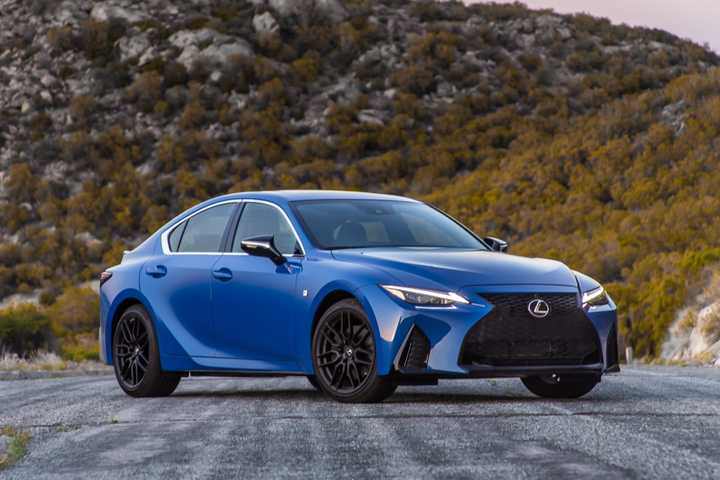
The industry baseline for three-year depreciation is 40 percent, yet Lexus brings this down to an average of 26.2 percent. One of the most significant examples of a Lexus which excels at retaining value is the Lexus IS300. After five years and 60,000 miles, the IS300 retains, on average, 66.9 percent of its original value – an astonishing contrast to many of the cars in its segment.
It’s not a mystery, though, as to why this is: Lexus has forged an identity of enormous longevity over the past 40 years, which still holds today. Having access to Toyota’s parts and manufacturing processes means Lexus uses some of the most widely available parts in the industry, making repair bills far cheaper than on other luxury vehicles. Moreover, it is Toyota’s thorough durability processes that give the IS300 some serious long-term prospects.
Why The IS300 Scores 91/100 For Reliability When Rivals Struggle To Break 75
2001 Lexus IS 300, front 3/4Lexus
The 2025 Lexus IS300 scores an incredible 91/100 onJ.D. Power’s quality and reliability survey, making it one of the top-performing cars in the industry.Having consecutively topped the last fourJ.D. Power reliability studies, the brand has an exceptional reputation. In 2026, Lexus posted a score of 151 PP100 (problems per 100 vehicles), which is far less problematic than the industry average of 204 PP100.
What Makes The Lexus IS300 So Reliable?
Lexus cars undergo testing by Takumi, with engine and electrical tolerances much more stringent than the industry standard
Lexus updates powertrains and features incrementally, meaning nothing enters the IS300 which hasn’t had long-term testing
Lexus and Toyota components are designed to withstand more extreme mileage and heat from the get-go
A $42,000 Luxury Sedan That Drives Better Than Cars Costing $7,000 More
The 2025 Lexus IS300 isn’t going to appeal to those who view luxury through the lens of curved screens, gadgets to show friends, and complex powertrains. Instead, it appeals to the more traditional and refined flavor of luxury – one that is actually becoming less common in the industry. The IS300 delivers fantastic isolation, sound deadening, and comfort. The cabin features plush materials and attention to detail, with precise leather stitching and even buttons offering a satisfying click or mechanical movement. It’s a very refined, mature and cocooned place to sit with little unnecessary distraction.
The Lexus IS300 is also cheaper than most of its direct competition. Starting at around $42,000, the IS300 is $5,000 cheaper than the BMW 330i and $7,000 cheaper than the Mercedes C300–it’s even cheaper than the Genesis G70.
Performance And Powertrain
2025 Lexus IS 300, front 3/4Lexus
The 2.0-liter inline-four engine produces 241 horsepower, 258 pound-feet of torque, and hits peak torque incredibly early, at 1,650 rpm, making it feel responsive around town. However, this engine does suffer from turbo lag, and paired with an eight-speed transmission that is hesitant and hunts for gears, it occasionally detracts from the luxury feel of the IS300. In return, though, this engine yields better fuel economy by a small but noticeable margin of three MPG and shaves 130 pounds off the V6 model thanks to a lighter engine and rear-wheel drive, making it more responsive and giving it sharper turn-in.
The 2025 IS300 AWD is powered by the 3.5-liter naturally aspirated V6 — a legendary engine that is the heart of the IS300’s reliability. The 2GR under the hood makes 260 horsepower and 236 pound-feet of torque, and it’s not boring by any means, however. With a smooth and instantaneous power delivery, the sensation of revving out the V6 is deeply satisfying compared to the inconsistency of a turbo four-cylinder. The six-speed transmission is less advanced than the eight-speed but is more certain in its selection and matches the traditional character of the V6 beautifully.
Is The IS300 Worth Having Over Its German Rivals?
2025 BMW 330i Sedan front 3/4 action shotBMW
Ultimately, the Lexus IS300 targets a completely different consumer than the BMW 330i and Mercedes C-Class. The German rivals focus more on appealing to consumers who prioritize serious performance and want the technological edge of larger screens, more features, and even sharper handling. It’s a more youthful approach, and one that does yield excellent results. But for those who care more about comfort, isolation, and stress-free motoring, the IS300 is almost impossible to beat.
With its $5,000+ lower price and much better resale value than its German rivals, if you were to buy these cars during their warranty period and then sell them, the IS300 would save you over $10,000 from initial purchase to sale. It’s clear which consumers Lexus appeals to versus BMW and Mercedes, but if you’re a consumer wanting a competent mid-size luxury car that is simply the best value, the answer is the Lexus IS300.
Base Trim Engine
2L I-4 ICE
Base Trim Transmission
8-speed automatic
Base Trim Drivetrain
Rear-Wheel Drive
Base Trim Horsepower
241 HP @5200 RPM
Base Trim Torque
258 lb.-ft. @ 1650 RPM
Base Trim Fuel Economy (city/highway/combined)
21/31/25 MPG
Base Trim Battery Type
Lead acid battery
Make
Lexus
Model
IS
Sources: The EPA, J.D. Power, Lexus, BMW, iSeeCars














No Comments