
The Luxury Plug-In Hybrid SUV That Almost Covers The Average Daily Commute On Electrons Alone
Plug-in hybrid electric vehicles (PHEVs) are often cited as the best of both worlds, but sometimes, when not used properly, they can be the worst of both worlds. The latter becomes the case if a PHEV isn’t regularly charged as intended. By then, you’re simply hauling a large battery pack as a dead weight.

Use it properly, though, and a PHEV pretty much becomes two cars in one. It becomes an EV for your daily drives, while for longer drives, it becomes an efficient hybrid. As technology has progressed, there are now PHEVs out there with pure electric ranges that can meet the needs of an average American driver.
By plugging a PHEV every night, you’re not just cruising in pure silence, but you’re also saving on fuel expenses. Remember, home charging is significantly cheaper than filling up. And if you’re in the market for a luxury PHEV SUV that can fulfill such a duty, here’s the model that’s perfect for your needs.

Using PHEVs As Intended

But before we talk about this compelling PHEV luxury SUV with a commendable real-world pure electric range, let us explain why PHEVs are great when used as intended.
Americans On Average Drive Less Than 40 Miles Daily

Not everyone needs a long-range vehicle, especially since, as Consumer Reports has determined, the average American drives less than 40 miles a day. If you’re part of the norm that doesn’t drive a thousand miles per day, then a PHEV may work for you if you want sufficient pure electric range but with the commonality of gas stations when going on extended trips. Do note, however, that due to the larger battery packs of plug-in hybrids, they often come with a few packaging constraints. Depending on the model, you may lose a bit of cargo capacity, or even the option for third-row seating on certain SUVs.
You’ll Benefit From Lower Running Costs

Once you do so, Qmerit has determined that when using home charging, the running cost is just $0.18/kWh, or $0.05 per mile. Since most luxury PHEV SUVs, including the model in today’s article, don’t usually have DC fast charging capabilities, we’ll only focus on home and Level 2 AC charging costs. Even when using a Level 2 AC charger, the average cost is just slightly more at $0.25/kWh. Take full advantage of a PHEV’s battery, and you’ll probably leave the gas tank untouched for months on end, thus saving you on gasoline costs.
|
Fuel type |
Energy used / year |
Unit price |
Annual fuel cost |
Savings vs gasoline |
|---|---|---|---|---|
|
Gasoline |
Qro540 gallons |
$3.99 / gal |
~$2,154 |
— |
|
Diesel |
~450 gallons |
$5.13 / gal |
~$2,308 |
−$154 |
|
AC Level 2 Charging |
~3,854 kWh |
$0.25 / kWh |
~$964 |
+$1,190 |
|
DC Fast Charging |
~3,854 kWh |
$0.53 / kWh |
~$2,043 |
+$111 |
5 PHEVs That Are Worth Every Penny (And 5 Fair Alternatives)
PHEVs have expanded to be offered in several models. Here are ten PHEVs to consider, five that are worth the price, and five great alternatives.
BMW X5 xDrive50e – The Luxury PHEV SUV That Exceeds Expectations

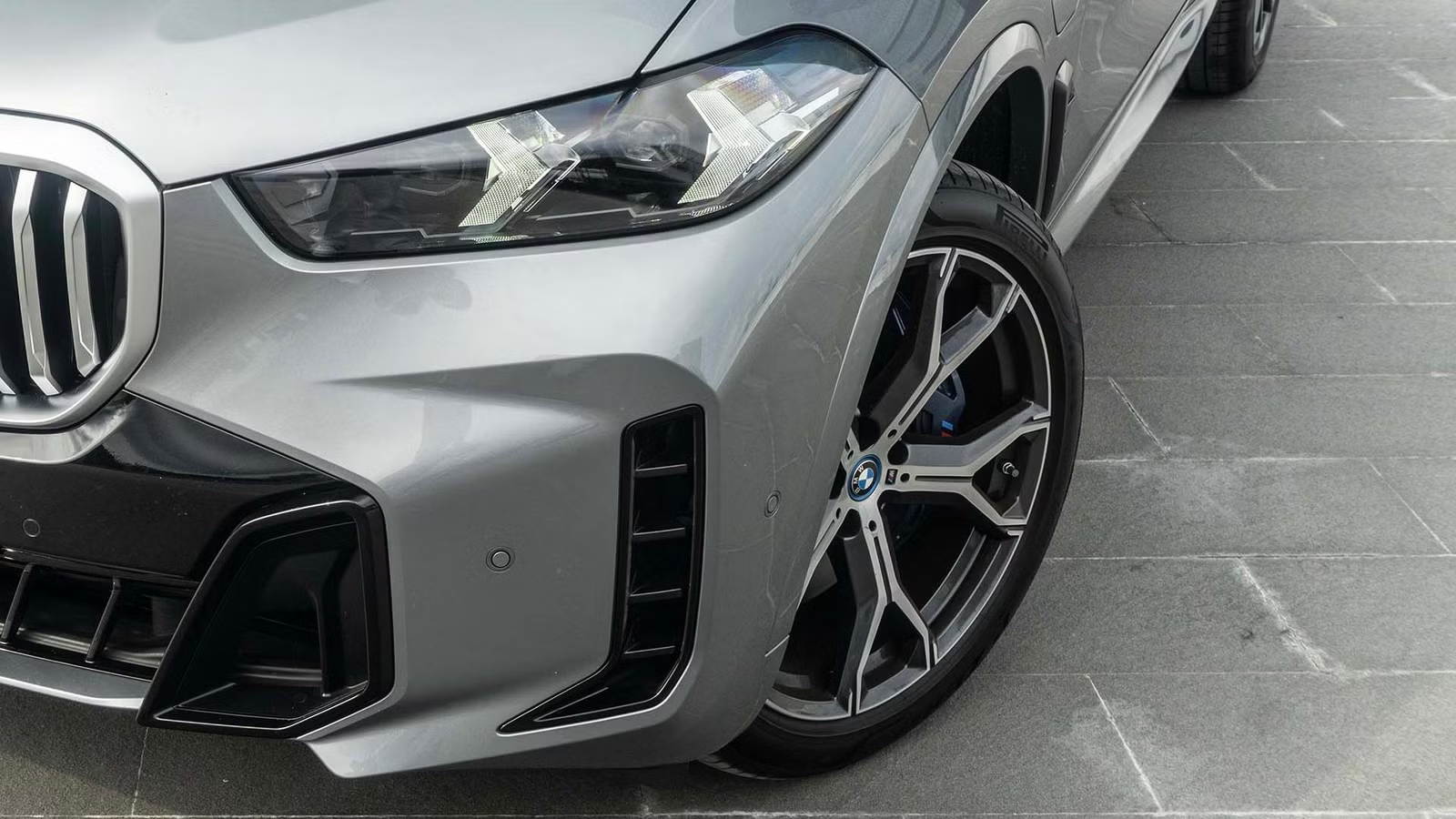
And without further ado, it’s time for us to reveal the luxury PHEV SUV that offers meaningful pure electric range. Say hello to the 2026 BMW X5 xDrive50e, one of the outright best PHEV SUVs you can buy today, thanks to its sheer performance capabilities, excellent real-world pure electric range, and practicality.
Going Beyond The EPA-Rated EV Range

To say that the 2026 BMW X5 xDrive50e is an overachiever is an understatement, in my opinion. Let’s start with the main subject of this article–its pure electric range. The EPA estimates that the X5 xDrive50e can do 38 miles on a full charge. BMWBlog, however, managed to get 45 miles — 7 miles better than the official ratings. Usually, it’s the other way around, considering how conservative the driving scenarios are during testing procedures, so for the BMW to achieve an even better real-world result is impressive.
Thank the X5 xDrive50e’s large 25.7 kWh lithium-ion battery, which, for 2026, now has the capability to accept up to 11 kW of AC charging. Still no DC fast charging here for the X5, but if I were being honest, most PHEVs don’t need that rapid charging capability anyway. If you’re still wary of going the pure electric route with models like the iX3 or the soon-to-be-discontinued iX, then the X5 xDrive50e can comfortably let you explore your limits in pure electric driving.
Yes, It’s That Efficient In Our Hands, Too

From our driving experience, the X5 xDrive50e exceeds efficiency expectations. It achieved 47.1 miles of pure electric range, which exceeds the EPA rating by 38 percent. Even when the battery is at a low state of charge after you’ve used up its pure-electric range, our team member achieved a 27 MPG figure with the X5 in hybrid mode. This likewise exceeds the EPA’s 22 MPG efficiency rating.
I’ve also been able to review this car for a week, and I was impressed by its pure-electric range. When fully charged, the X5 xDrive50e regularly achieves 80–90 kilometers, or 49–56 miles. Perhaps a contributing factor is that our highway speed limit is capped at 100 km/h (62 mph). Either way, in my use case, the BMW X5 xDrive50e easily becomes a silent EV for most of my drives, while it becomes an efficient hybrid during long drives. Meanwhile, at 13.4 km/l (31 MPG) in my hands, its fuel consumption is slightly lower than the X5 xDrive40d diesel that our market gets. However, with 483 horsepower, the X5 xDrive50e will run rings around the diesel version. Clearly, the X5 is an overachiever in terms of efficiency.
10 PHEVs That Depreciate The Most After 5 Years Of Ownership
From SUVs to sedans, these plug-in hybrids struggle to retain their value after being driven off the lot.
Still A BMW In Thrills

This now leads me to discuss the X5 xDrive50e’s driving dynamics, because while its pure electric range is commendable, you’ll have to applaud BMW for still making the X5 xDrive50e one of the best to drive in its segment.
All Hail The B58

Everyone loves the B58, Everyone loves the B58. I’ve driven numerous BMWs with this engine, from the GR Supra to the M340i and now the X5 xDrive50e. Even with electrification, this engine is a jack of all trades. It’s smooth and delicate when driven sensibly. There’s a distinct inline-six growl when you push it during overtakes, but what’s amazing is how the engine, ZF eight-speed automatic, and gearbox-mounted electric motor all synchronize to deliver smooth and responsive power.
And this is quite a performer. As mentioned, this X5 produces 483 horsepower and 516 pound-feet of torque, and that’s good enough for a zero to 60 mph time of just 4.6 seconds. That’s more than half a second quicker than the mild hybrid xDrive40i. I’ve also reviewed the Porsche Cayenne E-Hybrid, and having driven that car, I found myself preferring the X5. Sure, the Cayenne’s extensive electromechanical systems give it a handling advantage, but the X5 xDrive50e’s PHEV drivetrain is that much smoother and more seamless, and its inline-six produces a nicer engine note.
It Handles Amazingly, Too

As mentioned, yes, the Porsche Cayenne E-Hybrid will have the handling advantage, particularly when fitted with the Porsche Dynamic Chassis Control (PDCC) anti-roll stabilization, but it’s not like the X5 has sloppy handling in the first place. The X5 I drove came with the adaptive air suspension, which did an amazing job in terms of both ride and handling. Beginning with the handling part, the air suspension is so good at mitigating body. The chassis flows beautifully through corners, and the steering is direct and responsive. More steering feedback would be welcome, but at least it doesn’t feel completely numb.
|
X5 xDrive50e |
|
|
Engine |
3.0-liter turbo straight-six plug-in hybrid |
|
Drivetrain |
AWD |
|
Horsepower |
483 hp |
|
Torque |
516 lb-ft |
|
0-60 MPH |
4.6 sec. |
|
Top Speed |
130 mph |
|
Transmission |
8-speed A/T |
|
Battery Size |
25.7 kWh |
|
EPA Energy Efficiency |
58 MPGe |
|
EPA Electric Range |
39 miles |
|
EPA Combined MPG |
22 MPG |
|
Max Towing Capacity |
7,200 lbs |
|
Base MSRP |
$76,000 |
The air suspension doesn’t just make it handle like a dream, but it also makes the ride very compliant. Granted, as far as air suspensions go, the one in the X5 has a degree of firmness that is otherwise absent in a Mercedes GLE or Audi Q7, but it isn’t harsh by any means, and that is all in line with BMW’s preferred ride and handling tuning.
Sources: BMW, EPA, Qmerit

Related posts




Latest Post


No Comments