The American Hybrid SUV That Quietly Leads On Efficiency
12 minutes reading
Sunday, 5 Jul 2026 13:00 0 79 autotech
For nearly a hundred years, the SUV was a specialized vehicle meant to haul gear and tackle rough terrain, intended for buyers who needed the capability of a pickup truck but also needed a sheltered cabin for more passengers. Today, that formula has been completely overhauled, and the once-niche SUV now inhabits nearly every corner of the American marketplace. The family and retirement midsize sedans have mostly disappeared, replaced by compact crossovers that offer practical space and year-round dependability.
It didn’t just happen overnight, but it did happen rapidly over the past quarter-century, with the introduction of the more manageable compact size and the adoption of unibody construction. Still, SUVs retained their primary trait—fuel consumption. But that too changed with the development of hybrid powertrains around the same time, and their adoption as the powertrain of choice for improved efficiency (and sometimes power)—and it all started with this American SUV.
Three-fourths photo of 1985 Jeep Cherokee parked in a grass lotBring-A-Trailer
The modern SUV traces its roots back to the early days of the auto industry, with trucks that were meant to work and perhaps explore, but lacked the ability to carry more than two or three people in the cab (though we’ve all seen images of truck beds laden with dozens of workers). For the next seven or so decades, truck-derived SUVs emphasized durability, towing capability, and off-road prowess. Comfort and refinement were desirable, but they were things you compromised on when you bought a Cherokee, Blazer, or Bronco—rugged names for rugged vehicles.
By the 1980s and 1990s, families began discovering SUVs not as niche vehicles to drive to the back 40 acres or off into the mountains, but as suburban cruisers that offered different advantages than the family station wagon. Chief among those was four-wheel drive, which provided more assured year-round driving in northern regions. The elevated driving position inspired confidence in dense traffic, and conveyed driving superiority in southern regions. If only you could combine the two …
How SUVs Were Optimized For Urban And Suburban Use
2001 Toyota RAV4 front 3/4 shotToyota
With the fuel crisis and stricter tailpipe emissions of the 1970s, manufacturers started looking at smaller sport-utility and crossover vehicles as a compromise between rugged practicality and user-friendliness. Vehicles from Lada and Suzuki reduced the size of the ladder-frame platform for urban use, while others from AMC and Fiat elevated the car chassis for more practical year-round dependability. But it wasn’t until the turn of the century that size and user-friendliness really took off, with the addition of efficiency to the mix.
All three traits took a huge step forward with the advent of unibody SUV construction and powertrain electrification, both happening simultaneously but separately in the late 1990s, with vehicles from Honda and Toyota. The Toyota RAV4 and Honda CR-V started the compact SUV ball rolling in North America in 1996 and 1997, respectively, while the Honda Insight and Toyota Prius hit the road with hybrid powertrains in 1999 and 2000, respectively. However, it wasn’t until 2004 that the hybrid compact SUV would be launched.
How The Compact Hybrid SUV Became American Families’ Darling
A blue 2017 Toyota RAV4 Hybrid small hybrid SUV is parked.Toyota
The formula proved remarkably favorable for increased sales, with drivers especially loving the improved maneuverability and enhanced efficiency that came from a smaller, lighter vehicle that didn’t give up on the space and versatility that goes into a family vehicle you count on to get you where you need to go every day. By the time the 2020s rolled around, compact SUVs had pretty much taken over suburban driveways, and the increasing ranks of hybrid powertrains meant that long trips didn’t eat into the monthly budget significantly.
Today, compact and midsize SUVs and crossovers consistently rank among America’s best-selling vehicles, across many classes, and the chasm between basic transportation and top-tier luxury has narrowed considerably. The playing field is contested on many levels, from interior volumes to towing capability, with efficiency being one of the most important measures in today’s economic reality. One home-grown compact SUV stands above the rest in that respect and nearly tops the segment pioneers.
The Compact SUV That Quietly Became A Budget Superstar
GM’s underrated subcompact crossover is a silent winner in 2026.
The 2026 Ford Escape Hybrid Is The Most Efficient American Hybrid SUV
Base Trim Engine
2.5L Inline-4 Hybrid
Base Trim Transmission
Continuously Variable Automatic (CVT)
Base Trim Drivetrain
Front-Wheel Drive
Base Trim Horsepower
192 hp
Base Trim Torque
155 lb-ft @ 4500 rpm
Fuel Economy
27/34 MPG
Make
Ford
Model
Escape Hybrid
Segment
Compact SUV
Infotainment & Features
9 /10
EPA-Rated 39 MPG Topped Only By Lexus And Toyota Hybrids
The 2026 Ford Escape Hybrid is the latest descendant of the compact SUV that got the hybrid SUV ball rolling. Toyota helped start both parts of that combination, and today the Japanese giant dominates discussions about hybrids, but the Ford offers the most efficient hybrid SUV sold by an American brand and doesn’t make a big deal about it—rated at 39 mpg combined, it is a runner-up only to the Lexus UX 300h AWD and the Toyota Corolla Cross and RAV4 AWD (all rated at 42 mpg combined).
2026 Ford Escape towingFord
It shouldn’t come as a surprise that the Escape Hybrid is eclipsed only by Toyota models, since Toyota had a hand in helping to bring the original Ford Escape Hybrid to market in 2005. Full disclosure: there are more efficient FWD hybrid SUVs, but no AWD models except for the three mentioned above. The Escape Hybrid is only available in AWD for 2026, and though its 2.5-liter hybrid powertrain is comparable to Toyota’s, the current Ford Escape Hybrid’s powertrain is a proprietary system that doesn’t lose an mpg to the FWD 2025 Escape Hybrid.
Ford Escape Hybrid Development Over Three Generations
2026 Ford Escape rear 3/4 shotFord
The Escape Hybrid’s efficiency leadership did not happen overnight (though, in a sense, it did—but we’ll get to that later), with Ford spending multiple generations perfecting the Escape’s mechanicals and its efficient powertrain. It also spun off hybrid models for other Ford family and external models. The most significant leap came with the fourth and latest generation Escape introduced for the 2020 model year with a lighter and bigger platform that could facilitate the return of the hybrid powertrain after a seven-year hiatus.
In 2013, the third generation Escape adopted a platform shared with the European Kuga, which used smaller turbocharged engines, and Ford decided to concentrate on its EcoBoost engines rather than invest in the costs of developing a hybrid powertrain. In abandoning the second-generation Ford Escape Hybrid (2008–2012), Ford gave up a model that led all hybrid SUVs, with efficiency rated by the EPA at 32 mpg combined, which was three mpg better than the Lexus RX 450h and the Toyota Highlander Hybrid at the time.
Ford Gambled On The Ford Escape Hybrid And Launched The Hybrid SUV Market
A 2005 Ford Escape Hybrid driving on a roadFord
Ford took a calculated risk for the 2005 model year, introducing the Ford Escape Hybrid as the first American-branded hybrid and also the first hybrid SUV sold in North America. At the time of its introduction, hybrid technology was largely associated with compact passenger cars—Honda Insight and Civic, and Toyota Prius—and public reaction was mixed about whether the added complexity justified the efficiency gains in a compact SUV. But the Escape Hybrid was a hit with fleet buyers for its operating-cost-reduction and eventual longevity.
2006 Ford Escape Hybrid PowertrainFord
The original Ford Escape Hybrid wasn’t revolutionary, and it actually borrowed some Toyota technology (concerning transmission and algorithms), mostly to avoid patent-infringement issues with Ford-developed systems that were close to Toyota’s. While today’s hybrids make the 2005 Escape Hybrid’s technology seem simple, the execution was groundbreaking in that it was applied to a 4WD vehicle (Toyota was about a year away from launching its own hybrid SUVs) and helped launch countless hybrid SUVs from other manufacturers.
The Hybrid SUV Nobody Recommends That Owners Actually Keep For 200,000 Miles
This American SUV quietly built a reputation for surviving well beyond 200,000 miles, defying common concerns about hybrid durability.
The Ford Escape Hybrid’s Path To Efficiency Leadership
The current and last Ford Escape Hybrid competes in one of the most fiercely contested segments in the automotive marketplace, with various sizes and shapes, powertrains, and drivelines. Competing for attention with compact SUVs from Honda, Hyundai, and Kia (to name just a few), the AWD-only 2026 Ford Escape Hybrid boasts an impressive EPA rating and is bested only by the Toyota Corolla Cross, the Lexus UX, and its long-time adversary, the Toyota RAV4 AWD, which is still the best head-to-head comparison for family-friendly dependability.
2026
Ford Escape ST-Line Hybrid
Toyota RAV4 AWD
Starting Price
$33,890
$33,350
Powertrain
2.5-liter inline-4 + 2 motors
2.5-liter inline-4 + 2 motors
Transmission
Continuously variable
Continuously variable
Power
192 hp
236 hp
Torque
155 lb-ft
163 lb-ft
Driveline
All-wheel drive
All-wheel drive
Range
558 miles
609 miles
Efficiency City
42 mpg
46 mpg
Efficiency Highway
36 mpg
39 mpg
Efficiency Combined
39 mpg
42 mpg
Passenger Volume
102.2 cubic feet
98.9 cubic feet
Cargo Volume (Min–Max)
34.4–60.8 cubic feet
37.8–70.4 cubic feet
The Ford Escape Hybrid leans into fuel efficiency, around-town driving smoothness, and value, offering one of the better economical ownership experiences in the compact SUV segment, while the Toyota RAV4 AWD counters with a more rugged image, stronger brand recognition, and a broad array of variants to broaden its appeal. Both provide generous space and family-friendly versatility, but the Ford promotes comfort, while the Toyota prioritizes wide-ranging capability. Choosing between them depends on which qualities matter most.
Ford Escape Hybrid Efficiency Leadership Through The Years
Ford Escape Hybrid
2026
2012
2005
Powertrain
2.5-liter inline-4 + 2 motors
2.5-liter inline-4 + 2 motors
2.3-liter inline-4 + 2 motors
Transmission
Continuously variable
Continuously variable
Continuously variable
Power
192 hp
177 hp
155 hp
Torque
155 lb-ft
136 lb-ft
124 lb-ft
Driveline
All-wheel drive
All-wheel drive
Four-wheel drive
Range
558 miles
438 miles
405 miles
Efficiency City
42 mpg
30 mpg
28 mpg
Efficiency Highway
36 mpg
27 mpg
26 mpg
Efficiency Combined
39 mpg
29 mpg
27 mpg
Efficiency has been a top priority for the Ford Escape Hybrid from the beginning, with the vehicle’s capabilities evolving substantially over successive generations. Each redesign brought improvements in aerodynamics, engine technology, hybrid integration, battery performance, and software calibration. As the first hybrid SUV, the original Escape hybrid established the foundation, and later versions refined it to maximize efficiency without negatively impacting everyday drivability and usability.
The Original Ford Escape Hybrid Set The Table For The Hybrid SUV Feast
2008
Ford Escape Hybrid
Toyota Highlander Hybrid
Lexus RX 400h
Powertrain
2.3-liter inline-4 + 1 motor
3.3-liter V-6 + 3 motors
3.3-liter V-6 + 3 motors
Transmission
Continuously variable
Continuously variable
Continuously variable
Power
155 hp
270 hp
268 hp
Torque
124 lb-ft
212 lb-ft
212 lb-ft
Driveline
Front-wheel drive
All-wheel drive
Front-wheel drive
Range
480 miles
447 miles
430 miles
Efficiency City
34 mpg
27 mpg
27 mpg
Efficiency Highway
30 mpg
25 mpg
24 mpg
Efficiency Combined
32 mpg
26 mpg
25 mpg
The 2005 Ford Escape Hybrid started the hybrid SUV ball rolling, but it didn’t stand alone for long, joined about a year later by a couple of Toyota hybrids—the Highlander and Lexus RX (the first luxury hybrid SUV)—with each approaching efficiency differently. The Lexus emphasized smoothness, refinement, and comfort, while the Highlander leaned into all-weather dependability and family practicality. Due to the others’ V-6s, the Escape held the high ground in efficiency. It also set the stage for hybrid derivatives from Mercury (the 2006–2011 Mariner Hybrid) and Mazda (the 2008–2010 Tribute Hybrid), which were identical to the Escape in efficiency.
The 2026 Ford Escape Hybrid Is The American Hybrid SUV Efficiency Leader
2025 Ford Escape front driving shotFord
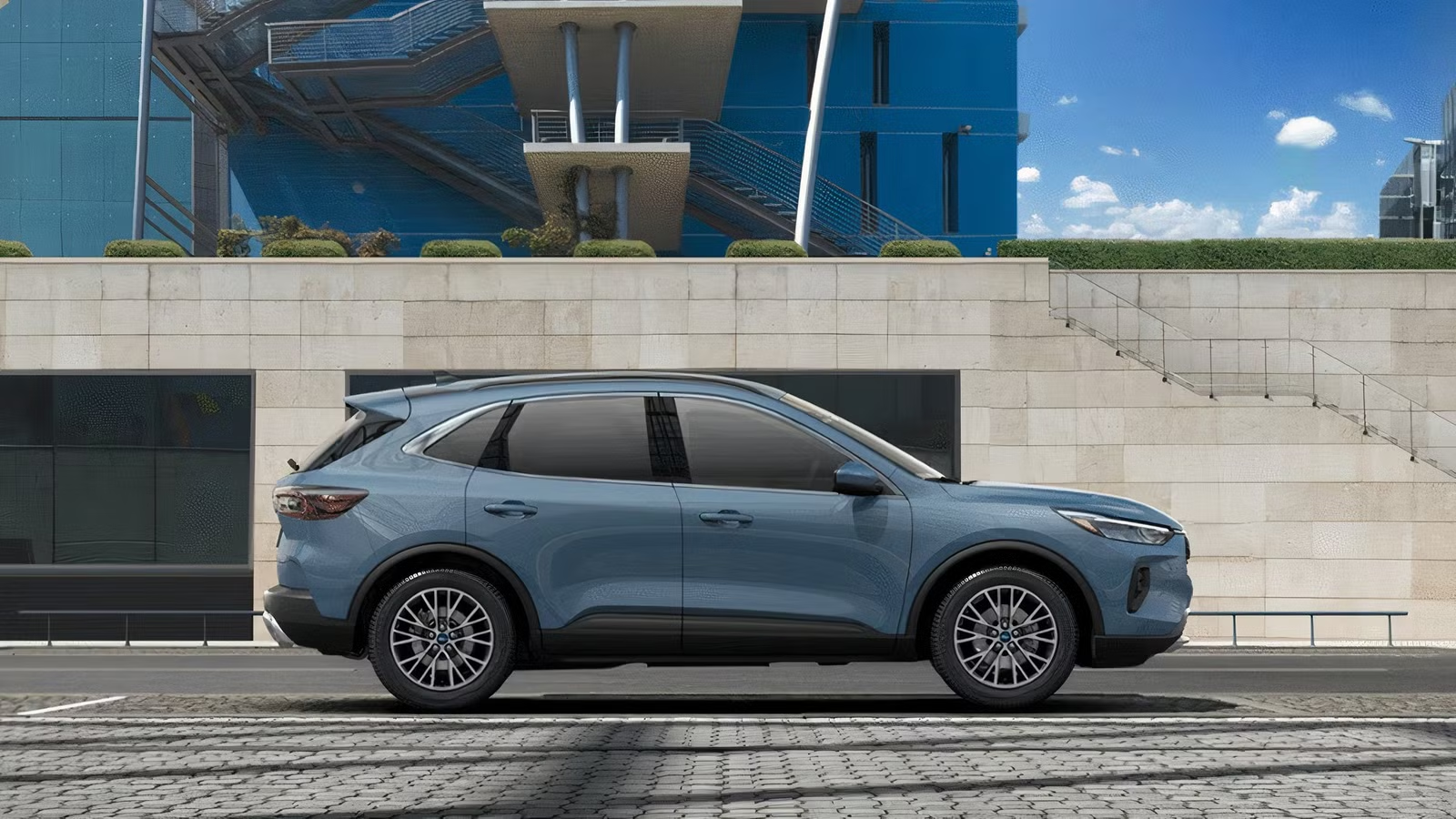
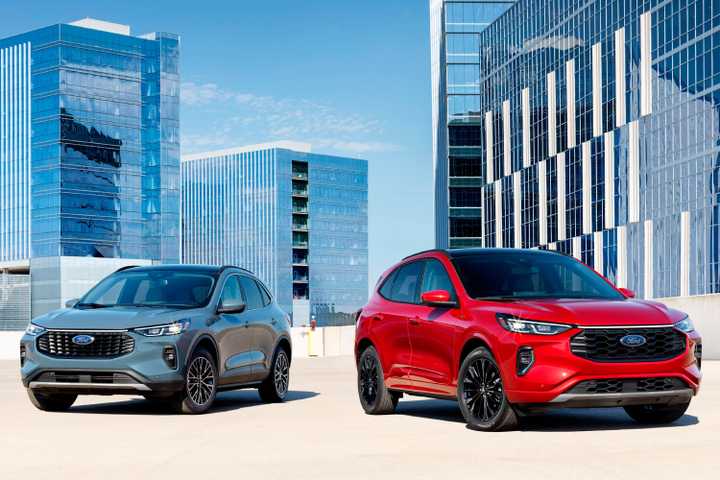
With its conservative design and steadfast practicality, the 2026 Ford Escape Hybrid may not generate the excitement surrounding newer hybrid SUVs, but its accomplishments in the area of efficiency are significant—it stands only one step behind renowned Toyota AWD compact hybrid SUVs, bested only by the Toyota RAV4 in terms of vehicle size and intent. That’s a heady crowd to be included in, and it is a testament to the quiet determination the Ford Escape Hybrid has shown in its two decades of service.
2025 Ford Escape rear 3/4 shotFord
As with the original, the current and last Escape Hybrid (Ford has decided to discontinue the model and concentrate on the Bronco Sport as its compact SUV competitor) combines practicality, affordability, and impressive fuel economy in a package that remains highly relevant to modern families. In a segment filled with strong competitors, the Escape Hybrid continues to earn its place among the segment’s efficiency leaders and to inspire other American compact SUVs to follow in its footsteps.
2026
Jeep Cherokee
Lincoln Nautilus
Powertrain
1.6-liter turbo inline-4 + 2 motors
2.0-liter turbo inline-4 + 2 motors
Transmission
Continuously variable
Continuously variable
Power
210 hp
310 hp
Torque
230 lb-ft
295 lb-ft
Driveline
All-wheel drive
All-wheel drive
Range
507 miles
600 miles
Efficiency City
39 mpg
29 mpg
Efficiency Highway
35 mpg
31 mpg
Efficiency Combined
37 mpg
30 mpg
The Compact Jeep Cherokee Goes Hybrid-Only For 2026
2026 Jeep Cherokee Laredo front 3/4 angle in gray while parkedBrett Evans/Valnet/CarBuzz
The 2026 Jeep Cherokee follows Toyota’s path and is available as a hybrid-only model, representing another significant direction for a vehicle that wants to stay relevant to the Jeep off-road philosophy while making itself more attractive to the everyday family driver. It’s not the most efficient in the class, but it’s a considerable step forward for the brand that prides itself on going anywhere the pavement leads—or ends.
The 2026 Lincoln Nautilus Hybrid Is A Rare Full-Hybrid Luxury SUV
Front 3/4 action shot of 2026 Lincoln Nautilus Hybrid drivingLincoln
There aren’t many full-hybrid compact luxury SUVs in the marketplace (most have either taken the mild-hybrid road to preserve performance, or gone full PHEV mode), and only one is American—the 2026 Lincoln Nautilus Hybrid. Aimed at the buyer who wants premium materials, advanced technology, and an upscale ownership experience, the Nautilus Hybrid adds an efficient hybrid powertrain to help balance the monthly budget.










No Comments