
The Luxury Car Built For Traditionalists
Luxury, at its best, has always been about subtraction. Strip away the noise, the effort, the intrusion of the outside world, and what remains is the experience — effortless motion, exquisite materials, and the quiet confidence of genuine quality. That definition hasn’t disappeared, but it has been crowded out. Today’s luxury market is increasingly defined by performance metrics and touchscreen spectacle, leaving a growing number of buyers wondering where the sanctuary went. The answer, it turns out, is closer than they might think.

For the luxury traditionalist, a car is not a home theater on wheels, nor is it a buzz saw for quickly carving through mountain passes. To them, a luxury car is a sanctuary, designed to separate the passenger from the indignities of the outside world. Traditional luxury is defined by unrivaled comfort, material opulence, and an effortless driving experience. While today’s luxury market has pivoted toward “Performance Luxury” or “Digital Luxury” that favors stiff suspensions and wraparound touchscreens, there is a luxury renaissance movement.
The Philosophy Of Traditional Luxury
The modern luxury landscape is dominated by what some call “digital luxury” — clean, minimalist interiors with large touchscreens that allow users to scroll through menus of feature controls once entrusted to buttons and switches. Physical craft skills are often hidden behind software-driven interfaces. The aesthetic is sleek and futuristic, but it also leaves luxury buyers chasing a non-luxury ideal.


In the traditional sense, luxury isn’t about minimalism. It’s about depth — premium materials, visceral textures, and intricate detail. It’s about craftsmanship you can see and feel, not layers of menus you navigate to control the finest detail. And as automakers push further into digital territory, a gap has opened for those who still want that traditional, tangible sense of richness — the thrumming cadence of a large engine, weighted knurled-metal knobs, and the deep, pillowy give of leather upholstery.
How Luxury Has Evolved And How It Affects Traditionalists

Over the past decade, the luxury car market has undergone a rapid digital revolution. Most flagship model interiors are now more akin to high-end smartphones; they surround front-seat passengers in glass cockpits, signal control engagement through haptic feedback, and minimize distraction through stripped-back aesthetics. There is no denying they are impressive, but the shift has also created a “sensory void” for the luxury traditionalist.

These connoisseurs of traditional luxury favor natural materials over synthetic finishes, physical controls over digital interfaces, and understated elegance over blank backdrops. Which is not to say the natural progression of luxury is wrong, but it caters to a fundamentally different mindset. Modern luxury is “active” — about engagement and instant gratification. Traditional luxury is “passive” — about relaxed comfort and going with the flow.
The Luxury Style That Attracts The Traditionalist

The traditionalist values three core luxury ideals — stature, integrity, and power, usually in that order. The luxury car has to look substantial (conservative design, typically with a long hood to signify a large ICE, and adorned with accessories rather than add-ons), feel tactilely intuitive (metal pieces should be cold to the touch; natural materials shouldn’t look fabricated), and deliver effortless power (it should never feel like it’s straining to accelerate, and control is easily managed through a deft right foot).

Its interior is studied, rather than intuitive. Modern luxury is like a smartphone — designed to require little prior knowledge to operate — but a traditional luxury car needs to be understood. The difference is like a computer program versus a high-school calculus course. Lastly, a traditional luxury car isn’t driven as much as it’s guided. Inputs are deliberate but unhurried. A traditional luxury car feels like it has a bottomless reserve of power. And yes, there are cars that straddle the line between the two ideals, such as this one.
The Genesis G90 Is A Modern Luxury Car Built For Traditionalists
Rides Like A Benz, Looks Like A Bimmer, Pampers Like A Bentley

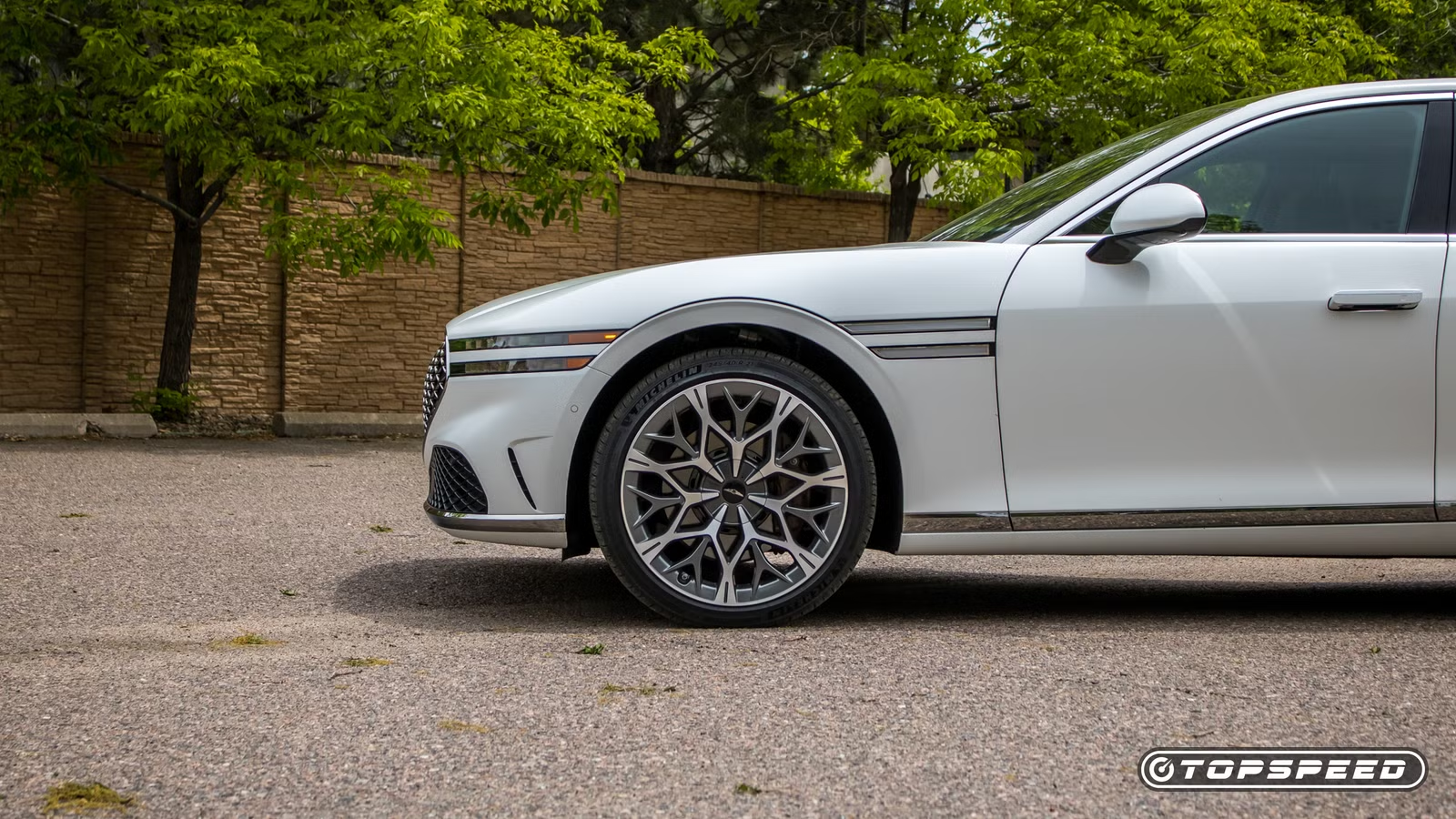
While much of its segment has moved toward sport-luxury, the 2026 Genesis G90 leans unapologetically toward traditional values. It doesn’t chase Nürburgring lap times like a Porsche Panamera, or headline-grabbing acceleration figures like a Tesla Model S, but instead focuses on refinement, comfort, and presence.

As European brands have raced toward aggressive haute couture design, the newcomer from South Korea has eased into the traditionalist void. The Genesis G90 is probably today’s best example of “quiet luxury.” It does not scream for attention with panel vents or a chiseled physique, but relies on traditional, functional design elements — a large grille and elegant, sweeping curves — establishing an almost regal presence that looks right at home pulling up to a five-star hotel porte-cochere.
The Heart And Soul Of Traditional Luxury Dynamics

The Genesis G90’s powertrain and chassis tuning are where its traditionalist philosophy becomes most apparent. Rather than delivering aggressive, neck-snapping acceleration, the G90 prioritizes progressive smoothness. Its engine delivers power in an almost effortless manner, with no sense of urgency or sudden surges, and transmission shifts that are nearly imperceptible. It has a modern V-6 powertrain engineered to replicate the character of a traditional V-8.

At speed, the ride quality is smooth and appropriately tuned for isolation. The suspension absorbs imperfections without transmitting harshness into the cabin and remains suitably compliant through higher-speed corners. Its overall composure may give off the aura of an executive sports sedan, but it doesn’t try to outdo the market’s top sports sedans. It’s not trying to raise drivers’ adrenaline level; its intention is to lower their blood pressure.
The Sanctuary Of Traditional Luxury

Inside, the Genesis G90 doubles down on traditional intentions. In the pursuit of creating a non-distracting environment for cabin occupants, many modern luxury cars strip away the tactile elements that promote luxury — buttons and switches, and upscale touch surfaces. The G90 doesn’t abandon state-of-the-art technology; it just refuses to sacrifice physical interaction in the name of increased automation.

Buttons and switches are prominent. Materials are layered and varied. Wood, metal, and leather are used as foundational elements, not accouterments. The cabin presentation is curated for a sense of construction rather than assembly, with every control having a physicality to it and every surface having texture. And it’s not noisy — audibly or visually — adding to the sense of isolation that has served luxury well for the better part of a century.
How The 2026 Genesis G90 Conveys Traditional Luxury

The 2026 Genesis G90 stands apart in the luxury market by adhering to traditional luxury traits that, around the turn of the century, began to be seen as old-fashioned by younger buyers more interested in the wave of performance luxury vehicles coming out of Europe — and later Japan, as Japanese brands challenged German marques.
It’s not that the G90 doesn’t embrace the progress of modernity; it’s just that it hasn’t completely abandoned the traditional American luxury features found in past Cadillac and Lincoln sedans. There are current luxury sedans that also display some traditional traits, but the Genesis G90 executes the overall traditional persona better and, in typical Hyundai Group fashion, at a lower price.
The Interior Is Well Executed

When it comes to ultra-luxury standards — particularly the level of craftsmanship seen in high-end traditional cars like the Bentley Flying Spur or Rolls-Royce Ghost — the Genesis G90 doesn’t come anywhere near the level of bespoke detail, and it would be unrealistic to expect otherwise. But it gets closer than you might expect. It starts with consistently high material quality — soft leathers, authentic woods, integrated metals — and follows through with convenience features like power doors that close at the push of a button and cabin diffusers to change the interior scent.

But what brings out shades of Bentley is execution. There’s a cohesiveness in the way the cabin is constructed as a complete, balanced experience — something many competitors with longer histories have yet to master — that doesn’t rely on a standout feature or an impressive theme. It does not yet offer the degree of personalization of more established rivals, but it genuinely captures the essence of traditional luxury.
A Modern Luxury Sedan For Traditionalists

The Genesis G90 succeeds because it understands something the broader luxury market has started to overlook: luxury doesn’t need to be loud, fast, or technologically aggressive to be effective. By focusing on time-proven fundamentals — effortless performance, ride quality, and interior craftsmanship — the G90 demonstrates what a traditional luxury sedan should feel like. It doesn’t reject modern technology, but uses it wisely and refuses to let it define the luxury experience.
And it’s wrapped in a package that readily conveys a classic luxury car — one that doesn’t look or feel out of place in a market increasingly nudging toward performance and digitalization. It shows that the appeal of traditional luxury hasn’t disappeared, and encourages the development of other luxury vehicles that convey traditional luxury in their own unique ways.
Sources: Genesis, The EPA

Related posts




Latest Post


No Comments