
10 Reliable Adventure Bikes That Can Take Almost Anything You Throw At Them
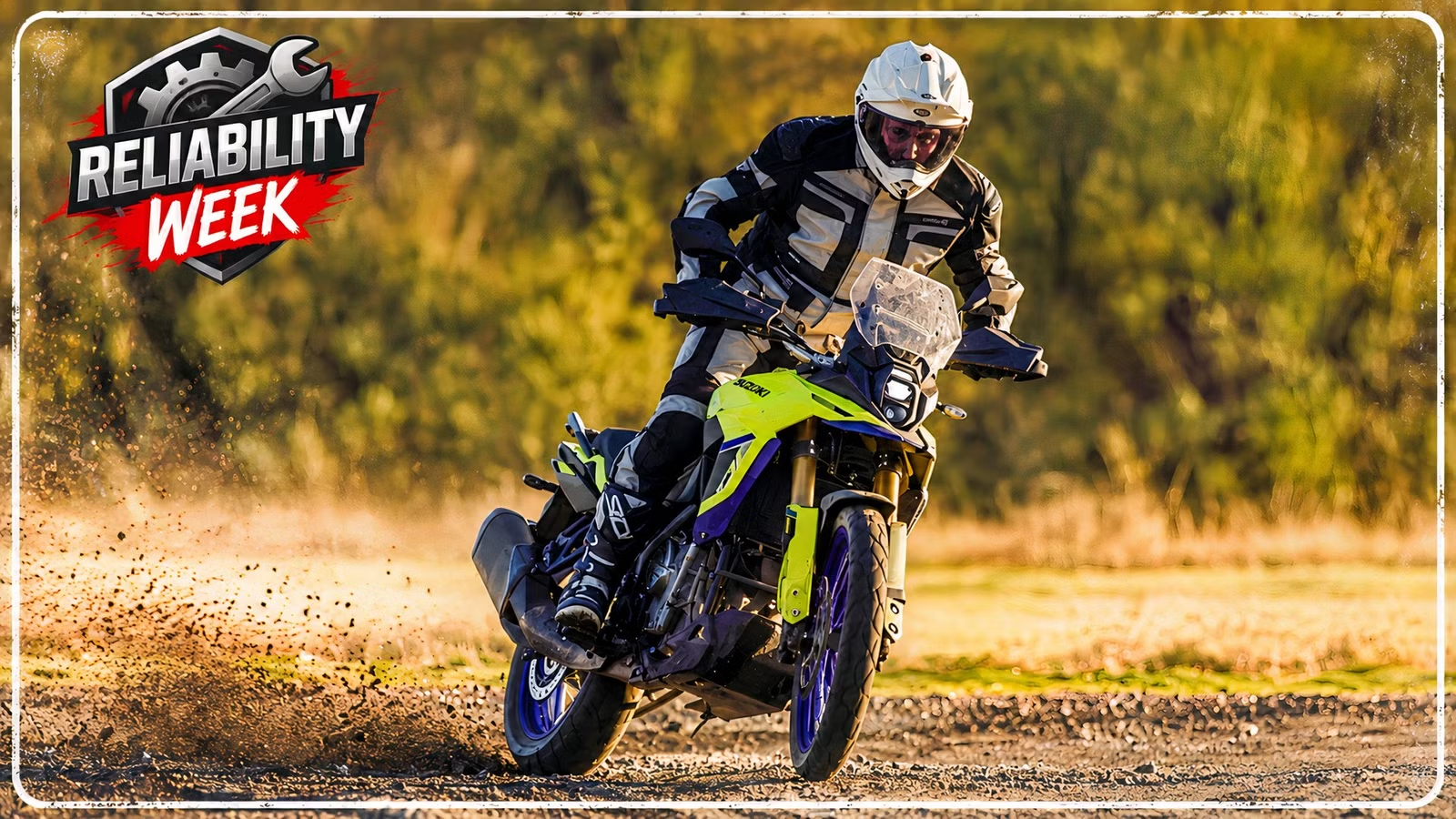
Adventure motorcycles are supposed to do a little bit of everything. They need to survive long highway runs, poorly maintained back roads, gravel, mud, heat, rain, and the occasional mistake when the road suddenly ends. The problem is that modern ADV bikes can also be incredibly complex, making long-term dependability an important part of the buying decision. What you need then is a strong reputation for durability, proven engine platforms, sensible mechanical layouts, and encouraging long-term owner feedback. The lineup ranges from inexpensive middleweights to serious long-distance machines.
Kawasaki Versys-X 300
Price: $5,799

The Kawasaki Versys-X 300 is not the fastest motorcycle here, nor is it the most imposing. But that is exactly why it deserves a place on a reliability-focused list. Kawasaki continues to offer the 2026 Versys-X 300 ABS with a 296cc liquid-cooled parallel twin, six-speed transmission and relatively straightforward electronics. The engine is a development of Kawasaki’s long-running small-capacity twin family, and the relatively low output means it is not being pushed particularly hard.

Its 19-inch front wheel, 4.5-gallon tank and 385.9-pound curb weight also make it a more practical adventure-touring option than its displacement might suggest. Owners tend to praise the Versys-X 300 for its simplicity, fuel economy, and ability to pile on miles without drama.
Honda NX500
Price: $6,899


The Honda NX500 makes a strong case for being one of the safest bets in the middleweight adventure segment. Honda’s 471cc parallel twin has been used across the company’s portfolio for years. The NX500 is deliberately easygoing. It does not chase huge horsepower numbers; its six-speed gearbox is conventional, and the motorcycle avoids the intimidating complexity found on larger premium ADVs.

That makes it especially appealing for riders who want one bike for commuting, weekend trips, and unpaved roads. Owner discussions about the NX500 family frequently point to the engine’s durability and low running costs. That reputation is a big reason the platform has remained so popular across multiple Honda models.
Kawasaki KLR650 Adventure
Price: $8,199

Few motorcycles have a reliability reputation as closely associated with simplicity as the Kawasaki KLR650. Its 652cc single-cylinder engine is not particularly sophisticated, but that is part of the appeal. Kawasaki has spent decades refining the basic KLR recipe, and the current fuel-injected generation retains the bike’s focus on durability, range, and easy ownership.

The Adventure trim adds factory side cases, guards, and auxiliary lighting for riders who want to load up and go without shopping the accessory catalog first. It won’t win any drag races; however, in all likelihood, it is likely to outlive the person who bought it.
Suzuki V-Strom 650XT
Price: $9,799

The Suzuki V-Strom 650 has earned perhaps the strongest reputation for reliability of any motorcycle in this group. At its center is the 645cc V-twin, a mature engine that has powered Suzuki motorcycles for decades. The XT trim adds tubeless spoked wheels and adventure-focused equipment without turning the motorcycle into a rolling computer.

The V-Strom 650 is powerful enough for highways, comfortable enough for long trips, and simple enough that routine maintenance does not feel like a specialist exercise. The model has also built an enormous owner community over the years, which means there is plenty of accumulated knowledge around servicing, common faults and modifications.
Yamaha Ténéré 700
Price: $10,999

Underneath the rally-inspired bodywork of the Yamaha Ténéré 700 sits the same CP2 engine that powers the MT-07, an engine with a well-documented habit of shrugging off high mileage with minimal drama. Riders on Ténéré forums routinely say they’ve struggled to find anything genuinely wrong with the bike beyond routine wear items.

It has long-travel suspension, a 21-inch front wheel, and enough electronic assistance to satisfy modern expectations without burying the rider beneath menus and modes. To round it off, the Ténéré 700 gets a simple steel frame, no needless electronics, and an engine that’s proven itself well beyond the T7 badge.
Suzuki V-Strom 800DE
Price: $11,799

The Suzuki V-Strom 800DE is newer than the V-Strom 650, which means it cannot yet claim the same decades-long reliability record. Still, Suzuki’s new-generation 776cc parallel twin is already establishing itself as a strong all-rounder. Suzuki positions it as the most dirt-capable V-Strom, with long-travel suspension and a 21-inch front wheel.

The engine also uses a 270-degree crankshaft and Suzuki’s Cross Balancer. Suzuki also explicitly highlights the balance of versatility and reliability. For a machine with genuinely serious off-road hardware, the price tag too remains refreshingly sane.
Yamaha Super Ténéré
Price: $16,299 (last recorded)

Yamaha pulled the Super Ténéré from the U.S. lineup a few years back, which is honestly a shame, because used examples are quietly one of the best deals in adventure biking. The 1199cc parallel-twin drives through a shaft, so there’s no chain to babysit on a 5,000-mile trip, and it’s not uncommon to find owners well past 100,000 miles who’ve done little beyond routine service.

It’s a big, heavy machine that was never quite as trendy as its European rivals, but that low profile has kept resale prices sensible. Buy a clean one with service records from the used market at around $8,000, and you’re getting a genuinely long-haul-proven engine for a fraction of what a new ADV costs.
Honda Africa Twin
Price: $15,199

Honda’s Africa Twin is one of the few big ADV motorcycles here that combines genuine off-road ability with an exceptionally established mechanical reputation. The 2026 Africa Twin uses Honda’s 1,084cc liquid-cooled parallel twin. It gets a six-speed manual transmission, long-travel Showa suspension, and a 21-inch front wheel. The engine is powerful without being excessively stressed, while Honda’s global experience with the Africa Twin platform means there is a huge pool of owner knowledge behind it.

The motorcycle is also available with Honda’s dual-clutch automatic transmission (DCT), although buyers opting for the same add another layer of mechanical sophistication and cost. The Africa Twin is heavier and more complicated than a KLR or V-Strom 650, but it is also capable of crossing continents without feeling out of its depth.
BMW R 1250 GS
Price: $17,995 (last recorded)

The BMW R 1250 GS is the European representative that belongs here. It has the electronics, sophistication and price tag that reliability purists sometimes shy away from, but the platform has now accumulated a huge global mileage record. Used examples in US portals currently appear for around $12,000–$15,000 depending on manufacturing year, mileage and equipment.

Its 1,254cc boxer twin uses BMW’s ShiftCam technology, and the shaft-drive layout makes it particularly attractive to riders covering long distances. There is also a vast owner and workshop community surrounding the GS. Recent used-bike discussions continue to show strong demand for well-maintained examples, with buyers emphasizing service history and pre-purchase inspection.
Ducati Multistrada V4
Price: $19,995

Ending the list with the Ducati Multistrada V4 may seem strange for a reliability-focused story. Yet the latest V4 deserves recognition for demonstrating how far modern European adventure bikes have come. Ducati’s 1,158cc Granturismo V4 makes 170 horsepower and 91 lb-ft of torque. That output figure tells you immediately that this is not a low-stress, old-school adventure motorcycle.

It is a technologically advanced machine with sophisticated electronics, ride-by-wire, and an engine designed to offer both performance and touring capability. Where the V4 earns its place is in the engine’s unusually long service intervals and improving owner reputation.
Source: Respective OEMs

Related posts



Latest Post


No Comments