
The Legendary Bike That Shattered The 100-HP Barrier Forever
Today, for a sports bike to make 100 horsepower is no big deal. In fact, an average middleweight sports bike makes well over 100 ponies today, with the top-of-the-line superbikes making well over 200 horsepower. But that wasn’t always the case. Back in the ‘70s, even making around 80-90 horsepower would shake up the industry. It was at this time that one Japanese manufacturer decided to outdo the competition by developing a groundbreaking 105-horsepower superbike. Here’s the story of that bike.
The Run-Up To 100 Horsepower Represents The Golden Era Of UJM Motorcycles

The ‘60s and ‘70s were the golden era of UJM motorcycles, with the late ‘70s marking a proper horsepower war among the Japanese Big Four. Honda had already set the scene with the legendary 1969 Honda CB750 Four, which is now regarded as the first superbike. It featured a high-performance inline-four engine producing 67 horsepower, a top speed of 123.2 miles per hour, and front hydraulic disc brakes and an electric start.

Shortly after, Kawasaki responded with the Z1 900 in 1972, featuring a 903 cc inline-four engine producing 82 horsepower. In 1976, Suzuki entered the four-banger scene with the GS750, but it failed to make a dent, producing only 63 horsepower. However, Yamaha introduced the XS1100 in 1978, producing 95 horsepower. By this time, the CB750 was getting long in the tooth, too, and Honda had to respond. Honda’s answer came in the form of an engineering marvel: a superbike featuring a straight-six engine.

While Honda’s goal wasn’t to breach the 100 horsepower mark, this bike did end up making 105 horsepower. It was a bold statement that marked the next chapter in the horsepower wars, which would eventually culminate with the 1999 Suzuki Hayabusa. But then again, is the horsepower war ever over? If you think so, the Kawasaki H2 R would like to have a word with you. And if you haven’t guessed it already, the Honda bike we’re talking about is the iconic CBX.
The First Production Bike To Cross The 100 Horsepower Mark


Time for some clarification. The CBX isn’t the first bike to cross the 100 horsepower mark, but it is the first production bike to do so. German bikes, like the 1973 Munch Mammoth 1200 TTS-E and 1978 Van Veen OCR 1000, had already reached 100 horsepower, but neither was produced in large numbers. Reportedly, the production numbers stand at 130 for Munch and only 10 for Van Veen. That doesn’t quite qualify as a production bike, which is why the CBX is the focus here.
The Honda CBX Was The First Bike To Make 105 Horsepower

Honda had realized simple numbers wouldn’t work against the ever-growing competition; it had to make a statement. And it did that from an old habit of adding more cylinders, revving higher, and letting engineers have some fun along the way. Back in the ‘60s, Honda had produced tiny six-cylinder engines for the RC race bikes, and it used that expertise to develop the next big thing after the legendary CB750 Four.

In 1979, Honda unveiled the CBX, an absolute marvel of Japanese engineering and the most powerful production motorcycle of its time. It wasn’t the first production six-cylinder, though; that title belongs to the 1973 Benelli 750 Sei, but it was arguably the first production six-cylinder to get the formula right… almost. Honda had set out to make a bold statement, and it did so. The CBX produced 105 horsepower, becoming the first production motorcycle to make over 100 horsepower.
The Bike Topped Out At 135.9 Miles Per Hour

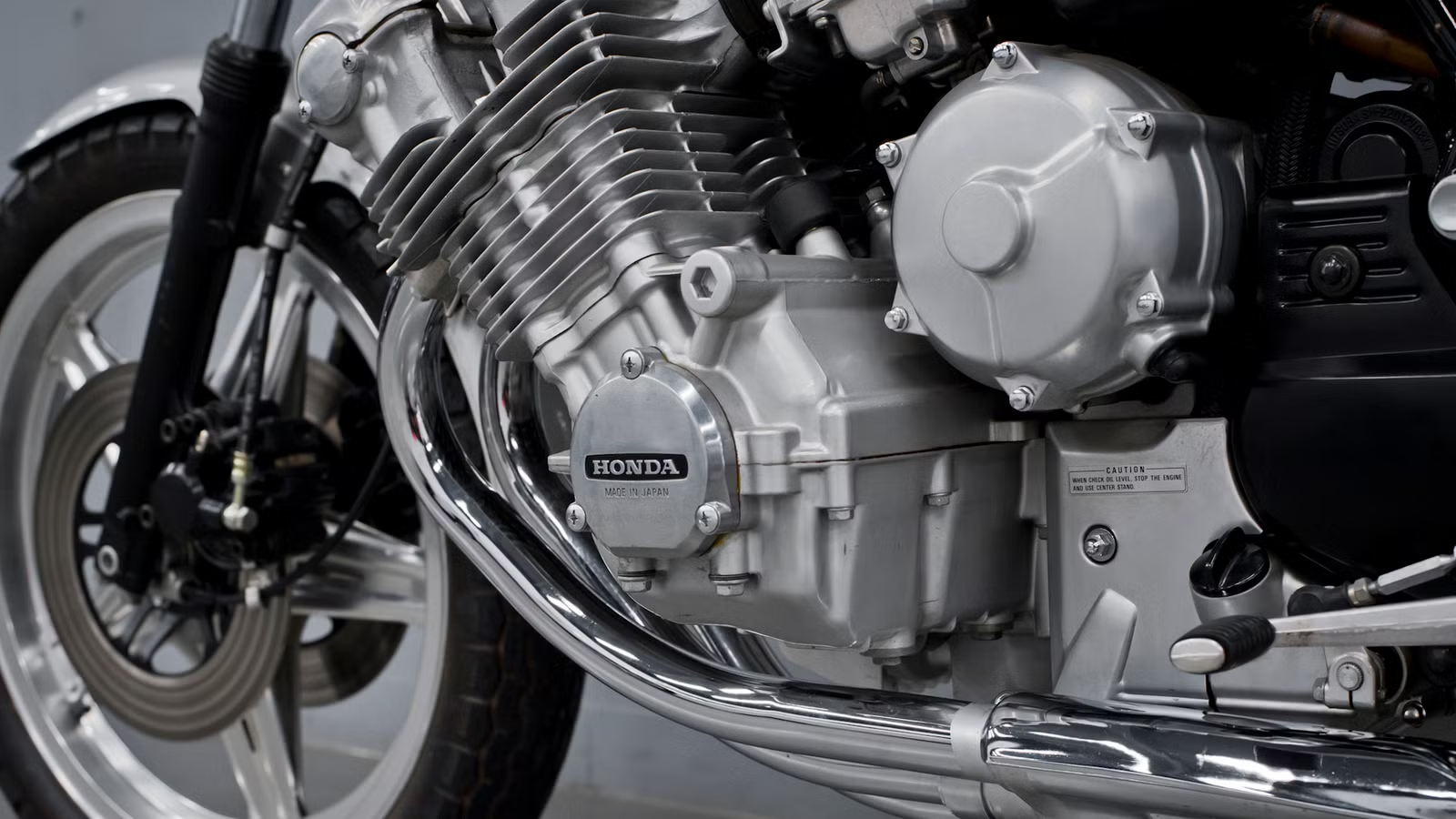
The engine here was a buff, transversely mounted 1,047cc inline-six engine, featuring 24 valves, dual overhead cams, and 6 Keihin carbs. It ran a 9.3:1 compression ratio, making 105 horsepower at 9,000 RPM and 52.27 LB-FT at 6,500 RPM. This power output allowed the CBX to top out at 135.9 miles per hour with a quarter-mile time of 11.9 seconds, which was properly fast for the time. Unfortunately, it fell short of the then-fastest production motorcycle, the Laverda Jota, by a small margin.
What made this inline-six engine so special wasn’t just the power output but its smooth power delivery. Inline-six engines are inherently balanced, and this being a Honda, it had to be smooth. At the same time, the engine produced a riotous exhaust note often compared to that of old Formula 1 cars. Many even praised the bike as the best-sounding bike ever made. We wouldn’t disagree. The CBX still sounds insane.
There Was A Lot Of Thought Put Into The Engine’s Design

Honda didn’t just plonk an inline-six in the CBX. A lot of thought went into the engine’s design to make it actually usable in the real world. For instance, Honda moved the alternator and ignition components behind the cylinder block, which reduced the engine’s width; it was only two inches wider than the CB750’s four-banger. Even the lower case was shaped to improve lean angle, so you could actually lean the bike in corners without typically grounding the engine.
Supported By Not-So-Outstanding Hardware

As was typical of the time, the outstanding inline-six engine was supported by not-so-outstanding underpinnings. The bike had a tubular frame, telescopic forks, and twin rear shocks. That was on par with the rivals, but the hardware would become a strong limiting factor in the bike’s riding experience. Apart from that, the bike looked terrific, with the straight six engines on full display, complemented by six polished exhaust headers sweeping forward from the cylinders into a six-into-two layout.
The CBX Was Far From Perfect, Though

The Honda CBX was a force to be reckoned with in terms of engine performance, but it had a few disadvantages that kept it from being a good all-rounder. For starters, it tipped the scales at 600 pounds with all necessary fluids, which was pretty heavy by ‘70s standards. That meant the bike wasn’t exactly nimble or easy to chuck into corners. That was only made worse by the skinny frame tubing and rudimentary suspension, which couldn’t handle the engine’s power output.

The inline-six engine also had its share of problems. The layout was complex, adding manufacturing and servicing costs that increased the sticker price compared to its rivals. It also consumed a lot of fuel, unless you were very conservative with throttle input (which would’ve been rather difficult with this bike). As a result, despite being one of the wildest things on wheels of its time, the CBX failed to turn media success into commercial success.
Honda Tried Keeping The Six-Banger Alive

Honda tried to keep the platform alive with the CBX-B sports tourer, which featured a detuned version of the inline-six engine making 100 horsepower with a stronger mid-range. It also got a front fairing, side cases, and a revised rear end with a monoshock. Still, the CBX continued to underperform and got outsold by Honda’s own CB900F. Honda would eventually discontinue the CBX in 1982.
You Can Still Experience This Masterpiece (But For A Pretty Penny)
Six-cylinder engines remain relatively uncommon, and the CBX stands as one of the first executions of the engine layout on two wheels. It should’ve been a success, especially given all the attention surrounding it in the press, but the CBX couldn’t stand the real-world pressures of a highly competitive market. It became Honda’s last great cylinder-count experiment. That’s why collectors and enthusiasts hold the CBX in such high regard today. Despite its flaws, the CBX became one of Japan’s most celebrated UJM classics long after it was taken off the shelf.

Thanks to that reputation, expect to pay a premium if you want to experience this awesome motorcycle. Classic.com estimates an average value of $15,642, while Hagerty puts the value at $14,600 for a good-condition model. However, Bring a Trailer shows that pristine-condition models can change hands for as much as $37,000. Don’t expect the bike to appreciate a lot in value, though. The price is already inflated as people are buying them as investment pieces, and experts suggest the bike won’t appreciate much in the near future.
The CBX Marked The End Of An Era For Honda


The Honda CBX marked the end of an era in which motorcycle manufacturers believed that adding more cylinders could solve any performance problems. Ironically, the bike launched just as the industry was moving in the opposite direction. Sports bikes were becoming faster and lighter, and within a few years, the 1985 Suzuki GSX-R750 would show that shedding weight could do better than simply adding more cylinders. The GSX-R750 would go on to be regarded as the first true supersport motorcycle.
Honda didn’t outright stop experimenting with engines, though. It still produced the iconic NR750, which featured an oval-piston V4 engine, and later the flat-six engine for the Gold Wing touring bike. However, Honda’s straight-six layout ended with the CBX. That’s another reason why enthusiasts still love the CBX. It was never the future, but it represents what could’ve been an alternate timeline for motorcycles. Regardless, it remains the first motorcycle to cross the 100-horsepower mark.
Source: Honda, Being a Trailer, Hagerty, Classic.com

Related posts

Latest Post


No Comments