
This M240i xDrive Coupe Won Over Even Loyal M2 Shoppers
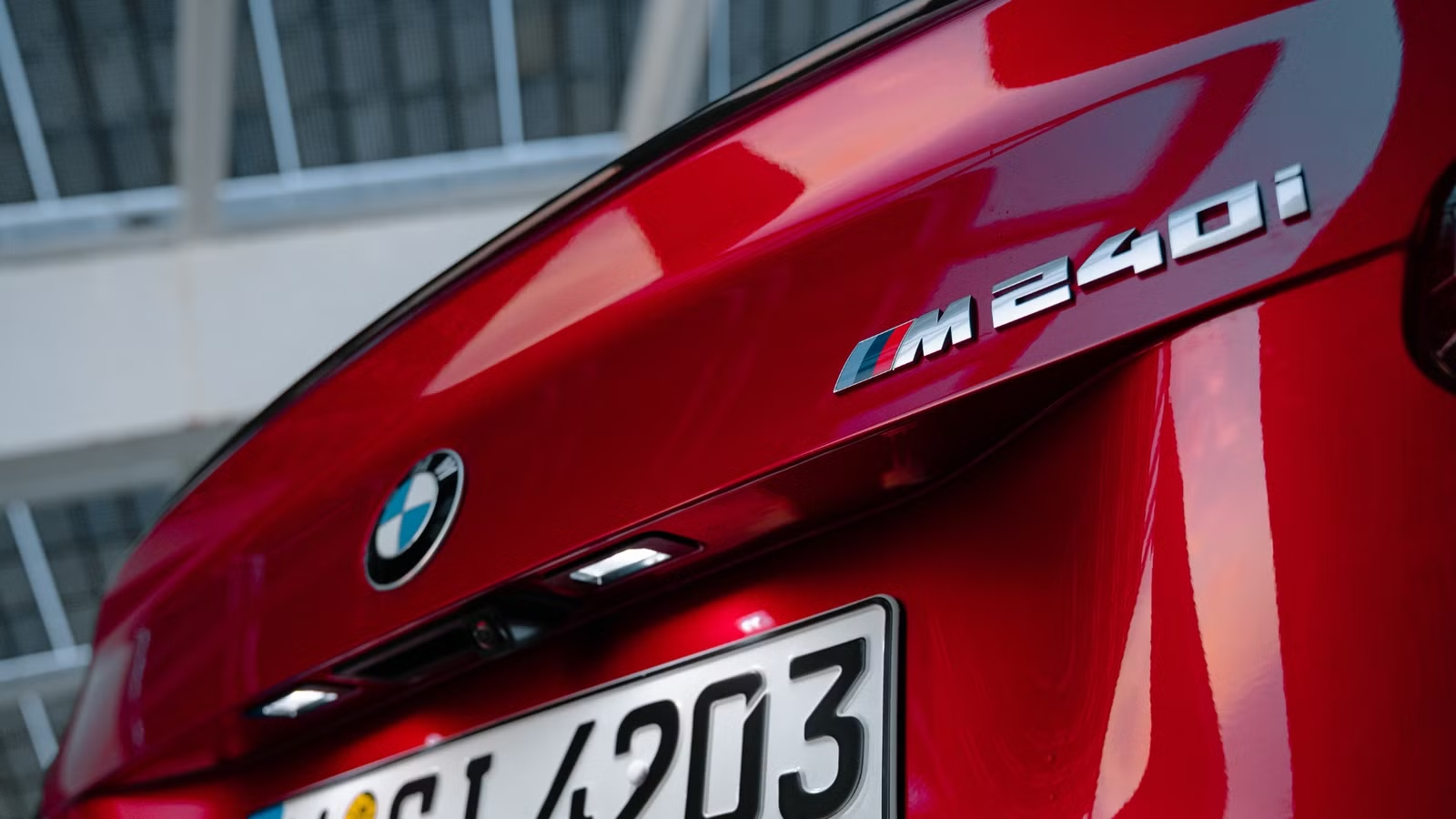
You’ve done the configurator dance. BMW M2, $69,500 before destination, a handful of option boxes ticked, and the total keeps climbing. That’s nearly $17,000 more than the first M2 asked when it landed in 2016, and the sports car you’re speccing still rides like it was set up for a racetrack and drinks like it too. If you live anywhere that sees a real winter, it might spend a quarter of the year waiting for spring. Here’s the twist. There’s a BMW coupe on the very same configurator page that matches the manual M2 to 60 mph, and it doesn’t ask for any of those compromises.
Why A $69,500 M2 Is Getting Harder To Justify Every Day

When the first M2 arrived for the 2016 model year, it started at $52,695 and made 365 horsepower. That was the whole pitch: a proper M car, small and raw, priced within reach of a well-paid enthusiast. The 2027 M2 is a far more serious machine, with 473 horsepower from the S58 twin-turbo inline-six, but it now starts at $69,500 before destination. Want the new M xDrive all-wheel-drive version? That’s $73,600.
None of that makes the M2 bad value in isolation. It’s a genuine M car, and it’s priced like one. The problem is that “entry-level M” has quietly become a $70,000 proposition before you touch the options list.
Track-Ready Hardware Makes Daily Driving A Compromise

The M2’s talents come with a daily tax. The EPA rates the 2026 M2 at 16 mpg city and 23 mpg highway, and estimates its annual fuel bill at $4,050. Its firm M chassis is tuned to shine on a circuit, which is exactly where most M2s spend the least time.

Cold weather is another sticking point. BMW’s own guidance for the rear-drive M2 recommends winter tires and concedes that all-wheel drive generally handles snow better. The new M2 M xDrive answers that, but it adds $4,100 to the price and is automatic-only. So the all-season M2 is now a $73,600 automatic. That’s a lot of money to make a weekend car usable on a Tuesday in February.
The BMW M240i xDrive Coupe Delivers Most Of The M2 For $13,900 Less

The 2027 BMW M240i xDrive Coupe starts at $55,600 before destination, exactly $13,900 less than the M2 Coupe on the same basis. For 2027, its 3.0-liter inline-six gains a 48-volt mild-hybrid system, and BMW rates combined output at 386 horsepower, made up of 375 horsepower from the engine and up to 11 horsepower of electric assist.
Here’s the number that matters. BMW quotes a 0-to-60-mph time of 4.1 seconds for the M240i xDrive. It quotes the exact same 4.1 seconds for the M2 with its six-speed manual. The automatic M2 is quicker at 3.9 seconds, and the M2 M xDrive quicker still at 3.6 seconds, so the M car keeps its crown. But that gap is measured in tenths, and the price gap is measured in five figures.
Why M2 Shoppers Keep Walking Out With The M Performance Coupe


On BMW owner forums, the M240i-versus-M2 cross-shop is a familiar thread. One M2 owner on Bimmerpost described building both cars, drawn to the M240i’s xDrive for year-round driving in Minnesota. What finally sent him to the M2 wasn’t speed or price. It was the six-speed manual, which the M240i doesn’t offer.
That’s telling. Take the stick out of the equation, and the M2’s case for daily drivers narrows fast. evo’s Jethro Bovingdon ran an M240i xDrive as a long-term test car for 12,501 miles and called it “a completely painless, high-quality car to live with in all weathers.” He carried kids in the back seats, saw strong real-world economy, and still found it properly entertaining whenever the road opened up.
What The B58 Inline-Six Gives Up To The M2, And What It Doesn’t

The M2’s S58 is a twin-turbo, M-developed engine built to rev hard and take punishment. The M240i’s B58 is a single-turbo inline-six tuned for a broad, accessible spread of torque. On paper, the S58 wins by 87 horsepower. On a public road, the B58 gives up far less than that number suggests.
Earlier US-spec versions of this engine delivered 369 pound-feet from just 1,800 rpm, which is why the M240i has always felt urgent off the line. BMW’s international figures for the new mild-hybrid car put peak torque at 398 pound-feet. Add all-wheel-drive traction, and every on-ramp becomes a non-event, no launch ritual required.
The B58 Has Built A Reputation For Durability
Durability claims need receipts, and the B58 has more than most. WardsAuto put it on its 10 Best Engines list in its debut form in the BMW 340i, again when judges tested it in the M240i, and again in 2020 in the M340i. When Toyota needed an inline-six for the GR Supra, it went to BMW for the B58. And across evo’s 12,501-mile, eight-month test, the M240i logged zero costs, albeit as a new car still under warranty.
None of that makes a BMW cheap to keep. RepairPal rates BMW 2.5 out of 5 for reliability brand-wide, with average annual repair costs of $968. Budget accordingly, but know that the engine at the heart of this car is one of the strongest the brand builds.
Why xDrive Turns The M240i Into A 12-Month Sports Coupe

The M240i’s xDrive system is rear-biased, sending power forward mainly when the rear tires need help, so it never feels like a nose-heavy all-wheel-drive car. Bovingdon noted how progressively his car slipped into a tail-led balance and how readily the front axle pulled it back out of a slide. In rain or on a cold morning, that traction turns the full output into usable speed.
To be clear, the M2 M xDrive now offers the same all-weather peace of mind, with more grip and more power. The difference is the entry fee. The M240i delivers four-season confidence for $18,000 less than the M2 M xDrive, and since that M2 is automatic-only too, you aren’t giving up a manual to get it.

The cost gap doesn’t end at the dealership. The EPA rated the 2026 M240i xDrive at 23 mpg city, 32 mpg highway, and 26 mpg combined, with an estimated annual fuel cost of $2,950. That’s $1,100 a year less than the EPA’s estimate for the 2026 M2, based on the agency’s assumption of 15,000 miles a year. The mild-hybrid update should widen that gap, too. The EPA rates the 2027 rear-drive M240i at 30 mpg combined, up from 26.
The M240i xDrive Isn’t An M2, And That’s Exactly Why It Works

The M240i xDrive has real limits. There’s no manual. It weighs 3,871 pounds, and you feel that heft when the road tightens. Even evo, which clearly loved its long-term car, is upfront that it’s no trackday weapon. And it doesn’t wear the full M badge some buyers want in the driveway.
But most M2 buyers aren’t lapping circuits. They’re commuting, running errands, and stealing the occasional back road on a Sunday morning. For that life, the M240i xDrive matches the manual M2 to 60 mph, shrugs off winter, burns less fuel, and leaves $13,900 in your account. If you need three pedals or genuine track bite, the M2 earns its premium. If you want a fast, comfortable BMW coupe you can drive every day of the year, this is the smarter buy.
Sources: BMW USA, KBB, RepairPal

Related posts





Latest Post


No Comments