
The Last Analog V8 Land Cruiser The Collector Market Forgot To Hoard
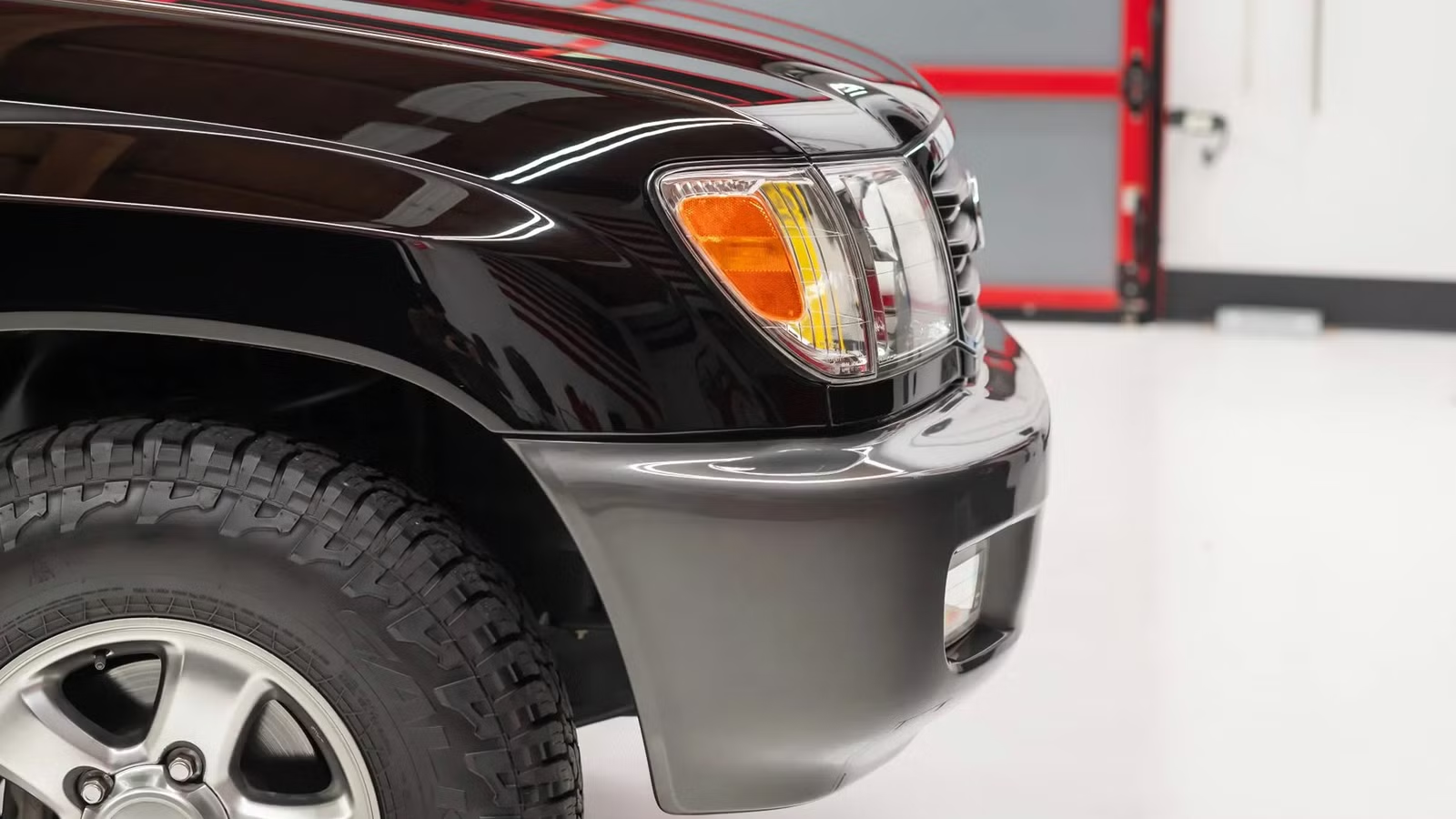
For decades, certain Land Cruisers have transformed from rugged workhorses into prized collector vehicles, yet one of the most capable generations has largely escaped the frenzy. A durable V8 4×4 can still occupy bargain used vehicle territory while exceptional examples command serious collector money, raising an obvious question: why did enthusiasts chase older models while continuing to use this generation as everyday transport?

Introduced in 1998, it changed the formula by combining V8 power and independent front suspension with a traditional full frame and genuine off-road ability. For collectors, that combination offers old-school durability without the compromises of an older truck.
Toyota Built A V8 Land Cruiser That Was Still Meant To Be Used
This Toyota was a luxury 4×4 that never lost sight of its working roots. The combination of a refined cabin, strong V8, and genuine off-road hardware made it equally suited to long highway journeys, family duties, and remote trails. Its full-time four-wheel drive system, low range and available locking differentials gave it the traction to tackle difficult terrain, while its substantial structure and towing ability reinforced its utility.

That versatility is increasingly important as older Land Cruisers become valuable enough that owners think twice before exposing them to mud, scratches and daily wear. This generation offers a different proposition: a collectible with enough comfort and capability to keep earning its keep rather than sitting in a garage.
The 4.7-Liter V8 Gave This Land Cruiser Its Analog Character

At the heart of the formula was Toyota’s 4.7-liter 2UZ-FE V8, an engine that favored durability and smooth, predictable power over the headline outputs of newer powertrains. In its original form, it produced 230 hp and 320 lb-ft of torque, figures that were modest even for the era, but well suited to a heavy-duty SUV. Its appeal today lies partly in what it lacks: there is no turbocharger to complicate the power delivery, and its conventional architecture gives enthusiasts a powertrain that feels straightforward and mechanical by modern standards.
Combined with a body-on-frame construction and full-time four-wheel drive, it represents a formula increasingly difficult to find. For buyers seeking an older SUV that can be understood, maintained and driven without the layers of electronic intervention common today, that simplicity has become a selling point.
Independent Front Suspension Made It A Better Everyday Land Cruiser

The move to independent front suspension was one of the most important changes beneath the redesigned Land Cruiser. Replacing the previous generation’s live front axle with unequal-length control arms and torsion bars allowed Toyota to improve steering precision and ride comfort without abandoning the vehicle’s off-road purpose.
Contemporary testing found the suspension delivered a supple, well-controlled ride and surprisingly confident handling for such a large, heavy SUV. That made a noticeable difference in everyday driving.
Earlier Land Cruisers retained more of the slow, heavy responses associated with traditional solid axle 4x4s, whereas this generation felt considerably more composed on paved roads. Crucially, the change did not turn it into a soft, road-going SUV. With a live rear axle, substantial suspension travel and its established four-wheel drive hardware, it remained highly capable when the pavement ended.
The 80 Series Became Collectible While Its Successor Stayed Affordable

The collector market did not treat these two generations equally. The 80 Series has developed a substantial premium, with tracked auction sales showing a current 12-month median of about $24,750, while exceptional examples can reach far higher. By comparison, the 100 Series spent years being viewed primarily as a used SUV rather than a future collectible. Doug DeMuro’s assessment captured that disparity, placing less perfect examples around $6,000 to $10,000 and well-maintained trucks around $14,000 to $16,000.
Part of the explanation is simple: the 100 Series was newer, produced in greater numbers and lacked the same nostalgic appeal. The 80 Series had already acquired an enthusiast following while its successor was still depreciating. Even today, that difference in perception helps explain why one became a collector target while the other remained a vehicle people simply kept driving.
Its Two Very Different Prices Reveal A Market In Transition

The valuation split becomes difficult to ignore when the luxury twin is used as a benchmark. Kelley Blue Book currently puts a 2001 example at between $4,775 and $6,200 in private-party value, depending on condition, placing an otherwise desirable V8 4×4 firmly in ordinary used-car territory. The Lexus LX470 makes the pricing divide even more revealing. Underneath its more luxurious styling and equipment, it is the luxury version of the same 100 Series Land Cruiser, sharing its basic platform and 4.7-liter V8. Yet KBB currently values a 2001 LX470 at just $4,775 to $6,200 between fair and excellent private-party condition, illustrating how conventional used-car shoppers can view it simply as an aging Lexus rather than a Land Cruiser derivative.
Yet collector-focused data tells a very different story. The Classic Valuer records a $22,000 median sale price for the model, with the highest recorded sale reaching $125,000. Its database also shows an 87% sell-through rate, demonstrating that buyers are already willing to pay substantially more for the right vehicles. The enormous gap suggests the market is not simply undervalued or collectible; it is increasingly separating ordinary examples from those considered worth preserving.
Rising Auction Prices Suggest Collectors Are Finally Paying Attention

The market’s direction matters as much as its current valuation. Reported auction data indicates that prices for the 100 Series have risen 31% since 2022, suggesting growing demand rather than a market merely settling at a higher level. More importantly, the spread between ordinary examples and standout auction trucks shows what buyers are beginning to prioritize.
On Bring a Trailer a 2000 example with 20,000 miles sold for $85,000 in June, while a 2002 model with 285,000 miles changed hands for $12,500 in July. That gap makes condition, mileage, originality and documented history increasingly important. The potential opportunity is finding a well-preserved example before those attributes become reflected more consistently in asking prices.
The Forgotten V8 Land Cruiser Could Be The Next One Collectors Want
Doug DeMuro’s assessment provides a useful snapshot of where this generation once sat, with less-than-perfect examples around $6,000 to $10,000 and well-maintained versions at $14,000 to $16,000. That makes the often-cited $7,000–$16,000 range better understood as a transitional buying zone, rather than a definitive market value.
Today, auction data places the 100 Series considerably higher, with a 12-month median of $19,220 across 105 completed sales. The opportunity, then, is not simply buying a cheap Toyota and hoping its value rises. It is finding an honest, usable example with the right history before the market decides that these last analog V8 Land Cruisers are better preserved than driven.
Sources: Bring a Trailer, Oldcarsdata, Theclassicvaluer, kbb, Toyota

Related posts




Latest Post


No Comments