

A sports car is fundamentally an emotional purchase. It prioritizes experiential value and mechanical feedback over the utility of a five- or seven-seater and the comfort of a sedan or SUV. For some buyers, it can also be a midlife-crisis remedy or a nouveau riche victory lap. Cutting-edge tech and equipment haven’t made it any easier to find an affordable manual sports car. But one Japanese model sticks to its old recipe and goes for just over $30,000.

Despite all the talk about therapeutic value from the purchase and the drives that follow, no sports car comes with a doctor’s note. What you’ll need is a healthy bank account because even affordable ones aren’t especially cheap anymore. Toyota currently lists the 2026 GR86 at a starting MSRP of $31,400 in the U.S. For this article, the bar is simple: we look high and low for a sports car with a manual gearbox and an attainable price. That rules out hot hatches, sporty sedans, and expensive performance machines that simply happen to offer three pedals.
Affordable Manual Sports Cars Are Nearly Gone Today
According to the EPA, manuals appeared in 34.6% of new vehicles in 1980. Since model year 2021, that number has stayed below 1% of production. Modern automatics have become more efficient, added more gears, and can now deliver better performance than manuals, taking away many of the practical reasons drivers once had for choosing three pedals.

Apply our sports-car filter and the field gets even thinner. The 2026 Toyota GR86 starts at $31,400 with rear-wheel drive and a choice of six-speed manual or automatic. Subaru’s closely related 2026 BRZ starts at $35,860, and its six-speed manual is standard across the range. Both remain proper affordable sports cars.
Move up to the 2026 Nissan Z and you get a standard 400-hp twin-turbo V6 with an available six-speed manual. You also get a $42,970 starting MSRP, more than $11,000 above the GR86. That’s not supercar money, but it’s already drifting away from the inexpensive sports-car formula that made cars like the original Z so appealing.
Yet another Japanese sports car undercuts all three. It has only two seats, rear-wheel drive, a naturally aspirated four-cylinder, and a short-throw six-speed manual as standard. It also weighs just 2,366 pounds, which helps explain why its relatively modest 181 hp isn’t nearly as disappointing as that number might suggest.
The Mazda MX-5 Is Still The $30,430 Benchmark

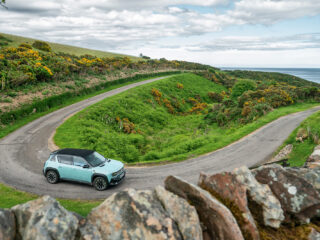
That car is the Mazda MX-5 Miata. Mazda lists the 2026 MX-5 Miata Sport soft top at a starting MSRP of $30,430, excluding destination and other fees. Better still, Mazda doesn’t make buyers pay for a higher trim just to get the manual: the Sport and Club are manual-only, while the Grand Touring offers a choice between the six-speed manual and six-speed automatic.
Under the hood is Mazda’s naturally aspirated 2.0-liter Skyactiv-G four-cylinder producing 181 horsepower at 7,000 rpm and 151 lb-ft at 4,000 rpm, with a 7,500-rpm redline. The manual soft top weighs 2,366 pounds, uses a front-midship engine layout, and sends power exclusively to the rear wheels.
|
2026 Sports Car |
MSRP |
Power |
Manual Transmission |
|
Mazda MX-5 Miata Sport |
$30,430 |
181 HP |
Standard |
|
Toyota GR86 |
$31,400 |
228 HP |
Available |
|
Subaru BRZ |
$35,860 |
228 HP |
Standard |
|
Nissan Z Sport |
$42,970 |
400 HP |
Available |
The GR86 beats the Miata by 47 hp, and you’ll feel it when you put your foot down, but for $970 more. The BRZ uses essentially the same 228-hp formula at a higher entry price. The Z is in another power league entirely, but you pay accordingly.
What’s more, the MX-5 isn’t bare-bones transportation dressed up as a sports car. The Sport gets an 8.8-inch infotainment display with Apple CarPlay and Android Auto functionality, LED lighting, keyless entry, and safety equipment including blind-spot monitoring, rear cross-traffic alert, Smart Brake Support, and lane-departure warning. Mazda has managed to add the things a modern car needs without turning its smallest sports car into something much larger, heavier, or, more importantly, pricier.
The Miata’s lack of outright power has always been part of the package rather than an accident. The MX-5’s engine doesn’t need to overpower the chassis for the car to make sense. You use the gearbox, work through the rev range, and rely on low mass rather than brute force to do most of the entertaining.
`;
}
itemsHtml += `

`;
itemsHtml += `
${price}
${isGreat ? ‘Great price‘ : ”}
${below ? `
${below}
` : ”}
View full listing
${src.title || ”}${src.type !== ‘car_bid’ ? ‘ ‘ + (props.trim || ”) : ”}
`;
if (src.dealername || address) {
itemsHtml += `
${src.dealername ? `${src.dealername}${props.address ? ‘,’ : ”} ` : ”}
${address}
` : ”}
${distance ? `
${distance}
` : ”}
`;
}
itemsHtml += `
`;
}
if (!itemsHtml) return;
section.innerHTML = “;
initCarousel(section);
})
.catch(function () {});
function initCarousel(section) {
var track = section.querySelector(‘.listing-marketplace-carousel__track’);
var container = section.querySelector(‘.listing-marketplace-carousel__items’);
var cards = section.querySelectorAll(‘.listing-marketplace-carousel__item’);
var leftBtn = section.querySelector(‘#carousel-left’);
var rightBtn = section.querySelector(‘#carousel-right’);
var index = 0;
function cardStep() {
var gap = parseFloat(getComputedStyle(container).gap || 0) || 0;
return cards[0].getBoundingClientRect().width + gap;
}
function maxIndex() {
var visible = Math.max(1, Math.floor(track.clientWidth / cards[0].getBoundingClientRect().width));
return Math.max(0, cards.length – visible);
}
function go() {
index = Math.max(0, Math.min(index, maxIndex()));
track.scrollTo({ left: index * cardStep(), top: 0, behavior: ‘smooth’ });
}
var sendCarouselNav = function () {
if (!window._carouselNavFired && window.websiteSentinel && typeof window.websiteSentinel.sendEvent === ‘function’) {
window._carouselNavFired = true;
window.websiteSentinel.sendEvent(‘Car Marketplace’, ‘listingscarousel_nav’, window.location.href);
}
};
rightBtn.addEventListener(‘click’, function () { index++; go(); sendCarouselNav(); });
leftBtn.addEventListener(‘click’, function () { index–; go(); sendCarouselNav(); });
var scrollNavFired = false;
var scrollNavTimeout;
track.addEventListener(‘scroll’, function () {
if (!scrollNavFired) { scrollNavFired = true; sendCarouselNav(); }
clearTimeout(scrollNavTimeout);
scrollNavTimeout = setTimeout(function () { scrollNavFired = false; }, 1000);
});
window.addEventListener(‘resize’, go);
}
}
if (document.readyState === ‘complete’) {
setTimeout(init, 200);
} else {
window.addEventListener(‘load’, function () { setTimeout(init, 200); });
}
}());
The Essential Reason Mazda Has Kept It So Affordable

Mazda has been thinking this way since the first MX-5. Its own history says the original development team stripped away unnecessary equipment instead of chasing more power and features. Engineers wanted to keep weight and cost down without giving up the handling they considered essential. That meant sticking with rear-wheel drive even when cheaper layouts were available.
A turbocharger could give the current MX-5 a punchier dyno sheet, while bigger tires, stronger brakes, and more power could raise its limits. But each addition usually asks for something else in return, whether that’s more cooling, heavier hardware, or more money. Mazda instead gives the manual Sport 181 horsepower and only 2,366 pounds to move around. It doesn’t need huge numbers to work.
The manual isn’t hanging around just so Mazda can say it still offers one, either. Motor1 reported that roughly 70% of MX-5 buyers chose the manual in 2025, while Subaru said 90% of BRZ buyers did the same. Those numbers look very different from the overall new-car market, where manuals have become almost irrelevant. Give affordable sports-car buyers three pedals, and plenty of them still want to row their own gears.
That also helps explain why the MX-5’s modest output works in its favor. You use the gearbox, work through the rev range, and rely on low mass instead of brute force to make the car fun to drive. There’s no need for 400 horsepower or ridiculous road speeds to get something out of it. In this case, simplicity keeps the price down and the grin intact.
Beyond The MX-5: Why This Simple Formula Still Matters

The bigger story isn’t that the manual gearbox is about to disappear completely. Modern automatics are faster and more efficient than they used to be, wiping out many of the practical reasons for shifting yourself. Manuals have instead become an enthusiast choice, valued less for what they can do better and more for how they make a car feel. What’s left is mostly the experience.
And manuals can survive while affordable manual sports cars still disappear. Buyers spending Porsche, BMW M, or other premium-performance money can still find three pedals in select models. The harder question is whether someone with roughly $30,000 to $35,000 will still be able to buy the same kind of purpose-built sports car. If the MX-5, GR86, and BRZ disappear or get much more expensive, that entry point goes with them.
Mazda now has to protect that formula while preparing the MX-5 for a very different automotive market. The company has discussed keeping the next-generation roadster extremely light while considering a structure capable of supporting non-combustion powertrains. Batteries, additional safety equipment, and new powertrain hardware can all make that harder. But the hardest feat ahead may be keeping the price of the MX-5 near today’s level.
A heavier, more complicated, and more expensive MX-5 could still be a very good sports car. But it would move away from the simplicity that has kept the nameplate within reach for more than three decades. The manual transmission itself will probably survive somewhere, especially at the expensive end of the market. The real question is whether the affordable manual sports car survives with it.







No Comments