
The Korean V8 Sleeper That Took The Fight To Europe’s Luxury Car Industry
Over the past decade, the U.S. luxury car market has experienced a structural pivot defined by the decline of traditional sedans. There’s now an overwhelming dominance of luxury crossovers and SUVs with a strong transition toward electrification. Affluent American consumers increasingly prioritized elevated driving height, cabin space, and multi-terrain versatility over traditional executive silhouettes.

Battery-electric architecture and software-defined platforms are also displacing larger internal combustion engines, providing more power and better efficiency. Not too long ago, V-8 engines were the go-to for most brands operating in the luxury segment. One South Korean option executed this with impressive refinement.
Genesis’s Approach To Modern Luxury
Over the past decade, Genesis has established a distinct presence in the luxury automotive sector by departing from traditional European design conventions. It focuses on athletic proportions and minimalist refinement. The brand continues to establish a cohesive visual identity built around its signature Crest Grille and parallel two-line lighting signatures.

The strategic direction prioritized inclusive product delivery, incorporating ultra-quiet cabins, advanced driver assistance systems, and high-tier interior materials as standard baseline features. It does so to compensate for the relative lack of heritage it has compared to European rivals. As market demands shifted, the overall project strategy expanded swiftly from traditional three-box saloons to high-riding utility vehicles and modular electric architectures. This trajectory emphasized architectural purity, tactile material selection, and sustainable propulsion, positioning the marque as a technology-focused alternative in the global luxury landscape.
The 2018 Genesis G90 V-8 Is An Understated Luxury Sleeper

The 2018 Genesis G90 served as the flagship full-size luxury sedan, occupying the top of the brand’s lineup above the executive G80 sedan. The G90 prioritized maximum passenger room, hushed interior refinement, and complete standard equipment offerings rather than charging exorbitant fees for optional add-ons. The goal was for it to compete directly with elite flagship rivals such as the Mercedes-Benz S-Class and BMW 7 Series.
Sales volume for the 2018 model year reflected its deliberate positioning as an exclusive alternative to established European icons. In the U.S., total Genesis G90 sales reached 2,136 units for calendar year 2018. The V-8 engine variant accounted for a minority fraction of those overall sales, as many luxury buyers selected the cheaper 3.3-liter twin-turbocharged V-6 engine. Globally, sales reached 12,236 units for 2018, with the overwhelming majority of buyers located in the brand’s home market of South Korea.
What Made The V-8 Such An Underrated Option

Genesis operated with a simplified single-trim philosophy for the V-8 model. Buyers looking for the eight-cylinder engine automatically received the fully loaded 5.0 Ultimate configuration, eliminating complex option packages. When new in 2018, the rear-wheel-drive Genesis G90 5.0 Ultimate’s MSRP started at $71,850. Opting for the brand’s advanced all-wheel-drive system raised the base sticker price to $74,350. A mandatory destination charge added $975 to both figures.
Depreciation has affected full-size luxury flagships heavily across the board, transforming the 2018 G90 V-8 into a compelling secondary market option. According to Edmunds and J.D. Power, clean examples on the used market generally trade between $14,933 and $19,208 depending on total mileage, service history, and physical condition. Lower mileage vehicles under 60,000 miles average around $19,000 to $22,000, while well-maintained higher mileage examples with closer to 100,000 miles frequently sell between $13,000 and $16,000.
A Simple Design With Impressive Performance

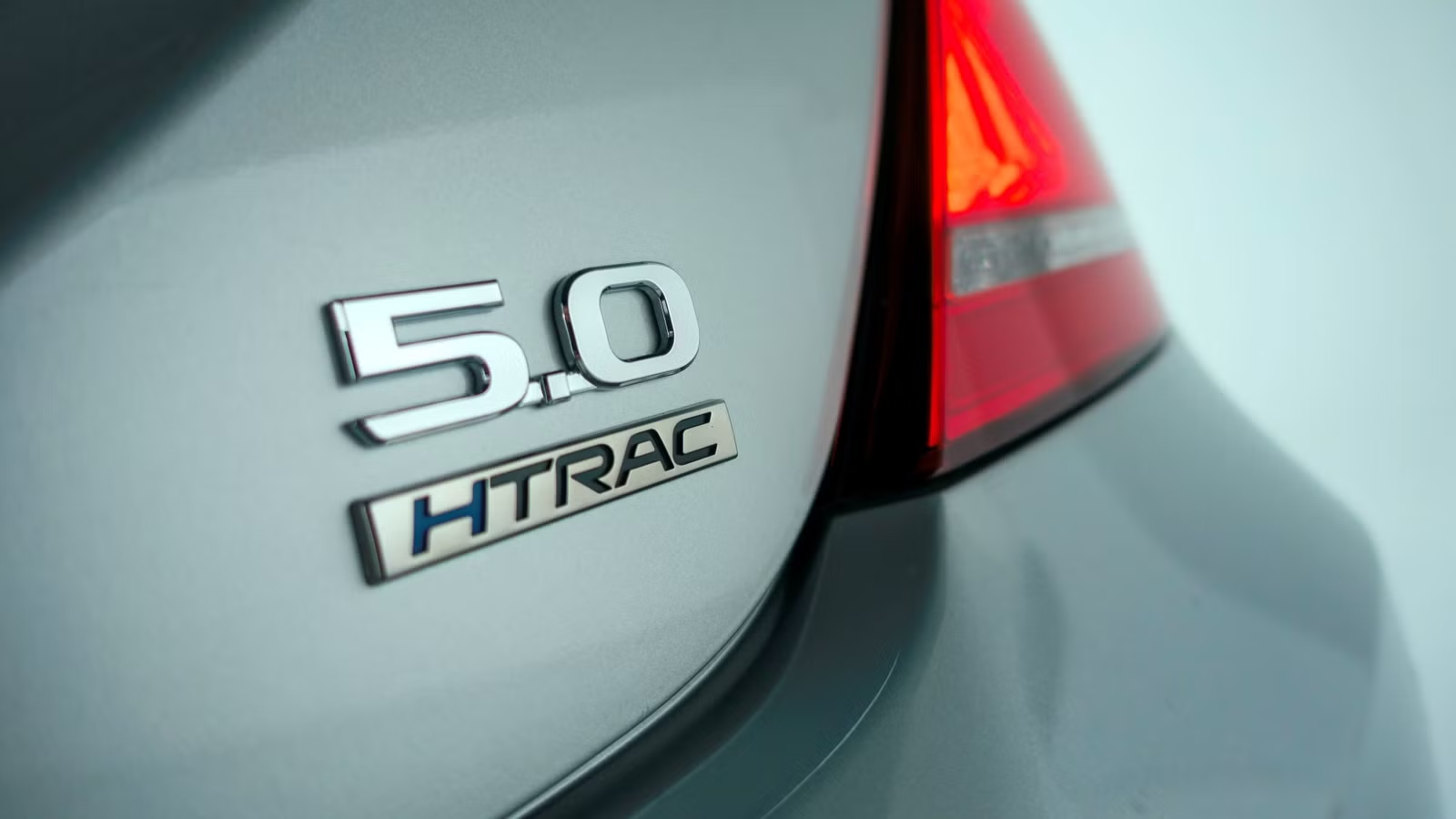
The 2018 G90 5.0 Ultimate features Hyundai’s naturally aspirated 5.0-liter Tau V-8 engine. The design consists of an aluminum cylinder block and matching aluminum cylinder heads, with double overhead camshafts and dynamic dual continuously variable valve timing alongside high-pressure gasoline direct injection. Output figures stand at 420 horsepower at 6,000 RPM and 383 pound-feet of torque delivered at 5,000 RPM.
Genesis pairs this with an eight-speed electronic automatic transmission equipped with manual shift controls and steering-wheel-mounted paddle shifters. Drivetrain options include standard rear-wheel drive or the optional H-TRAC all-wheel-drive system. The H-TRAC layout utilizes an electronic variable torque split clutch capable of routing up to 40 percent of available engine power to the front axle to maximize stability in low-traction environments. Fuel economy ratings are 16 MPG in the city, 24 MPG on the highway, and 19 MPG combined for rear-wheel-drive variants, with all-wheel-drive versions rated at 15 MPG city, 23 MPG highway, and 18 MPG combined.
How To Keep The Tau Running Forever

Maintaining the N/A Tau V-8 requires regular maintenance to preserve power output and mechanical longevity. While initial owners received three years or 36,000 miles of complimentary scheduled maintenance, subsequent owners must account for routine service costs out of pocket. Oil service intervals are recommended every 7,500 miles or 12 months under normal driving conditions. The 5.0-liter engine requires 8.4 quarts of full synthetic motor oil, driving typical oil and filter service costs up to approximately $160 to $210 per visit.
Routine service intervals mandate replacing cabin air filters every 15,000 miles, which generally costs between $50 and $90. Engine air intake filters demand replacement every 30,000 miles at an estimated expense of $70 to $110. Brake fluid flushes should occur every two years or 30,000 miles, running roughly $150 to $220. Spark plug replacement for all eight cylinders is scheduled at 105,000-mile intervals, with parts and labor averaging between $350 and $550. Premium fuel costs, high oil capacities, and large brake components mean routine maintenance costs remain higher than ordinary passenger sedans, matching the realities of full-size luxury vehicle ownership.
Some Common Issues You’ll Need To Be Aware Of

Despite a strong track record for overall drivetrain reliability, the 2018 G90 5.0 Ultimate exhibits a few known mechanical and electrical vulnerabilities that prospective buyers should evaluate. The electronic adaptive suspension system uses active dampers to smooth out road imperfections. Over time or at higher mileages, these complex electronic struts can suffer from leaking fluid seals or internal actuator failures, resulting in a firm ride and costly component replacements compared to traditional mechanical shock absorbers.
Direct injection technology on the 5.0-liter V-8 engine introduces the potential for carbon buildup on the intake valves over long periods. Because fuel is sprayed directly into the combustion chamber rather than across the intake valves, oil vapors can accumulate on valve stems, eventually requiring intake valve cleaning or manual walnut blasting to restore original engine performance. The electronic soft-close door mechanisms can suffer from micro-switch wear inside the door latch assemblies, causing doors to stop pulling fully flush. Additionally, the central infotainment unit can occasionally exhibit system lockups, delayed Bluetooth pairing, or temporary navigation blackouts that usually require dealer software updates to rectify.
Recalls Associated With The 2018 Model Year

Safety recalls issued by the NHTSA impacted specific batches of the 2018 Genesis G90 lineup. A notable action involves an electrical short circuit risk in the engine starter assembly. Moisture intrusion into the starter solenoid could cause an internal electrical short, potentially leading to an engine compartment fire hazard whether the vehicle was actively driven or parked. Authorized Genesis dealerships resolved this issue by installing an upgraded relay kit into the main engine junction box to prevent circuit overload.
An earlier factory recall affected the structural glass bonding on select 2018 models. Improper assembly primer application during manufacturing reduced the bonding strength of the front windshield and rear window glass panel. Under certain circumstances, improper adhesion could allow glass panels to detach from the body frame during a collision or under heavy stress. Dealerships addressed the defect by removing the original glass, applying proper adhesion primer, and reinstalling or replacing affected windshield assemblies. Recalls regarding turbocharger oil supply lines on smaller displacement models did not affect the naturally aspirated 5.0-liter V-8 trim.
Sources: Genesis, J.D. Power, the EPA, and the NHTSA

Related posts




Latest Post


No Comments