
The Kawasaki That Makes You Wonder Why You’d Spend More
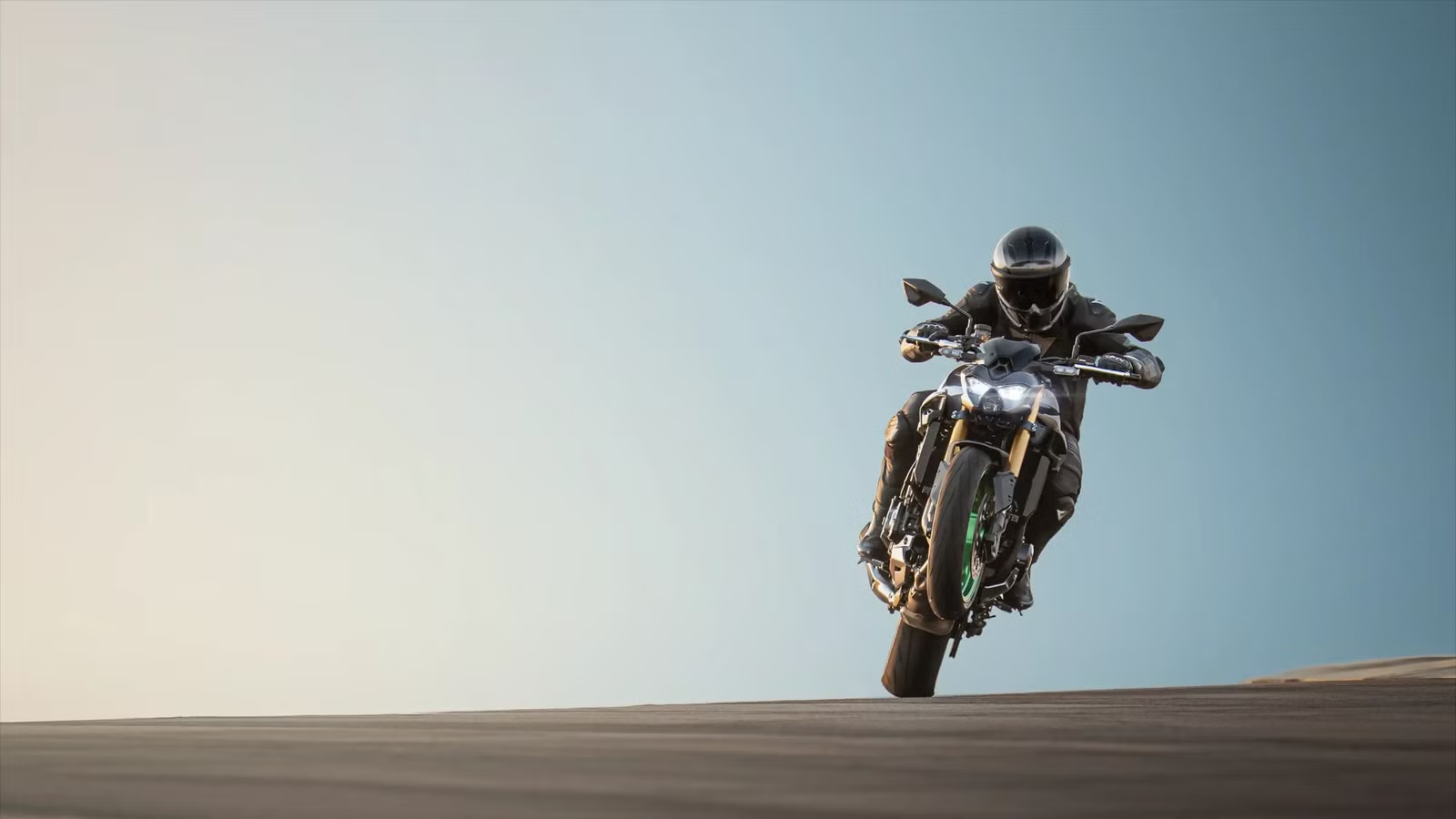
High-value motorcycles offer the best engine, technology, build quality, and features without charging exorbitantly. There are various categories of motorcycles that fall into this space, but if we are talking about one brand that has made this identity its own, it is Kawasaki.

The Japanese brand earned this recognition by focusing on an engine-first philosophy. Kawasaki delivers uncompromising quality like its European counterparts, but at a lower price. Moreover, there are other factors that work in their favor. The company has a global manufacturing footprint, with production facilities across multiple countries, allowing it to adapt to various markets while being efficient and accessible worldwide.
Furthermore, Kawasaki has decades of experience refining its platforms, rather than building them from the ground up with every generation. These factors help Kawasaki price its motorcycles competitively and establish itself as one of the best high-value brands in its segment.
Kawasaki Has No Shortage Of Competitively Priced Machines

The competitive pricing range that Kawasaki offers is not limited to one motorcycle. Kawasaki has spread its reach across different segments, ensuring its models are coupled with capable engines and reliable hardware that cater to riders’ needs.
Starting with the entry-level Kawasaki and mid-tier lightweight, the Ninja 300 and 500 deliver approachable performance backed by the proven reliability of their ‘bulletproof’ parallel-twin. Both are aggressively priced at around $5,000. The 300’s pricing makes it a highly affordable premium option compared to the single-cylinder bikes available in that range. The 500’s pricing, on the other hand, undercuts its double-cylinder competitors. Its naked sibling, the Z500, goes a step further by shedding the plastic fairings, giving it an aggressive streetfighter look, while also offering an even lower price tag.

The pattern continues with the Ninja 650 and Z650, and the heavyweights further up the range. Generally, bigger engines and improved performance equate to sophisticated electronics and durable components, which naturally drive up the price. Surprisingly, Kawasaki motorcycles bring all this while keeping the price and their competitors in check. The trick up their sleeve is avoiding the temptation of having an overwhelming specification sheet. They focus on fundamentals that improve the riding experience, and perhaps the clearest example of this formula is the Z900 Streetfighter.
The Z900 Bends The Rules Of Midweight Naked Bike Value

Z900’s journey began with a 750cc rivalry. Kawasaki initially designed a bike in this segment before scrapping its plans when Honda dropped the revolutionary CB750. This forced Kawasaki back to the drawing board, but what came of it was the birth of a legend. Four years after the reset, Kawasaki introduced the Z1 in 1972, pumping 85 horsepower from its 903 cc air-cooled inline-four. It immediately grabbed the crown of the fastest and most powerful production motorcycle in the world at that time.
The Z900 nameplate was officially introduced in 1976, improving upon the Z1 platform. The run was unfortunately short-lived. But throughout the years, the Z badge has lived under various monikers and carried forward the legacy. The Z900 eventually marked its return 40 years later in 2017 with a revived Sugomi design, replacing the departing Z800.

As a middleweight naked bike, the Z900 has successfully scooped the market, thanks to Kawasaki’s understanding of a proper high-value motorcycle. As of 2026, it is the only sub-$10,000 bike in its class. Providing near-liter-bike performance and hardware to match, it is fair to say the Z900 is the best in class.
The SE Adds Brembo Brakes, Öhlins Suspension, And A $2,000 Premium

If you felt the standard Z900 was too basic, Kawasaki brings a solution to that as well with the SE variant. While both share the same foundation, what makes the SE stand out is its sophisticated hardware. The standard Nissin front brakes are replaced with Brembo M 4.32 radial-mount monobloc calipers with stainless-steel braided lines.
Öhlins S46 gas-charged rear shocks come with a remote preload adjustment knob, allowing for effortless adjustments. Up front, it gets upgraded 41mm inverted forks with a distinctive gold color. If, for some reason, the two-tone stitched seat with a thicker urethane pad focused on longer distances doesn’t catch your eye, the SE-exclusive green paint scheme should do the job. However, these benefits come at an additional $2,000. It is worth it.
Kawasaki Z900 Is Fast Enough To Entertain, But Civilized Enough To Live With
How Kawasaki Shed 15 Pounds From Its Famously Heavy Frame

What makes the Z900 a bang-for-the-buck proposition is the engine and the chassis. Kawasaki sticks to its proven formula, powering the Z900 with a smooth 948cc liquid-cooled inline-four engine. It produces a segment-leading 123 horsepower at 9,500 rpm and a maximum torque of 73.1 pound-feet at 7,700 rpm. Housing this is a frame that has been developed from the mistakes of the past.
The previous Z badge holders were infamous for their heavy frame. It has been the oldest complaint against the model. Kawasaki addressed this by removing the bulky spine and introducing a steel trellis frame. Not only does it shed a mammoth 15.4 pounds (the Z800’s frame weighed 45.2 pounds), but it also uses the engine as a structural support, reducing unnecessary chassis weight. The aluminum swingarm also contributes to the weight reduction, helping the rear suspension react faster on rough roads.
Aggressive Looks, Surprisingly Comfortable Riding Position

Initially, the Sugomi design may ward off eyes looking for comfort. However, the Kawasaki Z900 strikes a strong balance between an aggressive riding position and all-day comfort. The wide handlebar sits slightly higher, providing a gentle forward lean, reducing the pressure on the wrists. The footpegs are positioned slightly rearward, giving enough leverage for your feet without cramping your knees. At just 31.9 inches, the seat height is on the lower side for a bike of its class, making the Z900 approachable for a wide range of riders.
Fully Adjustable Suspension — A Feature Rivals Charge Thousands Extra For

The stopping power comes from dual 300mm semi-floating discs with radial-mount four-piston calipers up front. The rear tire is coupled with a 250mm disc with a single-piston caliper. Both the front and rear suspensions are fully adjustable. The front features a 41mm inverted telescopic fork with rebound damping and spring preload adjustability. The rear also features the same benefits, along with a gas-charged shock with 5.5 inches of travel. The Z900’s hardware is tuned less aggressively, making it commute-friendly while still delivering weekend fun.
Four Ride Modes, Cornering ABS, And A Quick Shifter — All Under $10,000

Despite its pricing, the Z900 doesn’t compromise on the technological front. It features two power modes — Low and High — and four ride modes. Sport, Rain, and Road come preset, whereas the fourth — a customizable rider mode — allows you to make adjustments as needed. The five-inch display is big enough to showcase all the necessary details and ride modes, and supports various commands through the Rideology app.
Safety is not overlooked either, as the Z900 comes with Kawasaki Traction Control (KTRC), a three-level system that can be adjusted as needed. Some additional technological and safety features that come along with the $9,999 Kawasaki are an assist and slipper clutch, Kawasaki Quick Shifter (KQS), and Kawasaki Cornering Management Function (KCMF).
No Other Sub-$10,000 Gets You A Similar Package

Ultimately, it is difficult to overlook what the Z900 packs. Within this price bracket, every competitor sacrifices something, be it a cylinder, raw power, or electronics. Among the two-cylinder alternatives, the Suzuki GSX-8S and Yamaha MT-07 sit comfortably under the price bracket. However, in the process, they lack around 50 horsepower, a massive difference that can be clearly felt when the throttle is opened and the bikes are pushed.
If the intention is to match the power generated by the Z900, then the three-cylinder options, like the Triumph Street Triple RS or the Yamaha MT-09, are the only alternatives. However, they are expensive. Kawasaki has strategically priced the Z900 to undercut all of its rivals. Kawasaki has priced the motorcycle so that spending a little more than a two-cylinder costs gets you an inline-four, while making you question why you would spend more for a three-cylinder.
Source: Kawasaki

Related posts
Latest Post


No Comments