
The Japanese Superbike That Made 750cc Rivals Look Fat And Slow
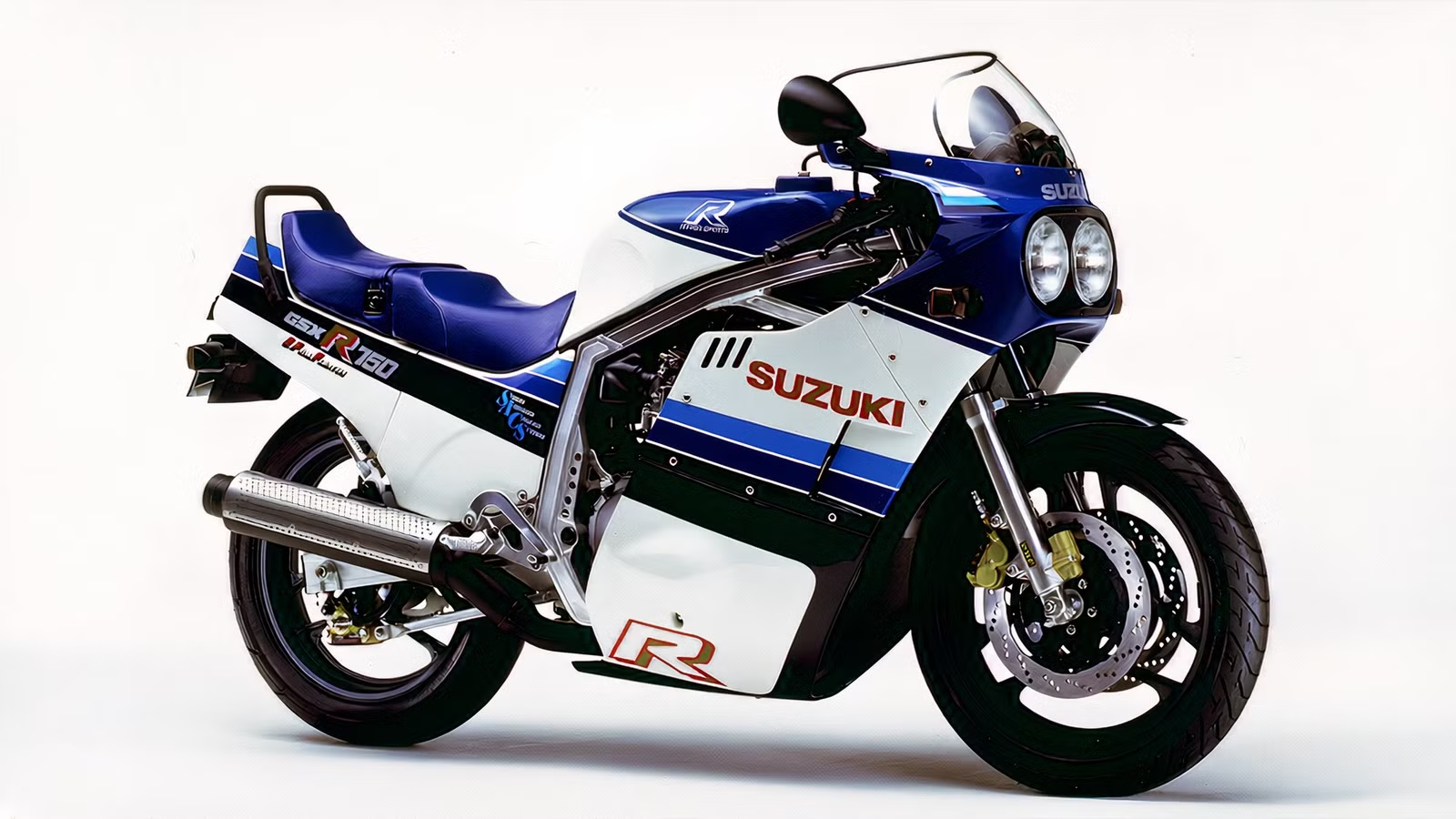
By the middle of the 1980s, Japanese manufacturers had figured out how to make a 750 genuinely fast. Honda had its V4 Interceptor, Kawasaki was extracting serious performance from the GPz750, and Yamaha arrived in 1985 with the five-valve FZ750. Horsepower was climbing quickly, but so was weight. A fast 750 could easily weigh more than 450 pounds before fuel entered the tank.

Suzuki took a different approach. Rather than chasing another jump in outright engine output, its engineers began removing mass wherever they could find it. The resulting motorcycle was developed around roughly 100 horsepower and a dry weight below 400 pounds. That combination would make competing 750s look much more like conventional road bikes.
750cc Superbikes Had Become Big, Fast Road Bikes
There was nothing slow about the early-1980s 750 class. Kawasaki’s 1983 GPz750 used a 738cc air-cooled DOHC four with revised cams, higher compression, larger carburetors, and extensive cylinder-head work. Kawasaki claimed 85 horsepower, up from 80 horsepower the previous year. Period testing established the GPz as one of the quickest motorcycles in its displacement class.

The problem was that extracting more performance had not necessarily made these motorcycles lighter. The GPz750 also used a conventional steel frame, reflecting the more traditional road-bike construction common in the class. These were still road motorcycles first, with racing informing their development rather than dictating the entire package. The distinction between a fast street bike and a production race bike remained fairly clear.
Honda And Kawasaki Were Already Fighting For The 750 Class

Honda moved the category further with the VF750F Interceptor in 1983. Its liquid-cooled 748cc V4, perimeter-style chassis, and racing success made the Interceptor one of the most technically important Japanese performance motorcycles of the period. Cycle World recorded an 11.67-second quarter-mile at 115 mph. For a 750 introduced in 1983, those were serious numbers.
The competition became even more intense by 1985. Yamaha’s FZ750 introduced its 749cc Genesis four with five valves per cylinder and around 100 horsepower. It was an advanced engine in a motorcycle weighing roughly 461 pounds dry. Suzuki didn’t necessarily need another 20 horsepower to change the class. Removing 60 or 70 pounds from a motorcycle with comparable power could accomplish just as much.
The 1985 Suzuki GSX-R750 Was Built Around One Number

The GSX-R750 that appeared at the 1984 IFMA show in Cologne was built around an aggressive target: 388 pounds dry. Suzuki wanted roughly 100 horsepower from a 750cc motorcycle weighing less than 400 pounds, when competing 750s commonly weighed well over 450 pounds. Former Suzuki race-team manager Etsuo Yokouchi oversaw the project, drawing heavily from the XR41 endurance racer and smaller GSX-R400. Production began at Hamamatsu in January 1985.
Reaching that target meant treating weight as a problem throughout the motorcycle. Suzuki’s engineers tested existing GSX750 engine components until they failed, then determined how much material each part actually needed. The frame, cooling system, bodywork, and engine components were all subjected to the same process. Suzuki’s retrospective describes cases where only a gram separated a component that survived testing from one that failed.
The Production Bike Missed The Target By Just Seven Pounds

Suzuki’s development history puts the intended dry weight at 388 pounds. The final Japanese-market specification came in slightly heavier at about 395 pounds dry. Either number was extraordinary for a 750 at the time. Suzuki’s historical archive notes that competing motorcycles in the class commonly weighed well over 440 pounds.
Yamaha’s FZ750 makes the difference easy to see. At roughly 461 pounds dry, it weighed 66 pounds more than the 395-pound GSX-R750, despite both displacing 749cc and producing similar power in export trim. The earlier Kawasaki GPz750 was heavier still at roughly 480 pounds dry, putting it about 85 pounds above the Suzuki. The GSX-R750 wasn’t competing in a smaller displacement class. It was simply carrying far less weight.
Its Oil-Cooled Four Made Around 100 Horsepower

The GSX-R used a 749cc DOHC inline-four with four valves per cylinder, a 2.76-inch bore, and a 1.92-inch stroke. Suzuki developed the engine around approximately 100 horsepower, although output varied by market. The restricted Japanese-market version produced considerably less than the export bike.
Power was only half of the engineering problem. Suzuki needed a compact, durable engine without giving back the weight being removed elsewhere. During testing, one development engine was held at 12,500 rpm, around 2,000 rpm beyond its peak-power speed, for 30 hours. It survived, demonstrating that the weight-reduction program had not produced a disposable racing engine.
SACS Helped Suzuki Avoid The Weight Of Liquid Cooling

Instead of conventional liquid cooling, Suzuki developed the engine around its Suzuki Advanced Cooling System, or SACS. The system circulated oil at high volume and directed it toward hot areas around the cylinder head and pistons. Suzuki had already experimented with the concept on machines including the XN85 and XR41. The GSX-R750 made it one of the motorcycle’s defining mechanical features.
Deciding on using oil cooling also had a direct weight argument behind it. A conventional liquid-cooled engine requires coolant, a water pump, a radiator, hoses, and the associated plumbing, while relying on air alone limits thermal control as output increases. SACS gave Suzuki another route, using engine oil for more of the cooling work while retaining the basic simplicity of an air/oil-cooled architecture. Suzuki credits the system with improving cooling and durability while contributing to the GSX-R750’s unusually low mass.
Suzuki Built The Chassis More Like A Race Bike Than A Road Bike

The XR41 influence extended beyond the engine. Suzuki based the GSX-R750’s chassis geometry on its endurance racer, using 26 degrees of rake and 4.2 inches of trail. It also retained 18-inch wheels rather than following the contemporary move toward a 16-inch front, allowing Suzuki to use larger 11.8-inch front brake discs. Even the fairing and twin headlights drew directly from the XR41.
The cockpit continued the theme, with foam surrounding its three instruments and a tachometer that didn’t begin registering until 3,000 rpm. Both details referenced Suzuki’s competition machinery. The GSX-R was still road legal, but the development process had effectively reversed the traditional superbike formula. Suzuki was adapting a racing package for the street rather than making a road bike progressively sportier.
An Aluminum Frame Helped Put The GSX-R On A Different Weight Scale

The aluminum frame was central to that approach. Suzuki constructed it from five cast-aluminum components and 21 extruded pieces, with only 26 major parts in total. The complete frame weighed less than 18 pounds. Suzuki says that was less than half the weight of a conventional steel frame.
The GSX-R750’s weight advantage didn’t come from one clever component. The combination of Oil cooling, the aluminum frame, and lightweight bodywork all worked together to bring the mass down. Suzuki also used an aluminum alloy developed for racing that didn’t require heat treatment after welding, making it more practical for production. Together, those decisions put a 750 into a weight range normally associated with much smaller motorcycles.
The GSX-R750 Changed The Formula For Japanese Superbikes

The GSX-R750 went racing almost immediately and won the 24 Hours of Le Mans endurance race in 1985. Suzuki followed with the limited-production GSX-R750R in 1986, adding a dry clutch, steering damper, and radial tires. In Japan alone, more than 5,700 standard GSX-R750s were registered between March and December 1985. The lightweight road bike had quickly proved that its race-bike influence went beyond styling.
More importantly, the original GSX-R established a formula Suzuki would refine for decades: strong power inside a chassis developed around low weight and racing performance. Frames, cooling systems, suspension, and electronics changed dramatically over subsequent generations, but the basic idea survived. Suzuki still sells the GSX-R750 more than 40 years later. The 1985 bike showed that making a 750 substantially lighter could matter just as much as making it more powerful.
Source: Suzuki Global, Yamaha Motor, Cycle World

Related posts



Latest Post


No Comments