
The Japanese Sportbike That Makes Every Dollar Count
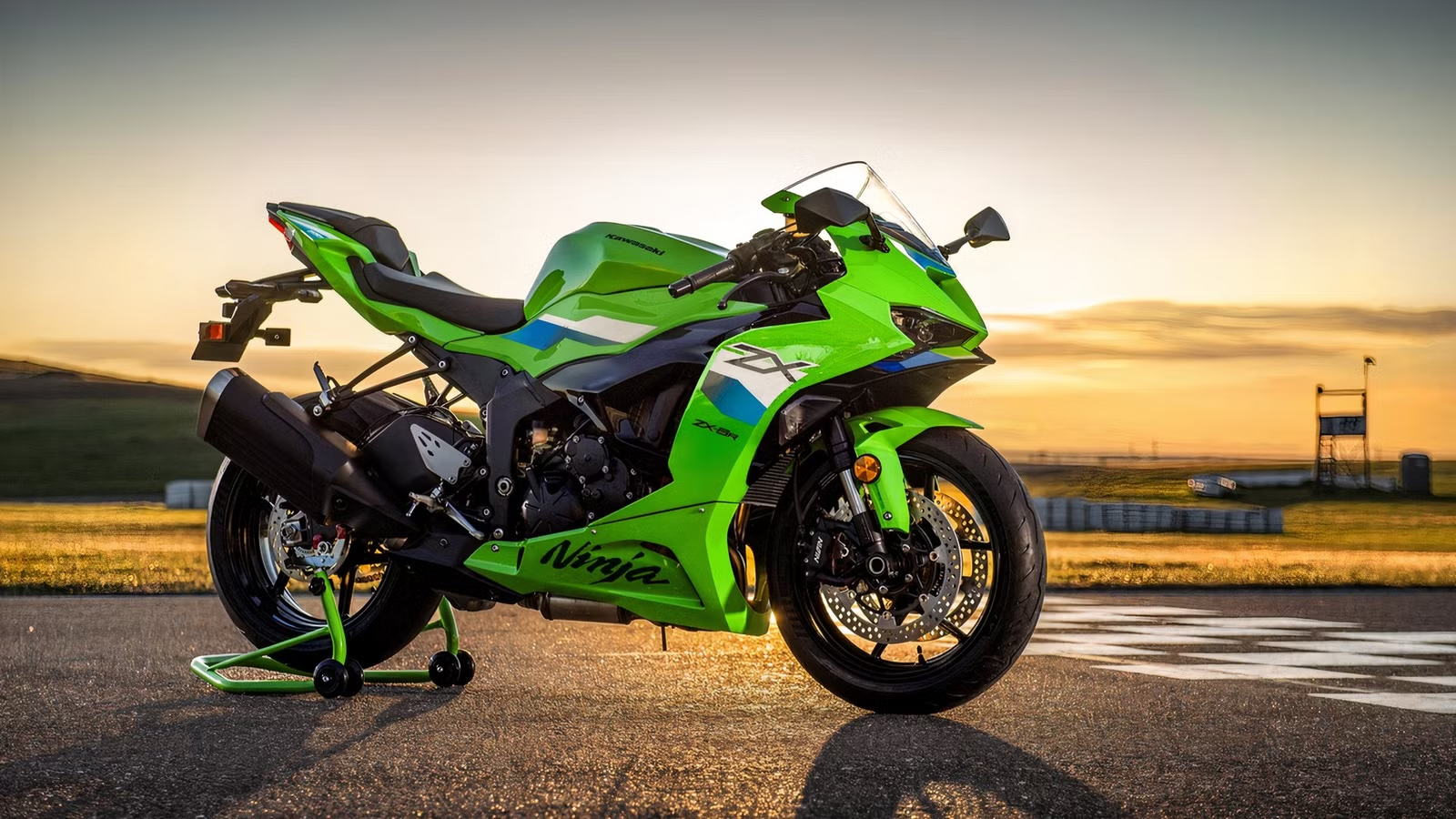
The idea of a sportbike has always been to go as fast as possible around the racetrack. That means light weight, a responsive chassis, and brakes, tires, and a driveline that all promise to give you a thrill a minute on a circuit.

Modern showrooms tell a different story, where manufacturers rely heavily on shared platform components to drive down retail prices. This shift has led to a proliferation of parallel-twin sportbikes that make bean counters happy, but leave purists underwhelmed.
Homogenization Will Take Away Excitement
By definition, when you talk about commonality of parts, it means that one part needs to suit multiple applications, and therefore tolerances might go up, but the stress on those components needs to go down. This is great for manufacturing costs and reliability, but it definitely contributes to reduced excitement. This is the way of the world today; most sportbike owners aren’t truly interested in honing their skills on a racetrack, and instead want the looks of a sportbike without all the negatives that come with it.
Middleweight Sportbikes Have Been The Hardest Hit


Flagship sportbikes don’t have much of a problem when it comes to homogenization. They are, by definition, flagship products and need to be the biggest, best, and fastest, so they have bespoke engineering. At the opposite end of the sportbike segment, expectations are low. Most beginner riders do not know what they want anyway, let alone have the knowledge and skill to judge a good bike from a mediocre one.
Where this watering down of excitement has hit hardest is the middleweight sportbike. These used to be the purest form of sportbike, but now they are just a cog in the platform-sharing machine with their parallel twins and easy riding positions. They are one of a few models based on the same chassis and driveline, and they need to fit in alongside their naked, adventure, and sometimes even cruiser siblings.
Green Sportbikes Have A Legitimate Claim To Being Some Of The Best In The World

If it’s a screaming, high-revving inline-four-cylinder sportbike you want, you can’t go wrong with Kawasaki. It is one of the few manufacturers that has used this engine layout in sportbikes for many decades to great effect—not just with wins in racing, but with road bikes powered by this configuration that have consistently fought for the crown of highest top speed for a production bike.
Remember, Kawasaki was one of the manufacturers that put the fear of the Lord into regulators and put a cap on the top speed of all motorcycles everywhere. Small wonder then that the Japanese sportbike that makes every dollar count is painted in lime green.
The Kawasaki Ninja ZX-6R Is The Japanese Sport Bike That Makes Every Dollar Count

The rest of the middleweight sportbike segment has embraced compromises to make life on the road easier, but the Ninja ZX-6R remains an apex predator. This is a high-revving, uncomfortable supersport to most, but will appeal to those who want to hone their skills at a racetrack.
You cannot hide behind a surfeit of power, there are minimal electronics that don’t intrude on skill, and the hardware is so engaging that no matter how experienced or skilled you are, you are going to have a good time on it. A bonus is that decades of continuous refinement have made it exceptionally reliable.
A Sub-$12,000 MSRP Makes It The Most Affordable Path To 100+ Horsepower

The Ninja ZX-6R has a base price of $11,599, which puts it squarely in the middle of other middleweight supersport bikes. This is for the non-ABS version; if you add ABS to it, it jumps to $12,599. This does not seem like a particularly fair price because more modern middleweight sportbikes with significantly more features tend to be priced somewhat lower.
The Ninja ZX-6R does not share its components with any other Kawasaki motorcycle, and it is essentially a race-bred machine, so you have to expect a premium for that sort of pedigree. It remains the cheapest sportbike with over 100 horsepower. If you want a discount, the KRT version is priced at $200 less at this point in time because it is a previous year’s model.

Today, sportbikes are increasingly being tuned for street usability. Kawasaki took note of this over 20 years ago when it increased the displacement of the 599 cc ZX-6R to 636 cc in 2002. This is still a screamer inline-four with a 12.9:1 compression ratio, but it now makes 127 horsepower at 13,000 RPM and 52.1 pound-feet of torque at 10,800 RPM.
Since peak torque arrives so high in the rev range, you’ll need to work the gearbox to keep it spinning high. There is no low-rev torque to pull you out of a missed downshift. This is fed through a six-speed gearbox with an assist-and-slipper clutch and an upshift-only quickshifter. An unexpected bonus is that it has been so reliable, it is still in production after decades.
Old-School Race-Bred Frame Is Designed For Maximum Attack

The middleweight Ninja has an aluminum perimeter frame with a double-sided swingarm. This hasn’t changed much in some time either, and it is designed for the best lap times possible.
The suspension consists of 41 mm Showa inverted forks; these are Separate Function Big Piston forks with preload, compression, and rebound adjustment. Additionally, they have top-out springs. At the rear, the monoshock has stepless compression and rebound damping adjustment, as well as preload adjustment. The suspension travel available is 4.7 inches at the front and 5.9 inches at the rear.

Braking hardware is equally impressive with twin semi-floating 310 mm discs at the front with radial four-piston calipers, and a single 220 mm disc at the rear with a single-piston caliper. The brakes are good enough to offer great initial bite and fade-free feel over and over again at a track day. Seventeen-inch alloy wheel rims and sticky tubeless radial tires are fitted as well. It might not sound like much, but this is the ultimate confidence-inspiring sportbike.
Middleweight Dimensions, But Don’t Expect A Comfortable Rider Triangle

The ZX-6R is designed for maximum performance at a track, so while its dimensions read like a normal middleweight supersport, it definitely does not feel like a modern road-biased one when you ride it. It is 79.7 inches long and 28 inches wide. The wheelbase is 55.1 inches, which should make it very agile.
The seat height of 32.7 inches and the ground clearance, which stands at 5.1 inches, make it par for the course in its segment. The fuel tank can hold 4.5 gallons, and it weighs 434 pounds wet.
An Older Cable-Actuated Electronics Package Lacks Six-Axis IMU Precision
The ZX-6R remains a model from a time gone by when it quietly dominated the segment. However, the feature set reflects its age. It did receive an update in 2024 that added a 4.3-inch TFT display. It also has smartphone connectivity via Kawasaki’s Rideology app, but this display is quite basic and smaller than what is typical in the segment.
The throttle is cable-actuated, which you’d think means no ride modes, but you would be wrong! There are three ride modes available along with a custom fourth ride mode, and in the custom user-definable mode, you can also turn the traction control off. The traction control has a total of four levels, including off.

There is also the option of purchasing the Ninja ZX-6R without ABS, but overall the dual-channel ABS option makes a whole lot more sense, especially when you discover that this is a smart system that also helps with rear-wheel lift mitigation and can modulate the rear brake to account for downshifts and engine braking. It isn’t a bad electronics set, but it doesn’t compare to modern by-wire systems equipped with a six-axis IMU.
Direct Middleweight Competitors Offer Modern Tech At Similar Price Points

Evaluating the Ninja ZX-6R against its natural competition, such as the Honda CBR600RR and the Suzuki GSX-R600, would miss the point here because the middleweight segment has changed substantially. Instead, we are going to compare it to other sportbikes that offer the most per dollar. An obvious choice is the Suzuki GSX-R750, a sports bike that doesn’t need superbike power to impress.
It might not seem like much value at $13,249, but this is a bike that has stood the test of time and offers a brilliant mix of usable large-displacement torque and high-revving screaming power. It is also extremely reliable since it has been around the block more than a few times.

Then there is modern competition like the Yamaha YZF-R9, the best midweight sportbike for riders who want it all. At a price of $12,499, it is shockingly $100 cheaper than the ABS-equipped ZX-6R. This is a modern motorcycle with the CP3 inline-three crossplane engine that generates slightly less power and slightly more torque than the Ninja, but also has a by-wire throttle, a six-axis IMU, and a large TFT display that not only has Bluetooth and navigation, but can also be switched to a racetrack display and can even take commands from the pits. This makes it one of the most usable all-around middleweight sportbikes today.
Source: Kawasaki USA

Related posts

Latest Post


No Comments