
The Japanese Motorcycle That Makes European Performance Look Expensive
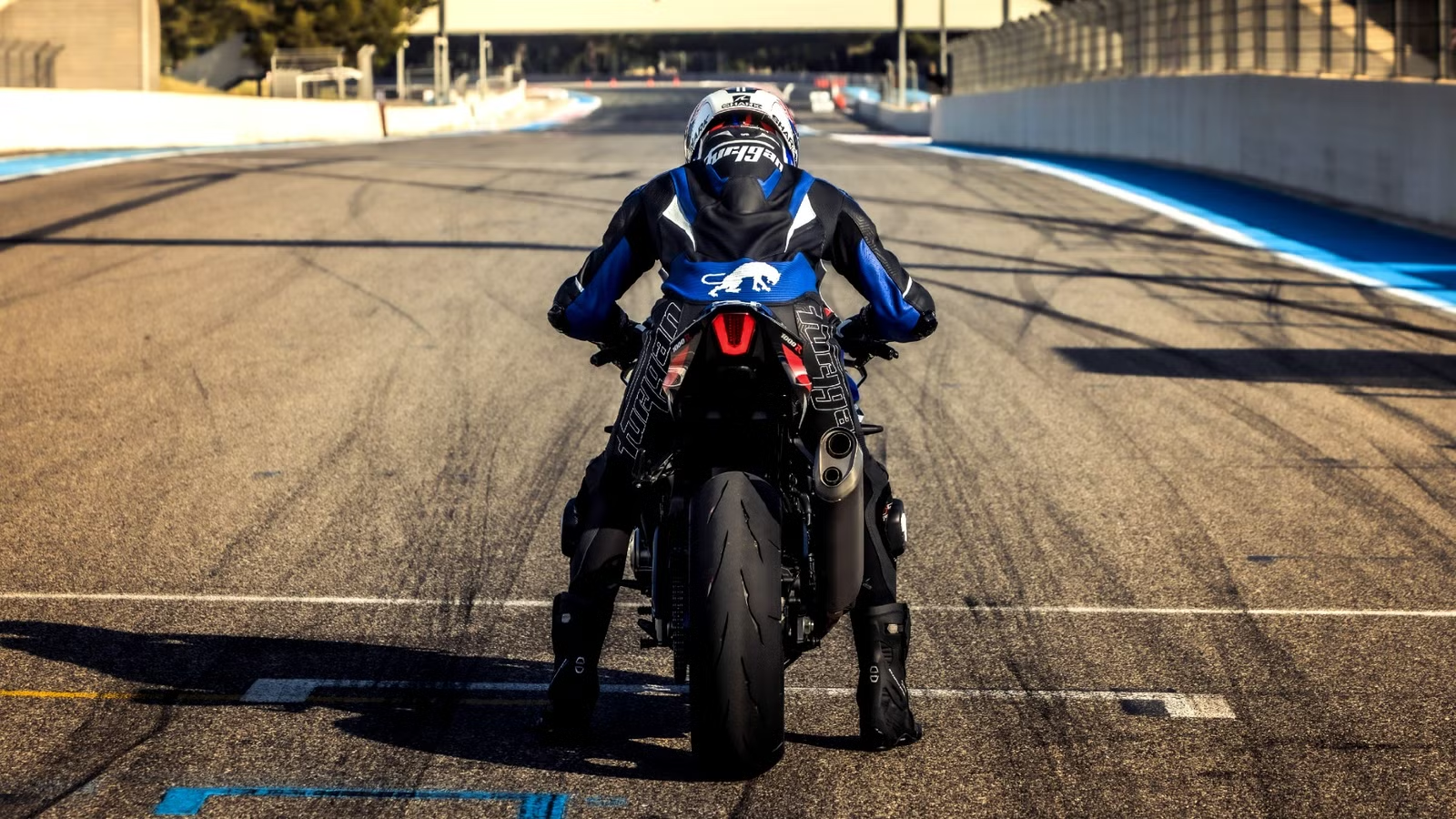
Most liter-bike riders often chase a specific moment: cracking the throttle open mid-corner and the motorcycle squatting down underneath them, while the front wheel just tickles the asphalt as the bike fires itself towards the next apex. The exhaust note gets unleashed, your vision narrows, and for a few seconds, everything else in the world ceases to exist. It’s this ‘tunnel vision’ that explains why the liter-class of bikes exists.

The problem, however, is that being able to buy that feeling has become a genuinely expensive proposition. And it’s not the “nice bike, better start saving” expensive. Instead, it’s the “check with your accountant first” kind of expensive. Honestly, cutting-edge liter-bikes never really needed to get that expensive, because the machine that arguably kicked off the modern superbike arms race is still sitting on showroom floors and costs a fraction of top-tier European performance.
The European Superbike Class Has Priced Out The Fun
Walk into a dealership today looking for a flagship European liter-bike, and you’ll find an MSRP that starts with “2” and ends in several thousand dollars you weren’t planning to spend. Looking over at Bavaria, a well-equipped BMW S 1000 RR routinely costs anywhere between $23,000 and $30,000 once you’ve added the electronics and suspension packages that make it worth owning.

The Ducatis are even more notorious, with the Panigale V4’s price starting at $27,795 and climbing close to $36,000 the moment you look at anything with an “S” on the tail. As for the R, be ready to shell out a whopping 50,000! Even Aprilia, historically the value play among Italian brands, has a starting price close to $20,000 for the standard RSV4. As for the RSV4 Factory, you end up shelling out $26,749.

None of that is a knock on any of those bikes. They are, after all, extraordinary examples of engineering with aero-packages, semi-active electronics, and MotoGP-adjacent software packed into them that justify the bill. But the entry fee for such performance has quietly drifted into a territory that was historically reserved for cars. There is, however, a Japanese motorcycle that continues to defy this trend.
The Suzuki GSX-R1000 Inspired One Of The Class-Leading European Superbikes

Here’s the part that will surprise many: while the German bike-maker has never admitted this officially, the first BMW S 1000 RR wasdesigned with a heavy helping hand from the 2005-2006 Suzuki GSX-R1000, also known as the K5/K6 generation. The reason? BMW did not have a history of liter-bikes to draw inspiration from, so its engineers went out and bought the competition to study and reverse-engineer parts of it.
In essence, the K5’s broad torque curve and chassis balance were the reference points the S 1000 RR was built to match and eventually beat. So the bike that taught a German manufacturer how to build a superbike is still in production, still wears the same GSX-R badge, and still costs dramatically less than the machine it inspired.
Its MSRP Is Lower Than Premium Middleweights

This is where the number gets almost funny. The current GSX-R1000R starts at $18,499 before destination charges, and the standard GSX-R1000 undercuts that at $16,399. For context, both those prices are less than what Ducati is currently asking for the Panigale V2 S — an 890cc middleweight twin, not a full liter-class superbike. You can buy the bike that shaped the modern superbike class for less money than a mid-size Ducati.
The Engine Suzuki Rebuilt From The Ground Up

None of this would matter if the GSX-R1000 were coasting on reputation, but the current-generation engine is anything but a leftover. When Suzuki redesigned the platform in 2017, it didn’t tweak the old motor — it built a new 999.8cc inline-four from scratch, borrowing directly from its GSX-RR MotoGP program.
The valvetrain swapped the old bucket-tappet setup for finger followers, cutting reciprocating mass and allowing the engine to rev past 14,000 rpm. Bore and stroke went shorter and wider, compression climbed to 13.2:1, and the whole package was wrapped in what Suzuki calls the Broad Power System — a combination of variable valve timing, tuned exhaust valving, and top-feed injectors designed to keep the power curve fat everywhere, not just at redline.

The variable valve timing piece is the real party trick. Rather than using hydraulics or electronics like most road-going VVT systems, Suzuki’s version relies on centrifugal force that acts on steel balls riding in grooves on the intake cam sprocket. This mechanical arrangement offers a top-end surge without sacrificing the low-end grunt riders actually use on the street. It’s a mechanical solution to a problem most manufacturers solve electronically, and it’s been sitting on the production GSX-R1000 since 2017.
Proven Showa And Brembo Equipment

Suspension and brakes are where a lot of liter-bikes quietly cut corners to hit a price point, and it’s the opposite story here. The entry-level GSX-R1000 comes with Showa Big Piston Forks and a Showa Link Type monoshock at the rear. The GSX-R1000R comes standard with Showa’s Balance Free Front Fork and Balance Free Rear Cushion Lite shock — race-derived hardware that moves the damping circuit outside the spring chamber entirely, so the fork’s behavior stays consistent whether it’s compressing gently over a bump or slamming through a hard braking zone.
Braking comes from Brembo, and not a watered-down version. Dual 320mm T-drive floating rotors are clamped by Brembo’s monobloc radial calipers fed by stainless steel lines (on the GSX-R1000R) instead of the rubber hosing that softens brake feel. The T-drive rotor design uses a mix of traditional floating spools and a stiffer secondary fastener pattern, specifically so the disc can absorb more heat and force without warping — a detail most riders will never notice unless they’re the type who tracks a bike hard enough to find its limits.
The Chassis Is Equally Proven

The frame underneath all of it is a twin-spar aluminum design that Suzuki reworked to be lighter and more compact than the generation before it, with an adjustable swingarm pivot (on the GSX-R1000R) carried over almost unchanged from the bike’s racing homologation special. That adjustability is genuinely useful — it lets a rider or tuner alter the anti-squat characteristics for track use, though Suzuki sensibly tells street riders to leave it in the standard position. It’s the kind of feature usually reserved for bikes costing considerably more.
The Trade-Offs That Keep The GSX-R1000’s Price Down

None of this comes free of compromise, and it’s worth being honest about where Suzuki saved money to hit that number. The GSX-R1000 hasn’t had a meaningful platform update since 2017 — recent model years have mostly brought new paint and emissions tweaks rather than fresh electronics.
There’s no cruise control, no semi-active suspension that reads the road in real time, and no aerodynamic winglet package like those you’ll find on the latest Ducatis and BMWs. The dash is a functional LCD rather than a full-color TFT, and the rider-aid suite, while genuinely capable with its IMU-based traction control and cornering ABS, doesn’t have the depth of adjustment you’ll find on a bike with a decade less age on its basic architecture.

Those are real trade-offs if you’re chasing the absolute cutting edge of liter-bike technology. But for a rider who wants the engine character, the brakes, and the suspension pedigree of a genuine superbike without financing it like a used car, the GSX-R1000 makes a case that’s hard to argue with — especially once you remember it’s the bike the competition was built to catch up to in the first place. And if you are a track enthusiast, we recommend you consider the GSX-R1000R, which features additional equipment that can genuinely enhance the track experience.
Source: Suzuki, Ducati, BMW, Aprilia

Related posts



Latest Post


No Comments