
Toyota’s Legendary Diesel Refuses To Die After More Than Three Decades
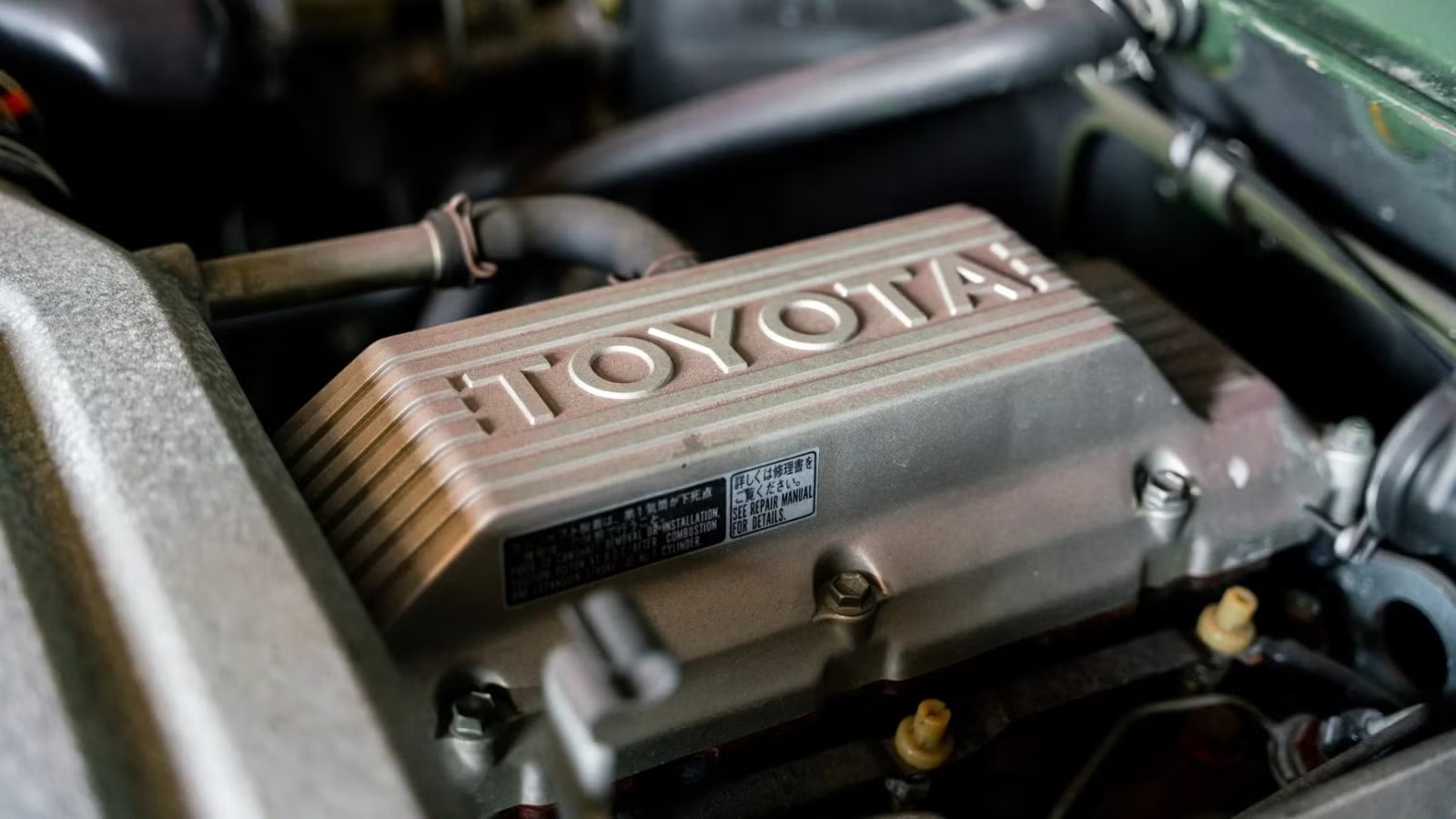
Modern diesel engines are marvels of modern science, pushing incredible power and torque figures while producing tailpipe emissions cleaner than ever before. Yet, for all their technological brilliance, these modern powerplants face a big problem: complexity. A single sensor failure, a tank of slightly contaminated fuel, or a glitch in the ECU can instantly throw a modern diesel into “limp mode,” rendering a heavy-duty machine completely useless. Over the last few decades, countless sophisticated diesel engines have come and gone, praised in their early years only to be retired prematurely when their complex systems proved too fragile or expensive to maintain over the long haul.

But tucked away in some of the most unforgiving parts of the world, there is an automotive anomaly. An engine that completely defies the modern engineering rulebook. It has no turbocharger, no computer chips, and no delicate high-pressure fuel rails. It is an engine that simply works and has been working for more than three decades. Its legendary longevity isn’t an accident; it is the direct result of an engineering philosophy that elevated absolute simplicity to an art form.
Why Most Diesel Legends Eventually Disappear
To truly appreciate an engine that has survived unchanged since the 90s, we must first look at the graveyard of automotive history. The automotive world is notoriously brutal, and the diesel segment has been hit the hardest by the rapid changes of time. Over the last thirty years, there have been huge changes in global emissions regulations, skyrocketing development costs, and changing consumer demands have helped kill off some of the most iconic engines ever built.

Regulators across the world have progressively tightened emissions standards for all types of engines. For an existing engine to comply, manufacturers can no longer rely on just having a good engine. They have to spend hundreds of millions of dollars redesigning every component. For many manufacturers, the math simply doesn’t add up. It is often cheaper to scrap an older, reliable engine entirely and build a downsized, heavily boosted replacement from scratch.
Progress Usually Leaves Even The Best Engines Behind

Consider the legendary engines that have fallen along the way. Think of the Ford 7.3-liter Power Stroke V8—a heavy-duty monster renowned for its reliability in the 1990s. Ford was forced to replace it with the 6.0-liter Power Stroke, an engine plagued with head gasket and EGR problems because it tried to force modern emissions hardware onto a platform that struggled to handle it. Look at Volkswagen’s iconic 1.9-liter TDI inline-four, a bulletproof engine that delivered incredible efficiency but couldn’t survive the transition to modern standards without massive over-engineering.
Even Nissan’s legendary TD42—a 4.2-liter mechanical inline-six diesel that was the primary rival to Toyota’s heavy-duty powerplants was eventually phased out because it couldn’t meet modern environmental mandates. To make modern diesels work today, engineers must introduce high-pressure common-rail systems that pump fuel at pressures exceeding 30,000 psi. While this allows for precise combustion and lower emissions, it also means the fuel injectors are manufactured to microscopic tolerances. If a speck of dust or a drop of water gets past the fuel filter, the entire system can fail, leading to thousands of dollars in repairs. Progress has given us cleaner, faster, more efficient diesels, but sacrificing longevity.
One Toyota Engine Never Followed The Rules

While the rest of the industry scrambled to build high-tech, aluminum-block, sensor-filled diesels, Toyota did something radical with one specific engine line: they chose to stop evolving. They looked at the trend of rising horsepower figures, electronic engine management, and forced induction, and decided to opt out.
Instead of chasing power, Toyota focused on a single metric that matters more than any other when you are 500 miles away from civilization: dependability. The corporate philosophy was clear. A simple engine that produces decent power but works every single time you turn the key, regardless of whether it is freezing in the mountains or scorching in the desert. This engine didn’t need to follow rules because it served its intended purpose.
Reliability Was A Non-Negotiable

This defiance wasn’t born out of laziness or a lack of engineering capability, Toyota had new engines; it was driven by necessity. Toyota understood that a specific segment of their customer base didn’t just want a reliable vehicle, they needed it for survival.
Think about mining corporations operating deep underground in Australia, where an engine failure could trap workers in toxic conditions. Think about humanitarian organizations like the United Nations or the Red Cross delivering medical supplies through roadless expanses of Sub-Saharan Africa. Think about farmers, researchers, and military personnel working in remote corners of the globe where the nearest mechanic takes several days by foot. For these people, a vehicle is a tool for survival. A computer glitch isn’t an inconvenience; it can be life-threatening. For this reason, Toyota kept producing a purely mechanical, old-school diesel because these customers simply couldn’t afford anything less reliable.
Meet The Toyota 1HZ That Refused To Die

That engine is the legendary Toyota 1HZ. Introduced in 1990, the 1HZ is a 4.2-liter naturally aspirated, inline-six diesel engine. It features a heavy cast-iron engine block and a cast-iron cylinder head, a single overhead camshaft (SOHC) and two valves per cylinder. There are no turbos, no intercoolers, and no engine computers. It relies completely on a mechanical Bosch-type indirect injection system.
When it debuted, it became the beating heart of Toyota’s heavy-duty workhorses: the legendary Land Cruiser 70 Series, the comfortable Land Cruiser 80 Series, and the Toyota Coaster bus. While the 80 Series eventually moved on to newer powerplants in mainstream markets, the 1HZ remained firmly inside the rugged, utilitarian 70 Series line, where it is still built to serve specific international markets today.
A Naturally Aspirated Diesel Built To Outlast The Vehicle Around It

The most defining characteristic of the 1HZ is that it is naturally aspirated. In a world where every modern diesel relies heavily on a turbocharger to force air into the cylinders, the 1HZ breathes on its own. Toyota intentionally kept it this way to eliminate stress. Without a turbocharger, there is no high-pressure boost wearing down internal components, no scorching oil temperatures spinning through turbine bearings, and no sudden spikes in cylinder pressure.
By keeping the power output low at a measly 129 hp and 210 lb-ft of torque, Toyota ensured that the internal components are never put under heavy load. The massive cast-iron block is incredibly over-built for the amount of power it produces. This translates directly into its legendary high-mileage reputation. It is common to find 1HZ engines with over 500,000 kilometers on the odometer that have never had their valve covers removed, and many routinely cross the 1-million-kilometer mark with nothing more than routine fluid changes and timing belt replacements. The engine is literally built to outlast the cars it came in.
Its Simplicity Became Its Greatest Engineering Achievement

In automotive design, it is easy to make something complicated; it is incredibly difficult to keep something simple while making it almost indestructible. The engineering genius of the 1HZ lies entirely in its simplicity. Because it uses a mechanical injection pump, the engine requires zero electrical power to keep running once it has started. If the battery dies, the alternator fails, and the entire electrical system of the vehicle shorts out while crossing a deep river, the 1HZ will continue to chug along perfectly fine as long as air is entering the intake and fuel is getting to the pump.
Furthermore, the 1HZ uses an indirect injection (IDI) design with a pre-combustion chamber. While this is less thermally efficient than modern direct-injection systems, it has a massive real-world advantage: poor fuel tolerance. In remote areas, diesel isn’t as refined as highway service stations. It is often pumped out of rusty drums, contaminated with water and impurities. A modern common-rail engine would instantly clog its injectors and ruin its fuel pump under these conditions. The 1HZ, however, eats dirty fuel for breakfast. Its mechanical pump and robust injectors can use fuel of incredibly poor quality without missing a beat, making it the only logical engine choice for developing nations.
Why Owners Still Trust It Completely

It is this resilience that has earned the 1HZ the complete trust of global organizations. When the United Nations deploys to a conflict zone or a disaster area, they don’t look for vehicles with leather seats and rapid acceleration. They look for white Toyota Land Cruisers with 1HZ engines. If a 1HZ does happen to need a repair, it can be fixed on the side of a dirt trail with a basic set of hand tools. There are no proprietary software codes to read, no wiring harnesses to trace, and because Toyota has kept the engine in production for over three decades, replacement parts are readily available in almost every corner of the earth. Contrast this with a modern diesel, where a failed emissions sensor can require a specialized dealer scan tool to reset, turning a minor mechanical hiccup into a nightmare.
Three Decades Later, The 1HZ Is Still Around

It is nothing short of a miracle that the 1HZ remains in production more than 30 years after its launch. Toyota has actively fought to keep this engine alive because the demand from commercial and humanitarian sectors has never ceased. However, time and environmental laws have slowly shrunk its territory. Because it is an old-school mechanical engine, it cannot meet the strict emission standards across the globe. As a result, you can no longer buy a brand-new 1HZ-powered Land Cruiser in a showroom in Sydney, London, or Los Angeles.
Instead, Toyota now sells these vehicles directly to emerging markets across Africa, South America, the Middle East, and specific industrial sectors like underground mining. Yet, despite its geographical restrictions, automotive enthusiasts all over the world still actively seek out used 1HZ-powered Land Cruisers. If you talk to anyone who owns one, they will readily admit that these vehicles are painfully slow. It struggles on highway inclines, it takes its time getting up to speed, and it behaves more like a tractor than a modern SUV. But they don’t care. They buy it because they know that no matter where they drive, they will always make it back home. And that is exactly why, after more than three decades, this legendary diesel simply refuses to die.
Sources:

Related posts




Latest Post


No Comments