
The Japanese Motorcycle That Arrived A Decade Too Early
The motorcycle industry has always been open to bold ideas; just not always immediately. Sometimes the market simply isn’t ready to understand, appreciate, or pay for machines that arrive with advanced technology. In motorcycle history, bikes introduced with revolutionary engineering often disappeared quietly while more conventional rivals filled dealership floors.

In the early 1990s, Yamaha decided to challenge accepted rules of motorcycle design in a single model. At the time, the market largely rejected it. Looking back today, however, many of its once-radical ideas have become perfectly ordinary, and the bike itself has attained cult-classic status.
What Makes A Motorcycle “Ahead Of Its Time”?
When a motorcycle arrives with innovations before the industry, supporting technology, or customer expectations are ready to embrace them, it earns the “ahead of its time” label. The ideas may initially seem unnecessary or overly complicated before the industry finally accepts them and makes them standard across most segments.

One good example is anti-lock braking systems. While widely accepted now, they were once dismissed by many enthusiasts who thought they were unnecessary and complex, particularly on sport bikes. Another example is electronic fuel injection. It faced similar skepticism because carburetors had a history of success and were more familiar and easier to tune. Today, both technologies are considered standard equipment across virtually every premium motorcycle segment.

Modern motorcycles increasingly rely on electronics and advanced engineering to improve both performance and safety. Many of those concepts, however, appeared years or even decades before riders were willing to accept them.
Being ahead of the curve is usually considered an advantage, but it can also be a curse. Customers would rather buy something familiar even after manufacturers have spent large amounts of money on developing the latest technology.
Meet The Japanese Motorcycle That Tried To Reinvent The Rulebook
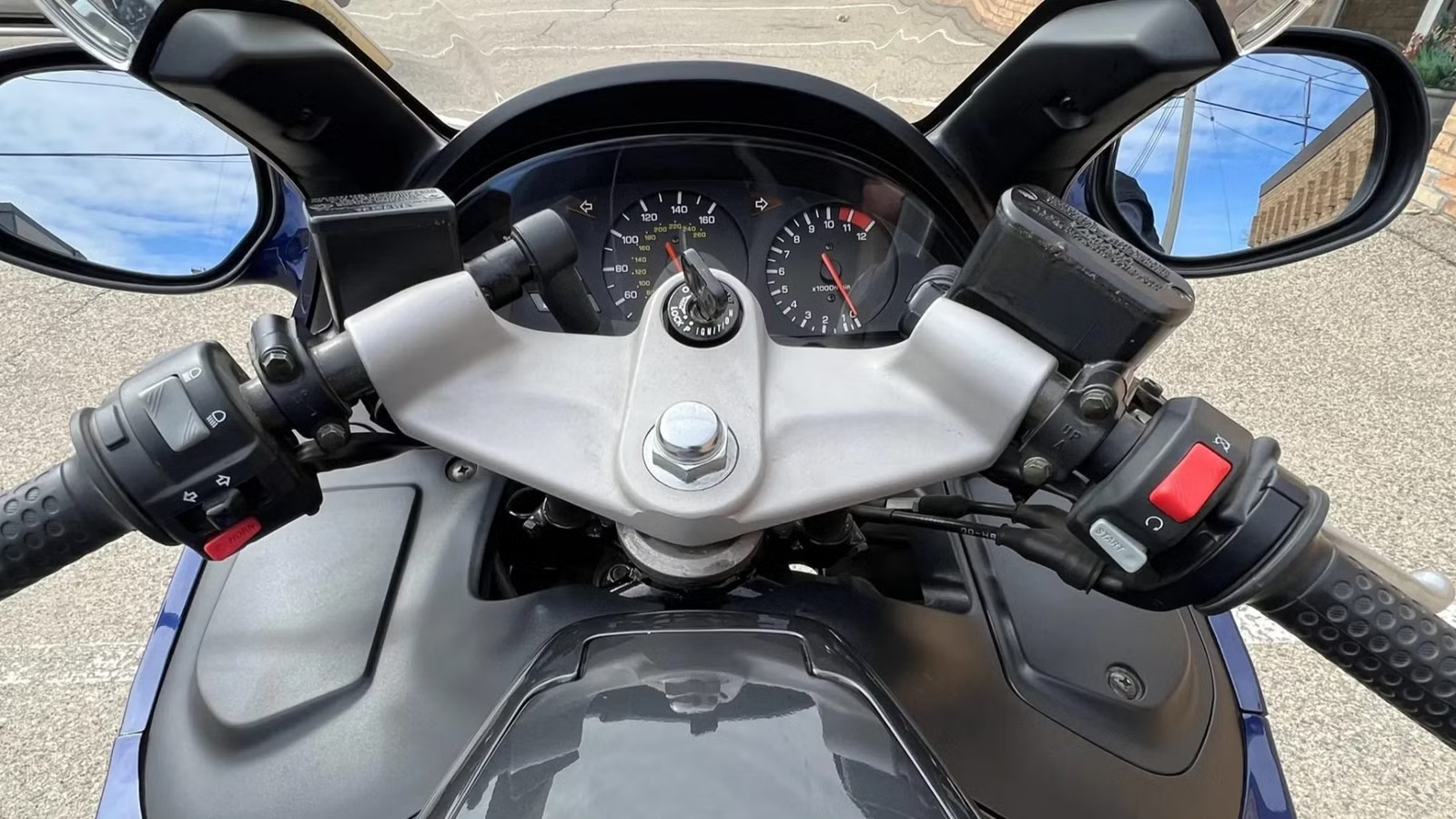
That motorcycle was the 1993 GTS1000. Yamaha set out to create what it considered the ultimate high-tech grand tourer, rather than building another conventional sport-tourer. It was one of the most ambitious production motorcycles ever built as it challenged every major engineering decision and design philosophy.
The bike was powered by a 1,002cc liquid-cooled DOHC inline-four derived from the FZR1000’s legendary five-valve Genesis engine. Yamaha prioritized stronger mid-range torque instead of chasing peak horsepower, producing just over 100 hp. This figure is ideal for long-distance sport touring rather than outright superbike performance. Another major new addition was electronic fuel injection, which replaced carburetors at a time when EFI remained a rarity on production motorcycles.

The real showstopper, however, was the front suspension. Yamaha did not go for conventional telescopic forks; instead, it equipped the GTS1000 with James Parker’s RADD (Rationally Advanced Design Development) hub-center steering system. By using a single-sided front swingarm that separated steering and suspension functions, the bike dramatically reduced brake dive while maintaining more consistent steering geometry under hard braking. Back then, it looked unlike anything else on the road and even today remains one of the most distinctive front-end designs ever fitted to a mass-produced motorcycle.
The bikemaker used an aluminum OMEGA chassis to complement the unconventional suspension. It wrapped around the engine instead of using a traditional steering-head layout. The motorcycle also featured a single-sided rear swingarm, electronic fuel injection, a three-way catalytic converter, a six-piston front brake caliper, and ABS in many markets — features that were remarkably forward-thinking in 1993.
However, all that innovation didn’t result in showroom success. Sales never met Yamaha’s expectations, even though production continued until 1999 in some international markets. Today, the GTS1000 enjoys cult-classic status precisely because enthusiasts now recognize just how ambitious it really was.
Why Its Revolutionary Engineering Didn’t Win Buyers Over

The biggest obstacle facing the GTS1000 wasn’t its engineering; it was its price. The bike carried a sticker price of around $13,000 back in 1993. That made it one of the most expensive Japanese motorcycles available in the American market. Though the bike had technological advantages, people could buy faster, lighter, and more familiar bikes for thousands less, making it a hard sell.
Weight was another factor. The GTS1000 wasn’t exactly nimble at over 550 pounds. The sophisticated front suspension added complexity, while the touring-focused chassis prioritized stability over razor-sharp agility.
Then there was the steering itself. Although the RADD system significantly reduced front-end dive under braking and delivered impressive stability, it also felt unfamiliar. Riders accustomed to telescopic forks often described the steering as heavier and different during corner entry. It wasn’t necessarily worse — it was simply unlike anything most motorcyclists had experienced. Rather than being a selling point, the unfamiliarity became a hurdle.

It didn’t do well in the styling department, either. The GTS1000 looked clean and functional but lacked the aggressive visual drama of the era’s booming superbike market. During the 1990s, buyers were flocking to motorcycles like the Honda CBR series, Kawasaki ZX models, Suzuki GSX-Rs, and Yamaha’s own YZF lineup — machines that prioritized outright performance and familiar engineering.
The GTS1000 asked riders to spend more money on technology whose benefits weren’t immediately obvious during a short dealership test ride. That’s a difficult proposition in any era.
The GTS1000 Proved Its Point—Just Years Too Soon

If we look at the GTS1000 today, it feels almost prophetic. Due to stringent emission regulations, manufacturers had to make electronic fuel injection, once considered unnecessary, standard across the motorcycle industry during the late 1990s and 2000s. The same goes for ABS. Motorcycle ABS was pioneered by BMW in the late 1980s, but widespread adoption didn’t accelerate until the 2000s.
Aluminum frames are now a common sight on performance motorcycles, while every modern street bike sports catalytic converters and sophisticated emissions systems. Chassis behavior, suspension performance, braking stability, and rider confidence are also areas to which manufacturers devote enormous resources. Interestingly, this is the exact engineering philosophy Yamaha pursued with the GTS1000 more than three decades ago.
There is, however, one exception. The bike’s hub-center steering, on account of being expensive and complex, never became mainstream. The benefits it offered for the price were not practical in real-world use. However, the GTS1000 proved that bold innovations should be taken seriously, no matter the era. That’s ultimately one of the reasons why the bike has gained its cult classic status among enthusiasts today.
Source: Yamaha, Bring a Trailer

Related posts




Latest Post


No Comments