
Porsche’s New Patent Could Let The Same Powertrain Run As A Full EV, Hybrid, Or Range Extender—Here’s What That Means
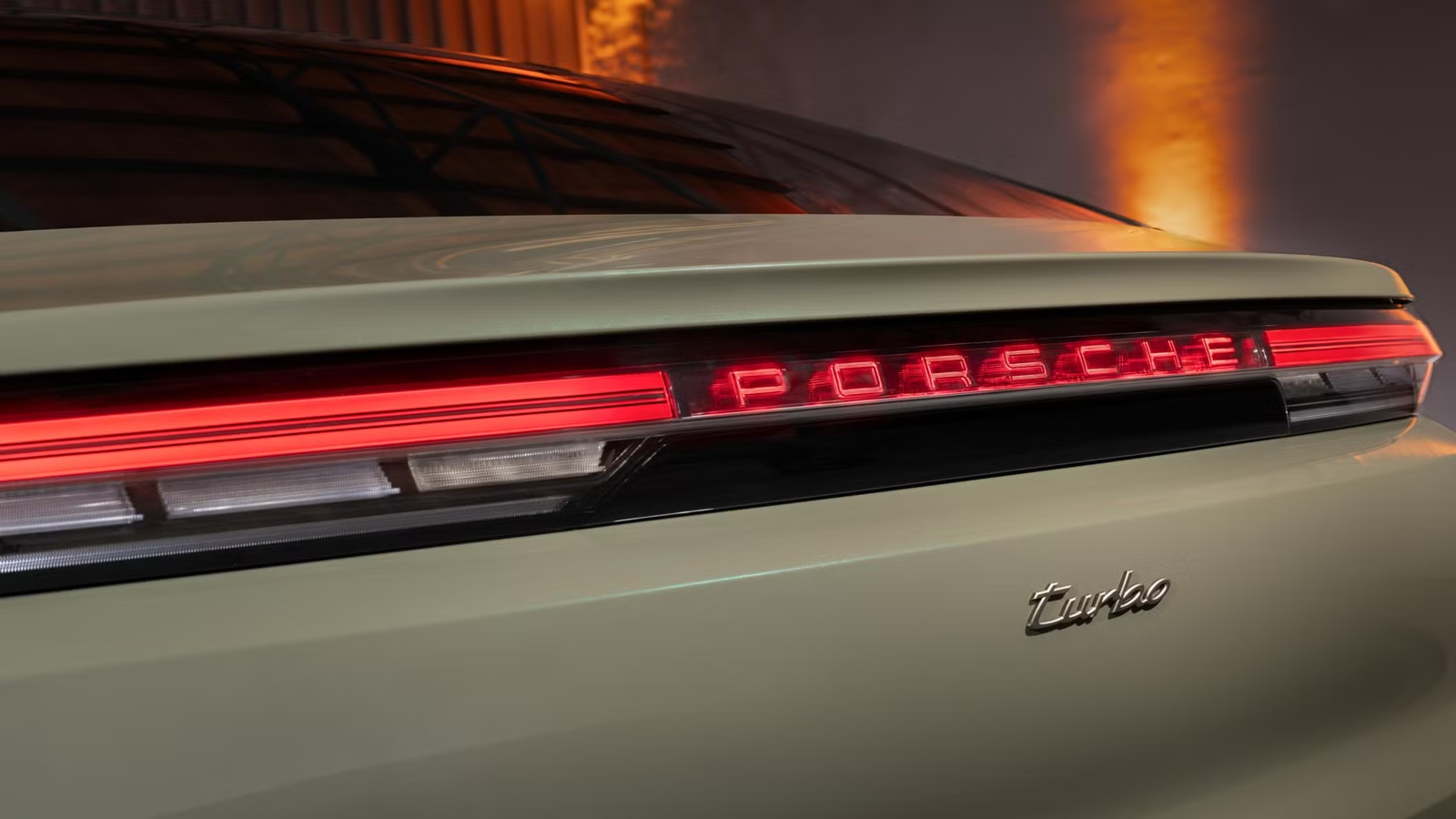
Porsche has filed a patent for a modular powertrain architecture that can operate as a full battery-electric vehicle, a conventional hybrid with the combustion engine driving the wheels directly, or a range-extended EV where the ICE functions purely as a generator. The filing, which surfaced this week, signals that Porsche is engineering flexibility into the hardware itself rather than committing to a single drivetrain philosophy—a meaningful hedge in a regulatory environment that looks different depending on which market you’re selling into.

The core idea is that one physical architecture can serve three distinct operational modes without requiring a ground-up redesign for each. That’s not just a cost play. For enthusiasts, it raises a more interesting question: can a powertrain optimized to do three different jobs actually do any of them as well as a dedicated system?
What The Patent Actually Describes
The patent outlines a powertrain that switches between three modes depending on conditions, driver input, or regulatory requirements. In full-EV mode, the combustion engine is decoupled entirely, and the car runs on battery power alone—straightforward enough. In hybrid mode, both the ICE and the electric motor contribute torque to the driven wheels simultaneously, which is how most performance PHEVs operate today. The third mode is where it gets interesting: range-extended EV operation, where the combustion engine runs but never connects mechanically to the wheels. Instead, it spins a generator to replenish the battery, keeping the car in electric drive at all times.

That last mode is a meaningful distinction from a driving-dynamics standpoint. When the ICE is a generator rather than a direct drive source, throttle response is governed entirely by the electric motor—immediate, linear, and unaffected by engine inertia or gear selection. The tradeoff is that the system’s peak output is constrained by what the generator can produce and what the battery can store, rather than by the combined torque of both powertrains working in parallel.
Porsche Will End Production On One Of Its Bestsellers Two Years Before A Replacement Arrives
Porsche’s sales are down in 2026, and this move won’t help the brand at all.
How Mode-Switching Changes the Way the Car Drives

The performance character shifts noticeably across the three modes, and that’s worth unpacking. In full hybrid operation—ICE plus motor, both driving the wheels—you get the broadest power band. The combustion engine contributes its torque curve directly, which means the powertrain can feel more like a traditional performance car: responsive to revs, with a sound profile that matches the acceleration. This is the mode where something like a Cayenne Turbo S E-Hybrid already operates, and it works well for high-output applications.
Range-extender mode trades that breadth for consistency. Electric-only drive is predictable and immediate, but the system is essentially capped by generator output during sustained hard driving—a concern on a track or a long alpine pass where the battery can deplete faster than the generator replenishes it. BMW’s i3 Rex demonstrated this limitation years ago before the company dropped the configuration. That Porsche is revisiting the concept—alongside Ford and Renault, who are also exploring range-extender architectures—suggests the industry sees a regulatory use case, particularly in urban zero-emission zones, that justifies the engineering compromise.
Which Porsche Models Could Use This Architecture

The modular nature of the patent makes it plausible across several platforms. The Cayenne and Panamera are the most logical candidates—both already carry PHEV variants, both have the packaging volume for a more complex hybrid system, and both sell in markets with strict urban emissions rules where a genuine EV mode matters. A range-extender option would let those cars operate emission-free in city centers without requiring the large battery pack of a full BEV.
The 911 is a harder fit. The rear-engine layout constrains packaging severely, and Porsche has been deliberate about keeping the 911’s driving character intact through each generation. A modular powertrain that can dial back ICE involvement entirely runs against what 911 buyers expect. That said, Porsche has already shown with the 918 Spyder and the ongoing Mission E development work that it isn’t afraid of electrification in performance applications—the question is whether the 911’s successor uses a bespoke solution or pulls from a shared architecture like this one.
The Bigger Strategic Picture

What the patent really reflects is a reluctance — shared across the industry right now — to bet everything on one drivetrain outcome. Lexus recently scrapped its LF-ZC flagship EV. Lotus has pivoted back toward a hybrid supercar. Mazda has pushed its EV timeline to 2029. The regulatory picture in Europe, the US, and key Asian markets remains fluid enough that locking a performance platform into a single powertrain type carries real risk.
Porsche’s answer, at least on paper, is to build the flexibility into the hardware from the start. Whether that produces a powertrain that’s genuinely excellent in all three modes—rather than merely competent across them—is the question that prototype testing will eventually have to answer. A dedicated EV powertrain and a dedicated performance hybrid each have tuning advantages that a modular system has to work harder to match. But if Porsche’s engineers can close that gap, the architecture could underpin a generation of performance cars that stay relevant regardless of which regulatory direction wins out.
Sources: Yahoo Autos, Carscoops, Motor1

Related posts

Latest Post


No Comments