
The Japanese Coupe That Delivers Pure Driving Joy Without The Drama
Pick up any automotive publication today and you will find the same breathless superlatives: 1,000 horsepower, sub-three-second 0–60 mph times, active torque vectoring, and dual-clutch transmissions that shift in milliseconds. It is an impressive arms race, no question. But for a growing number of drivers, all that computational firepower has quietly killed the thing they loved most about getting behind the wheel.

The modern sports car has become a high-speed video game where the computer does most of the heavy lifting, and the driver is little more than a passenger with a nice view. If that digital isolation has started to wear on you, there is an antidote. Deep in the heart of Japan’s car culture, a back-to-basics blueprint was drawn up: a sports car that rejects the horsepower arms race entirely in favor of pure, tactile sensation.
The Toyota GT86: A Modern Legend Born
This purist philosophy found its perfect physical manifestation in a car that took the world by storm: the Toyota GT86. Produced from 2012 to 2021 and sold as the Scion FR-S in North America before the nameplate evolved into the modern GR86, this compact coupe was built to do one thing: bring driving back to its absolute roots.
Analogue Simplicity In A Digital Era

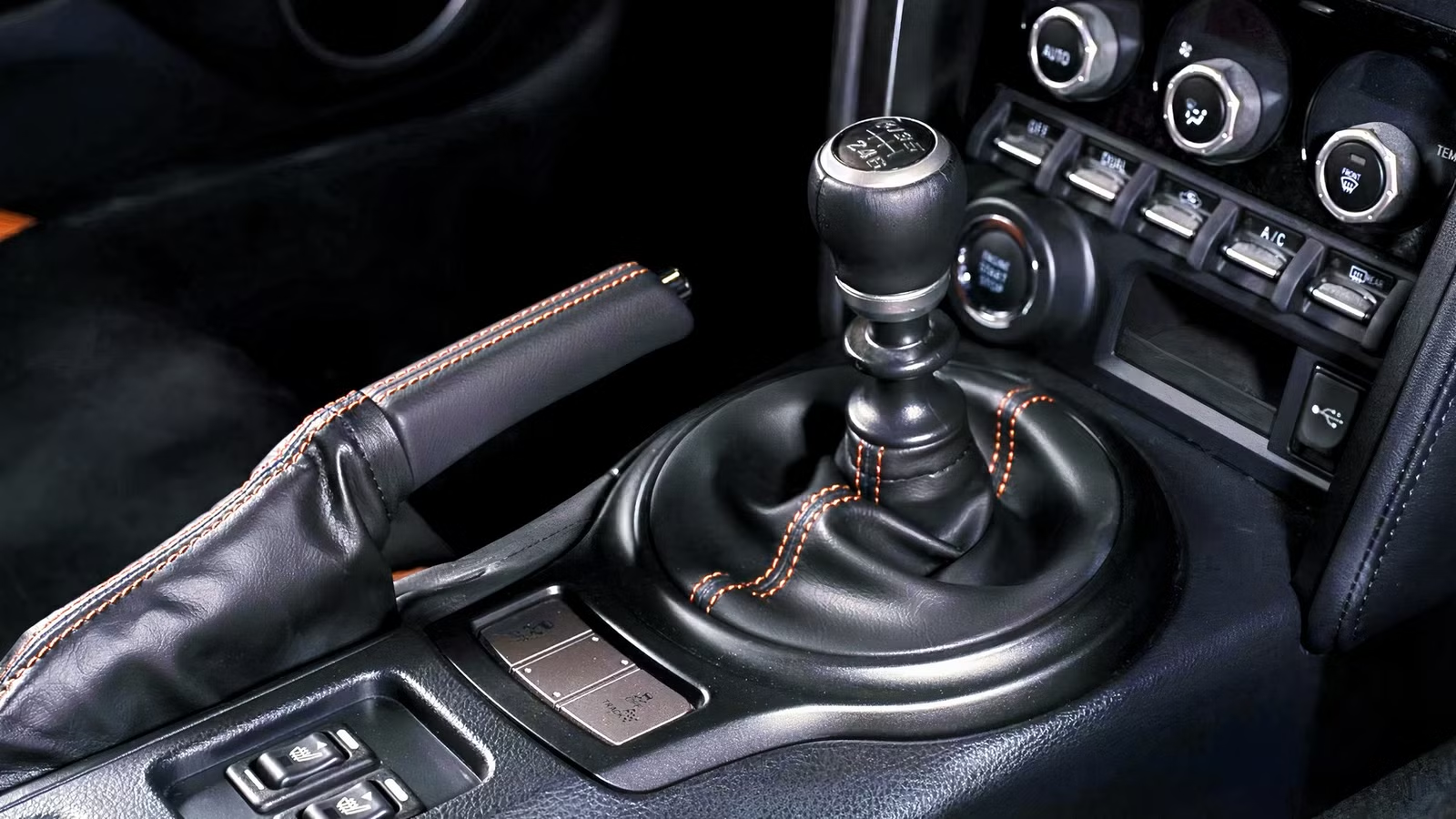
Step inside the GT86, and you won’t find a giant touchscreen dominating your field of vision or a confusing array of drive-mode buttons. Instead, you get three pedals, a beautifully upright steering wheel devoid of buttons, and a crisp, short-throw six-speed manual shifter.
Every control is physical. The clutch has a distinct, communicative bite point; the shifter notches into gear with a satisfying, mechanical clack; and a manual cable-pull handbrake sits exactly where your hand expects it to be. It is a delightfully analogue cockpit designed to eliminate distractions and keep your focus entirely on the road ahead.
The Secret To Low-Speed Thrills: Fun Without The Speeding Ticket
The magic of the GT86 lies in where it delivers its thrills. While a modern supercar requires three-digit speeds to start feeling alive, this lightweight Japanese coupe makes a trip to the local grocery store feel like an alpine rally stage.
The Genius Of Low-Grip Dynamics (The “Prius Tire” Paradox)
When Toyota designed the GT86, they did something hilariously brilliant: they intentionally fitted the car with the same narrow, low-rolling-resistance Michelin Primacy HP tires found on the eco-friendly Toyota Prius.
To high-performance purists, this sounded like heresy. But it was a calculated masterstroke. Because the car isn’t over-tired with massive, sticky rubber, you don’t need to be travelling at triple-digit speeds to find the limits of grip. At entirely legal velocities — say, taking a local roundabout at 25 mph — you can easily feel the tires begin to slip, giving you a safe, progressive taste of oversteer. Toyota designed this car to slide and play on the limit, making driving heroes out of ordinary people at completely safe speeds.
Telepathic Steering And Chassis Communication

Without a massive, heavy engine weighing down the nose, the GT86’s electric power steering is incredibly sharp and communicative. It doesn’t filter out the road; it sings to you.
Every ripple in the asphalt, every change in road camber, and every micro-loss of traction is transmitted straight to your palms and the seat of your pants. You don’t guess what the car is doing; you know it. It is a level of telepathic communication that builds immense driver confidence, turning driving back into an active, rewarding sport rather than a passive commute.
Why Our Test Drive Proves The 86 Recipe Was Perfect From The Start


Our team test drove the 2017 Toyota GT86 when it was new, and we immediately noted that Toyota seems to have taken everything enthusiasts love about the art of driving and stuffed it into a small sports coupe. The road ability jumped out as soon as we took to the streets, and especially the curves. Ample low-end punch gets you going with urgency, though we did note that, while the engine revs freely to the redline, it was rather tame for how rowdy it felt out of the gate. Regardless, it isn’t meant to pin you to your seat — it’s made to draw excitement from its occupants.
As mentioned, the GT86 really shines when you throw it around curves and on tight roads, where chassis balance means more than power. The steering is well-weighted with excellent feedback, the brakes wind it down without fuss, and the chassis rotates the way a proper RWD coupe should.
Out in the canyons, 200 horsepower feels about right. You finally understand why Toyota has focused so unwaveringly on this thing’s driving dynamics over the engine output. It’s agile, it’s responsive, it’s precise, and above all, it’s fun. Drive it on the right road, and you’d have to be dead to not smile.
Pure Joy Without The Ownership Drama

A major problem with classic or exotic sports cars is that they often come with a dark side: temperamental electronics, oil leaks, and eye-watering maintenance bills. The GT86 completely bypasses this drama, offering a sports car experience that is as reliable as a standard family hatchback.
Bulletproof Japanese Reliability And Everyday Practicality
Underneath the sleek, low-slung bodywork is tried-and-true Japanese engineering. It starts every single morning, uses regular parts that don’t cost a fortune, and can be serviced by any competent local mechanic. According to CarEdge, five-year ownership costs sit at around $37,643, with only approximately $1,571 of that total attributable to maintenance — a remarkably low figure for a sports car. Bear in mind that the newest GT86 is now well over five years old, so real-world costs will vary depending on the car’s history and condition, though parts remain cheap and widely available.
A Blank Canvas For Car Enthusiasts
Perhaps the greatest joy of GT86 ownership is its thriving community. Because it was designed to be affordable and simple, it has become the darling of the automotive aftermarket.
Whether you want to keep it completely stock, bolt on a subtle cold-air intake and a throaty cat-back exhaust, or build a dedicated track weapon with adjustable coilover suspension and lightweight wheels, the GT86 is a blank canvas. It is a car that grows with you as a driver, adapting perfectly to your skills, tastes, and budget.
The Spiritual Successor To The Hachiroku (AE86)


The GT86 wasn’t built in a vacuum. It was engineered as the spiritual heir to the legendary 1980s Corolla AE86, the lightweight, rear-wheel-drive hatchback and coupe made world-famous by mountain racers (touge) and drift pioneers in Japan.
To achieve the razor-thin center of gravity needed to honor that legacy, Toyota partnered with Subaru to develop a compact, naturally aspirated 2.0-liter “boxer” flat-four engine. By laying the engine flat and mounting it as low and far back as possible, they created a machine with a center of gravity lower than many exotic supercars, all while keeping the price accessible to the everyday enthusiast.
Sources: Toyota, CarEdge

Related posts





Latest Post


No Comments