
Toyota’s V6 Recall Casts New Light On The Legendary Million-Mile Tundra V8
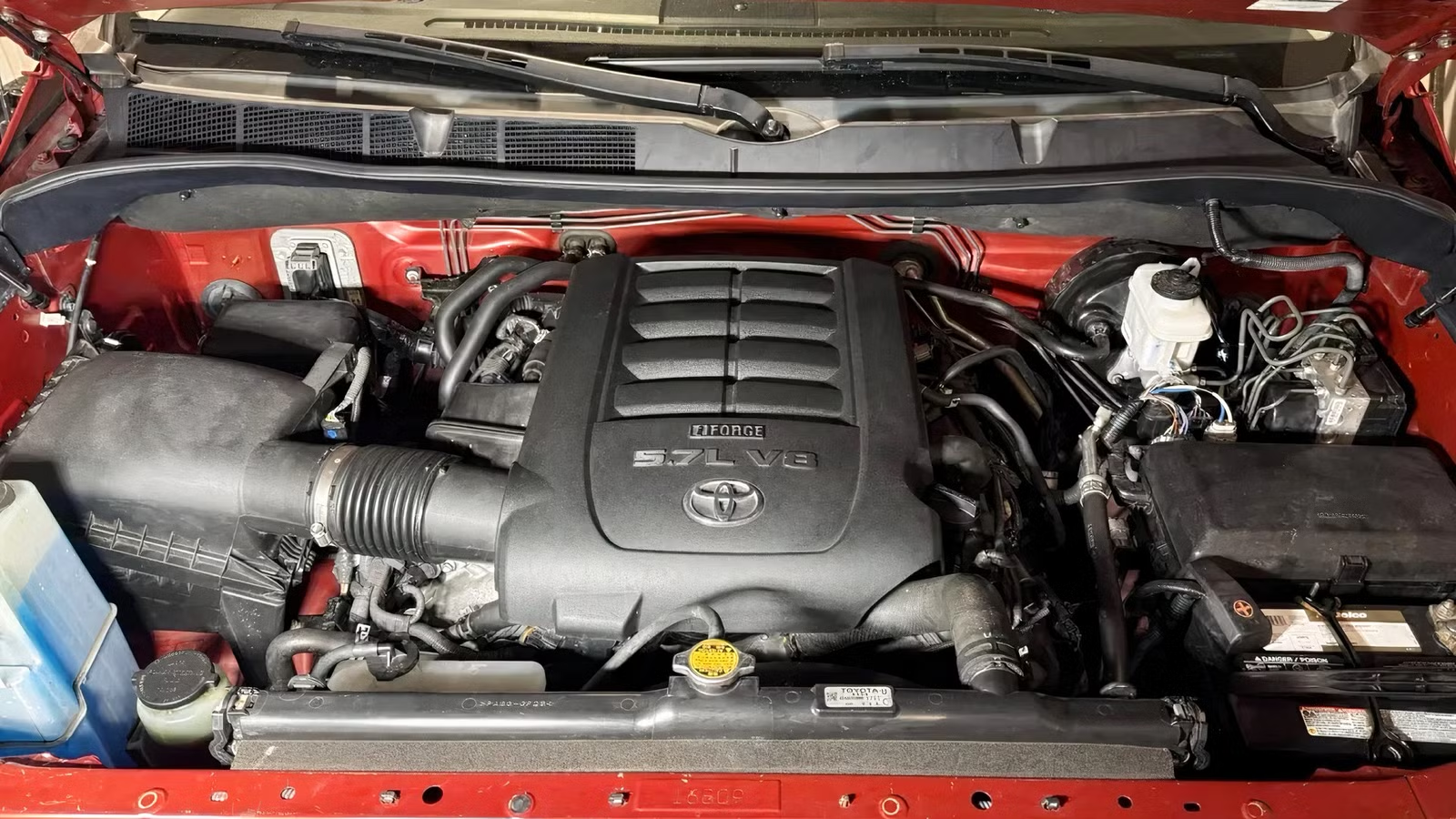
A million miles is a number most engines never see. Toyota’s 5.7-liter V8 — the i-Force unit that powered the Toyota Tundra from 2007 through 2021 — apparently got there, and engineers pulled it apart to document exactly what happened inside. The findings offer a rare look at what long-haul durability actually looks like at the component level, not just on the odometer. Those findings are more important than ever given a recent recall for the turbo V6 engine that replaced it.

The short version, according to the teardown report: the secret recipe for a reliable engine turns out to be simpler than most people expect. What that means in practice is which components held their tolerances, which surfaces showed wear, and what the cylinder walls looked like after fourteen-plus years of combustion cycles is the kind of data that separates engineering reputation from marketing copy.
What a Million-Mile Engine Teardown Actually Measures
Engine teardowns at extreme mileage are uncommon for a reason. By the time most powerplants reach deeper into six figures, they’ve already been rebuilt, replaced, or retired. Getting a factory-original unit to seven figures with documented service history intact is a prerequisite for any teardown data to mean anything. It’s a bar that very few trucks, or their owners, ever clear.

The Toyota 5.7-liter V8 in question is the 3UR-FE, a dual-overhead-cam unit producing 381 horsepower and 401 lb-ft of torque in its Tundra application. It’s an engine with a strong reputation among truck buyers precisely because of its conventional architecture: no turbochargers, no direct injection, a relatively conservative state of tune. It’s the type of build that has historically translated to fewer failure points over time. And that’s exactly what the teardown proved.
Million-Mile Toyota V8 Teardown Findings
- The biggest blemish the team could find was a slight mark on a bearing.
- There was very little carbon buildup on the valve stems.
- The cross-hatching on the cylinder walls was still visible.
- The crankshaft journals had no visible wear marks.
- The head, block and cams were noted, on remeasuring, as not being within spec, but the team said that “nothing was abnormal,” noting that blocks and heads simply aren’t going to fall within spec after a million miles.
In short, Toyota engineers found an engine that essentially looked brand new and would have scored 99 out of 100 in their quality tests. Now that’s a testament to reliability if there ever was one.
The Tundra V8’s Reliability Record — and the New V6 Complication

Toyota’s truck lineup has faced significant scrutiny in recent months over a separate issue: a recall covering roughly 250,000 Tundras equipped with the twin-turbocharged V6 that replaced the 5.7-liter V8 starting with the 2022 model year. That recall centers on engine debris contamination, and the disagreement between Toyota’s official explanation and what independent mechanics have observed has kept the story alive well past the initial announcement.
That context matters for how buyers read the million-mile V8 story. The engine that broke seven-figure mileage was the old one — the naturally aspirated unit that Toyota retired in favor of the more powerful but apparently more fragile twin-turbo setup. For buyers who preferred the 5.7 and are now shopping used Tundras, or for anyone trying to understand what Toyota’s reliability reputation is actually built on, the teardown data speaks directly to that question. Used vs. New is a more legitimate question than ever.
What This Means for Tundra Buyers Today

The practical takeaway depends on which Tundra you’re shopping. If you’re looking at a pre-2022 Tundra with the 5.7-liter V8, the teardown findings add a data point to an already-strong anecdotal record. High-mileage examples of this engine are not rare on the used market, and the teardown results — whatever the specific wear measurements show — give buyers a clearer picture of what to expect from a well-maintained unit at extreme mileage.
For buyers considering a 2022-or-newer Tundra with the twin-turbo V6, the million-mile V8 story is a useful contrast rather than a direct guide. The two engines share a nameplate but not an architecture, and the ongoing recall situation for the newer unit is a separate data set entirely. The V8 teardown is ultimately a story about what Toyota’s truck reputation was built on — and whether the engineering decisions behind it hold up when you count every mile.

Related posts

Latest Post


No Comments