
The Insanely Valuable 425-HP Plymouth Muscle Car Mopar Barely Wanted To Build
In the early 1970s, the peak of the muscle car era had passed as the auto industry transitioned into the infamous malaise era. Many automakers, like Chrysler, were increasingly hesitant to build heavy, high-powered cars with massive V8 engines. Costs were starting to get a bit out of control due to rising insurance premiums.

Buyers were also starting to gravitate toward smaller cars that were more fuel-efficient and easier to park, abandoning high-performance models. So, why build something that wouldn’t sell? Well, Chrysler didn’t exactly mean to.
There is an extremely rare Plymouth muscle car that wasn’t really intended to be built. However, a few models slipped through production anyway, Now this robust model that delivers a dynamic performance with 425 horsepower is insanely valuable. Because it was a rare mishap, Mopar fans will pay anything to get behind the wheel.
Brutal Economics Made Plymouth Hesitate

Plymouth had perfect car racing, and toyed with the idea of providing it as a convertible. However, the company was reluctant to build it due to a few different reasons. For example, insurance companies were targeting muscle cars due to a surge in catastrophic accidents. Fatal accidents, along with total loss claims, were increasing.
So, insurance companies targeted high-powered cars with higher premiums. Younger drivers were the primary buyers of muscle cars, so the expensive insurance costs priced them out of the market. Some of the insurance costs linked to affordable V8-powered cars cost more than the vehicles themselves.

As safety was a growing concern, new federal bumper and rollover standards were also introduced. This forced manufacturers to add heavy reinforcements to their vehicles’ frames. As a result, beefy drag racing cars got even heavier. When paired with detuned engines and low-octane fuel, this provided a sluggish performance that caused potential buyers to walk away.
Plus, the E-body Barracuda was notoriously nose heavy before the 800-pound cast iron Hemi engine was placed towards the front of the chassis. The excessive weight up front impacts handling and cornering, leading to understeer. It was prone to pushing straight in tight corners, and the rear tires lost traction under rapid acceleration.
The Rarest Plymouth Muscle Car Ever Sold To The Public
It’s the result of an oddball specification that actually wasn’t supposed to be allowed!
Mopar Didn’t Want To Build The Plymouth Hemi ‘Cuda Convertible

Compared to other muscle cars like the Ford Mustang, the 1971 Plymouth Hemi ‘Cuda convertible was simply too expensive. The original MSRP for the 1971 Ford Mustang 355 Boss or the most powerful variant was $4,124. Then the Plymouth Barracuda convertible came in at $3,410 at about $875. This added about 25% of its cost to the price.
So, the starting price of the Plymouth Hemi ‘Cuda was $4,255. The starting price combined with the soaring insurance premiums simply made the muscle convertible too expensive for younger buyers. Plus, Mopar already knew that it wasn’t something that people wanted anyway. The majority of fans interested in high-performance cars wanted hardtop models, not convertibles. Roughly 18,690 Barracuda models were made in 1971, but only 374 were convertibles across all engine options.

The Hemi ‘Cuda was already front-heavy, so it didn’t handle as well as rivals with smaller engines. The convertible variant is even worse, as it needed heavy-duty suspension and driveline upgrades that added to its weight, taking away from its track performance even more. This beast tips the scales at nearly 4,000 pounds.
Last but certainly not least, Mopar and Chrysler wanted to make a shift with changing trends. Meaning they wanted to build smaller, lighter, and more efficient cars that potential buyers were looking for. Instead of trying to keep the Barracuda name alive with reduced power, it was decided to simply discontinue it to protect the brand’s racing heritage. This is when the 426 Hemi engine and E-body Barracuda were discontinued.
1971 Plymouth Hemi ‘Cuda Convertible Models Slipped Through Production

About 11 or 12 1971 Plymouth Hemi ‘Cuda convertible models made their way through production. This figure is debated among historians, but most sources believe that seven models were built for America, two were exported, and two went to Canada. They had to be specially ordered, and a few dealerships checked off the right boxes before Mopar pulled the plug. Also, they may have been leftover from a corporate retreat.
Those who managed to get their orders in were probably over the moon with excitement as the Hemi ‘Cuda as it delivered legendary power. The 426 cubic-inch (7.0-liter) Street Hemi V8 engine produces 425 hp and 490 lb-ft of torque. It can accelerate from 0 to 60 mph in about 4.7 seconds and covers a quarter-mile in 13.1 seconds with a top speed of 150 mph.
1971 Hemi ‘Cuda Specs
|
Engine |
HP |
Torque |
0 – 60 MPH |
|
426 ci (7.0-liter) Hemi V8 |
425 |
490 LB-FT |
4.7 seconds |
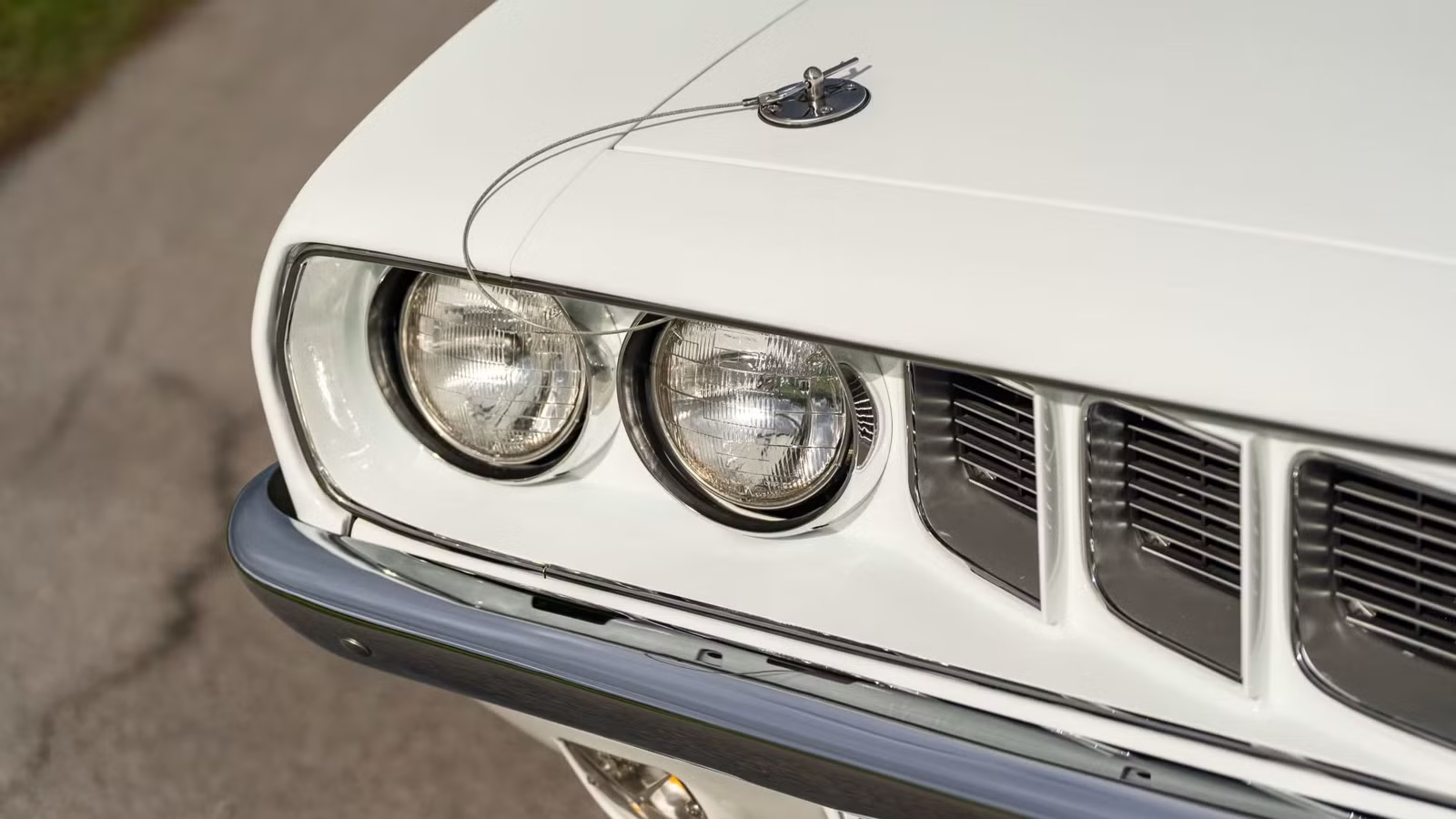
The engine was literally a big deal as it was so large that it didn’t easily fit into the Barracuda’s engine bay. It was also wrapped in a unique package. The 1971 Plymouth Hemi ‘Cuda convertible is pretty unique with four headlights and side fender gills that didn’t exist on the 1970 model. They pair extremely well with the shaker hood in my humble opinion.
Adding the Hemi package included serious upgrades such as a heavy-duty suspension, Dana 60 rear axle, dual four-barrel carburetors, extra-heavy-duty torsion bars, thick leaf springs, heavy-duty cooling, power front disc brakes, heavy-duty drum brakes, a dual exhaust with chrome tips, and bucket seats.
The Rarest Plymouth Muscle Car Produced In The ’60s
Hemi-powered Plymouths were some of the coolest muscle cars of the golden era, but this one was the rarest.
Killing The 1971 Plymouth Hemi ‘Cuda Convertible Turned It Into A Unicorn

Chrysler didn’t mean to create an extremely rare and valuable muscle car, as they weren’t planning to build any 1971 Plymouth Hemi ‘Cuda convertibles. But the 11 to 12 models that slipped through are now considered to be holy grail finds. It has the legendary 425-horsepower 426 Hemi V8 engine and aggressive Mopar styling that commands attention.
These convertibles are harder to find than European exotics and command premium prices. Plenty of Ferrari supercars are easier to find in comparison. Hemi ‘Cuda convertibles go for an average of $3.3 million. The four-speed manual models sell for between $3,300,000 and $3,500,000. But models with original sheet metal and the manual transmission are estimated at over five to six million dollars.

There are believed to be seven automatic models and five with the four-speed manual transmission. The last time one of these muscle convertibles went to auction was on January 17, 2026. The ‘Sno White’ automatic model sold for $3,300,000. It could be years before another one of these Barracuda models goes to auction.
While the 1971 Plymouth Hemi ‘Cuda convertible models are treated like museum pieces, most of them are currently placed in private collections. Coming across one of these historic muscle cars may come down to sheer luck. But while we daydream about driving one, we can at least pretend that Heart’s “Barracuda” is about this convertible rather than the predatory fish.
Source: Classic.com, Classic Industries, Mecum

Related posts



Latest Post


No Comments