
The Honda Superbike That Was A Race Bike With A Headlight
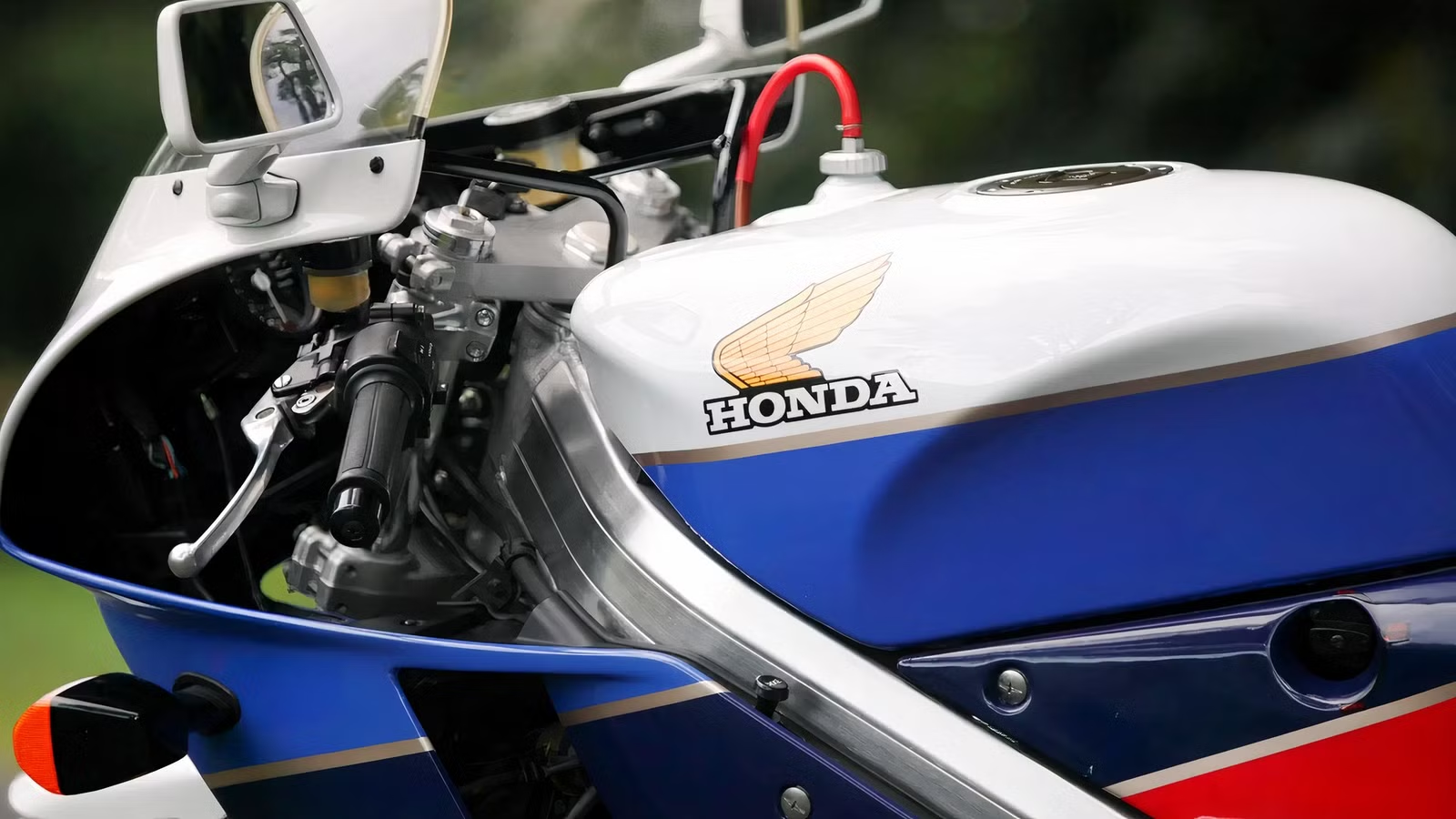
Some rules exist to be followed. Others exist to be beaten so thoroughly that the sport has to rewrite itself afterward. In the late 1980s, motorcycle racing built an entire championship around the idea that road bikes and race bikes should be close cousins, and most manufacturers found comfortable ways around that promise. Honda did not. Honda’s racing division read the letter of the rule and decided to answer it with unusual literalness, building a machine that blurred the line between showroom stock and works racer almost entirely. What that machine was, and how far it pushed the sport’s own rulebook, still defines how collectors and racers talk about it decades later.
Setting the Stage for a Rulebook Built to Be Bent

When the FIM launched the World Superbike Championship for the 1988 season, it built the series around road-based machinery rather than pure prototypes. The rule sounded straightforward: a manufacturer could only race a bike in Superbike trim if it had built and sold a minimum number of essentially identical machines to the public. That homologation requirement was meant to keep costs down and keep the grid full of bikes that ordinary riders could recognize, and in theory, buy for themselves.
In practice, most manufacturers treated the rule as a box to check rather than a genuine engineering brief. They took an existing sport bike, stiffened the frame, bumped compression, and called it a racer. The public version and the works racer shared a silhouette and little else underneath the bodywork. That gap between showroom bike and grid bike became an open secret in the paddock, and it left the door wide open for any manufacturer willing to close it for real.

The Rare Sportbike From The ‘90s That Collectors Quietly Obsess Over
A rare ’90s homologation special hid in plain sight, but collectors know why this road-legal racer is becoming impossible to ignore.
One Manufacturer Refused to Compromise

One manufacturer decided the loophole was worth exploiting properly rather than squeezing through it with the bare minimum. Instead of adapting an existing sport bike, its racing division built a machine from the ground up around technology its endurance racers already used, then detuned just enough of it to make the result street legal. The public was offered something closer to a genuine factory prototype than any road-going motorcycle had been before it.
The price reflected that approach. Buyers paid roughly double what a contemporary sport bike cost for a machine built around a titanium-heavy engine, race-bred suspension, and a production run measured in the low thousands rather than tens of thousands. Waiting lists formed outside dealerships before most riders outside the factory had even seen the bike in person, let alone ridden one.
None of that spending was really aimed at road riders. The manufacturer’s racing division needed a legal number of bikes on the street to keep its actual works racer eligible for the championship, and every engineering decision flowed from that priority rather than from what would make a comfortable commute. Comfort, running costs, and everyday usability sat well below outright pace on the list of things that mattered, and the finished bike made no secret of it.
The Honda RC30 Was a Works Racer With a License Plate

|
Model |
Engine |
Power |
Torque |
0-60 mph |
Top Speed |
|---|---|---|---|---|---|
|
Honda RC30 (VFR750R) |
0.7-liter V4 |
112 hp |
53.5 lb-ft |
4.0 sec |
153 mph |
The Honda RC30, officially named the VFR750R, was the machine Honda’s factory team built once it decided the World Superbike homologation rule was worth exploiting fully. Honda Racing Corporation built each RC30 largely by hand, borrowing technology directly from its RVF750 endurance racer rather than adapting an existing road bike. In European trim the engine produced 112 hp at 11,500 rpm, and gear-driven camshafts, titanium connecting rods, and a single-sided Pro-Arm swingarm developed with the French engineering firm Elf all came straight from the race program, features few other production motorcycles of that era carried at all.
Honda’s gamble paid off almost immediately. Fred Merkel rode the RC30 to the inaugural World Superbike title in 1988 and repeated the feat in 1989, giving Honda back-to-back championships on a bike the public could technically walk into a dealership and buy. Japanese-market examples were restricted to roughly 80 hp and American versions ran their own detuned tables, market variants of the same 112 hp European bike rather than a different machine. Only 4,885 examples were built worldwide, a production number so tight that Honda’s racing budget effectively subsidized a homologation special the company had little hope of profiting from directly.
The Honda RC45 Refined the Same Homologation Trick

|
Model |
Engine |
Power |
Torque |
0-60 mph |
Top Speed |
|---|---|---|---|---|---|
|
Honda RC45 (RVF750R) |
0.7-liter V4 |
119 hp |
56 lb-ft |
3.8 sec |
160 mph |
Honda replaced the RC30 in 1994 with the RVF750R, better known as the RC45, once the original platform needed modernizing to remain competitive at the front of the World Superbike grid. The new bike kept the gear-driven V4 layout but adopted PGM-FI electronic fuel injection and moved its camshaft drive to the side of the engine, allowing a narrower overall package than the RC30 ever achieved. Peak output rose to around 119 hp in European trim, with 56 lb-ft of torque and a top speed close to 160 mph.
John Kocinski delivered the RC45 its only World Superbike title in 1997, a single championship built on a homologation strategy that had already proven itself once with the RC30. Honda built the RC45 in even smaller numbers than its predecessor, with only around 200 examples produced worldwide across its full production run. That scarcity, more than outright performance, is why the RC45 now commands prices that meet or exceed what a comparable RC30 brings at auction.
Japan Built A Motorcycle That Embarrassed Every European Superbike
This Japanese bike took on all of Europe and won.
What the Homologation Loophole Is Worth Today

|
Bike |
Average Price |
|---|---|
|
Honda RC30 (VFR750R) |
$51,700 |
|
Honda RC45 (RVF750R) |
$66,500 |
Honda RC30 values swing hard depending on condition, originality, and how much of the original toolkit and paperwork survives with the bike. One clean, standard example sold at a recent Las Vegas sale for $51,700, a result that closed just over a year ago and gives a realistic sense of what a solid, unmodified RC30 brings today. A pristine, numbers-matching standard example set the benchmark higher still, reaching $121,000 at a record 2019 auction sale. The gap between those two results comes down almost entirely to condition rather than any real difference between the bikes themselves.
Race provenance moves the number into an entirely different bracket. Joey Dunlop’s own 1988 Isle of Man TT-winning RC30 sold for $176,157 at a 2025 Bonhams sale, roughly 45% above the standard record and proof that a documented racing history is worth as much as the bike underneath it. A standard RC45 trades for far less, with a clean example changing hands for $66,500 at a 2023 sold listing, though Dunlop’s own RC45 brought $122,582 at the same Bonhams event, confirming that race provenance moves both models by a similar margin. Mileage, matching frame and engine numbers, and whether a bike still carries its factory tool kit all move both models meaningfully in either direction, but nothing moves the number quite like a name attached to a genuine race win.
Honda’s racing division answered a rulebook with unusual literalness back in 1987, building two of the closest things to a factory racer ever sold with a license plate attached. The market has spent every year since agreeing that the gamble was worth it, and the six-figure results still coming out of auction houses today suggest that verdict has no reason to change.
Sources: Mecum, Bonhams, Classic.com, Bring a Trailer.

Related posts

Latest Post


No Comments