
The Honda NS400R Was A 3-Cylinder GP Bike Made Road-Legal
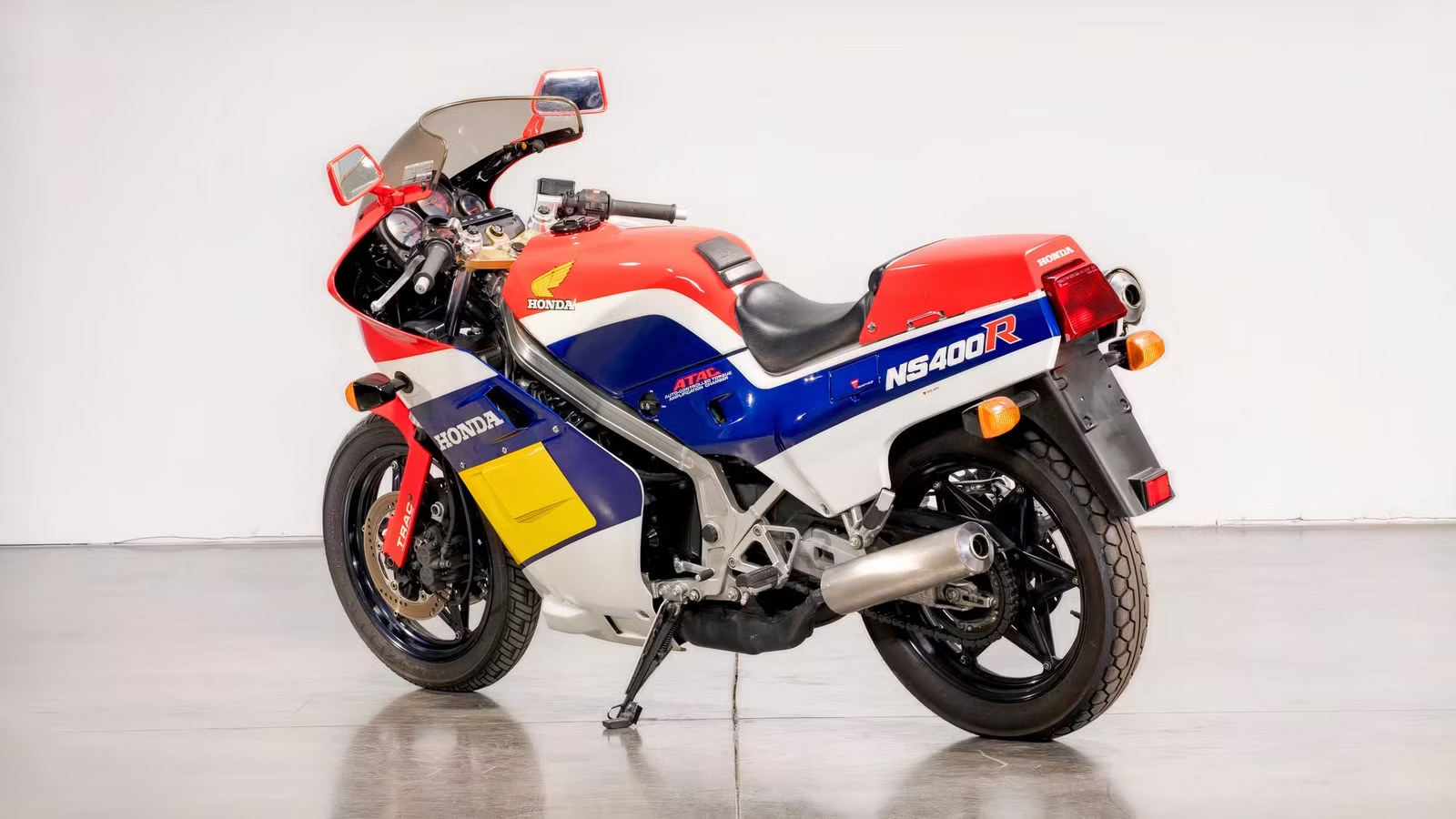
The 1980s was a wild time for Grand Prix motorcycle racing. Two-stroke engines were the preferred mechanical design but, outside of that, manufacturers were desperately trying anything they could to get an advantage. Honda was no different. The Japanese brand had come back after a 12-year hiatus and struggled to make headway, so it took a drastically different approach to what it hoped would be Grand Prix glory. Not only would that pay off, but it would spawn one of the most exciting race-bike-turned-legal in the brand’s history.
The Era When Honda’s Grand Prix Bikes Were Two-Stroke Monsters

1980s Grand Prix motorcycle racing was a very different beast to what it is today, with all the electronic interference. Traction control was how much a rider twisted their wrist, fuel injection was done by carburetors rather than 1s and 0s, and bikes were altogether rawer. The top flight was a two-stroke arms race, as manufacturers and engineers competed to make the best thing with a 500cc engine.
Honda was freshly back into the sport, having stepped away from the premier class in the 1960s to focus more on passenger cars. It returned in 1979 with the four-stroke NR500, but to little success. After three years of development, testing, and racing, the bike had failed to deliver a single podium, leaving Honda with little choice but to rethink its approach. So it took a gamble on something more unconventional for 1983: a three-cylinder bike.
Freddie Spencer’s V3 Changed What A 500cc GP Bike Could Be

1983’s three-cylinder NS500 was a runaway success. 1982 hadn’t been terrible, as Freddie Spencer took the four-cylinder NS500 to two wins from 12 races and third overall, but he dwarfed that by taking six wins from 12 races the year later, securing the title by two points over Kenny Roberts and becoming the youngest premier-class champion at the time at 21 years old. Three cylinders clearly worked. But that wasn’t all.
While the NS500’s narrow V3 engine helped Honda to make the bike both brutally powerful and devastatingly light, the format didn’t have to be confined to racetracks; it could go on the road as well. It offered Honda a template for genuine performance without the need for a bulky four-cylinder, offering riders something race-bred and road-legal.
Of course, it couldn’t just take a GP engine, slap it in a road frame, and call it a day. Normal riders don’t have the reflexes of a Grand Prix racer, nor do they have the budget for engine rebuilds after every ride. But it could certainly apply the same format, shrink it, refine it, and give people something with true Grand Prix heritage. So that’s exactly what it did.
The Honda NS400R Put A V3 Two-Stroke In The Hands Of Road Riders

Just two years after Spencer’s title-winning season, Honda put what it had learned from its 1983 race bike into practice for the road, releasing the Honda NS400R in 1985. It wasn’t quite as lairy as the NS500, displacement dropping from 498cc to 387cc, power dropping from 123 HP to 72 HP in export fettle (it was less in Japan), and the road-legal bike having the necessary changes it needed to be allowed on the road, but both had a race-honed two-stroke V3 engine, a six-speed ‘box, and the bodywork of a champion.
These numbers might sound like Honda had made a diluted version of Freddie Spencer’s title-winning bike and, in reality, they had. This wasn’t by mistake, though, it was by design. The NS500 was made to survive Grand Prix distances, dancing on the limit, backed by entire teams and ever-expanding budgets rather than cold starts, traffic jams, and thousands of road miles by people who don’t quite have the same mechanical intuition as Spencer. The NS400R’s job, then, was to take the architecture that had proven itself at the highest level of motorcycle racing and make it accessible enough for mere mortals while retaining that dazzling two-stroke character.
Given this context, the dilution makes sense. Anyone who’s ever spent any time with racing machinery knows how highly-strung they are, especially when they’re at the lower end of their capability. They’re professionally tuned for an incredibly narrow operating window — one which a road bike will likely never exist in — so Honda needed the NS400R to deliver real-world riding without sacrificing the two-stroke performance that had helped to make the NS500 famous. Competitors like the Suzuki RG500 Gamma and Yamaha RD500LC were bigger and meaner. But Honda deliberately didn’t go down the same route, and not for the reason you think.

See, Japan’s licensing laws of the time dictated what size bike a rider was permitted to ride. There were four categories — moped for anything
This lower displacement compared to contemporaries actually makes the bike more interesting, rather than less. The NS400R couldn’t rely solely on power to make a name for itself so, along with its V3 engine, it needed something interesting to determine how those three cylinders delivered their power.
Honda’s ATAC System Gave The Honda NS400R A Trick Up Its Two-Stroke Sleeve

The NS400R’s V3 engine gets the headlines, but its two-stroke power delivery was where the engineering got particularly clever. The key was Honda’s Automatic Torque Amplification Chamber, or ATAC, which was a system designed to improve torque and broaden the engine’s usable powerband.
Two-stroke engines are notoriously beholden to their exhaust tuning. Getting the timing right means an engine can produce a ferocious surge of power when prompted, while getting it wrong means the band can become too narrow and difficult to exploit, essentially killing the fun.
ATAC worked by altering the effective exhaust volume at lower engine speeds by having an additional chamber connected to the exhaust system. When revs rose, the operation changed and allowed the engine to breathe differently to build power more effectively, creating more torque at low revs then allowing more horsepower at higher ones. It was something it had developed for its 1982 NS500, then used in 1984 for its CR250R motocross bike before making its first road-bike appearance in the NS400R in 1985. And it really mattered, as it helped to make what was ostensibly a Grand Prix engine work across a far wider spectrum of riding.
The NS400R Is The Affordable Link To Honda’s Last Great V3 Era

Though the NS400R had a mixed reception on launch, with glowing reviews of its chassis contrasting a tough market where its 387cc engine put it almost directly between 250cc and 500cc machines, it remains one of Honda’s most important Grand Prix machines. The NS500 that normal people could buy, and experience the same as Freddie Spencer did.
Its brief production run of around 12,000 bikes across three years only strengthens that appeal. Surviving bikes are harder to find in original condition, clean bikes are increasingly desirable, and low-mileage examples command a premium. A 678-kilometer (~420 miles) sold for $36,300 in 2025, while a 47,594-kilometer (~29,570 miles) bike sold for $11,877 in 2024. It makes for a compelling Honda for those who care more about engineering than what has the biggest number; something with both genuine racing heritage, and an interesting solution to a problem.
So while the NS400R might, in some ways, be a baby NS500, that’s only part of its story. It’s a bike that has so much more to offer than an unorthodox engine layout, if you just look hard enough.
Sources: Genteikaijo Hibari, Classic Bike Hub, Mecum, Iconic Motorbike Auctions

Related posts


Latest Post


No Comments