
The Adventure Bike That Feels Right At Home On Any Road
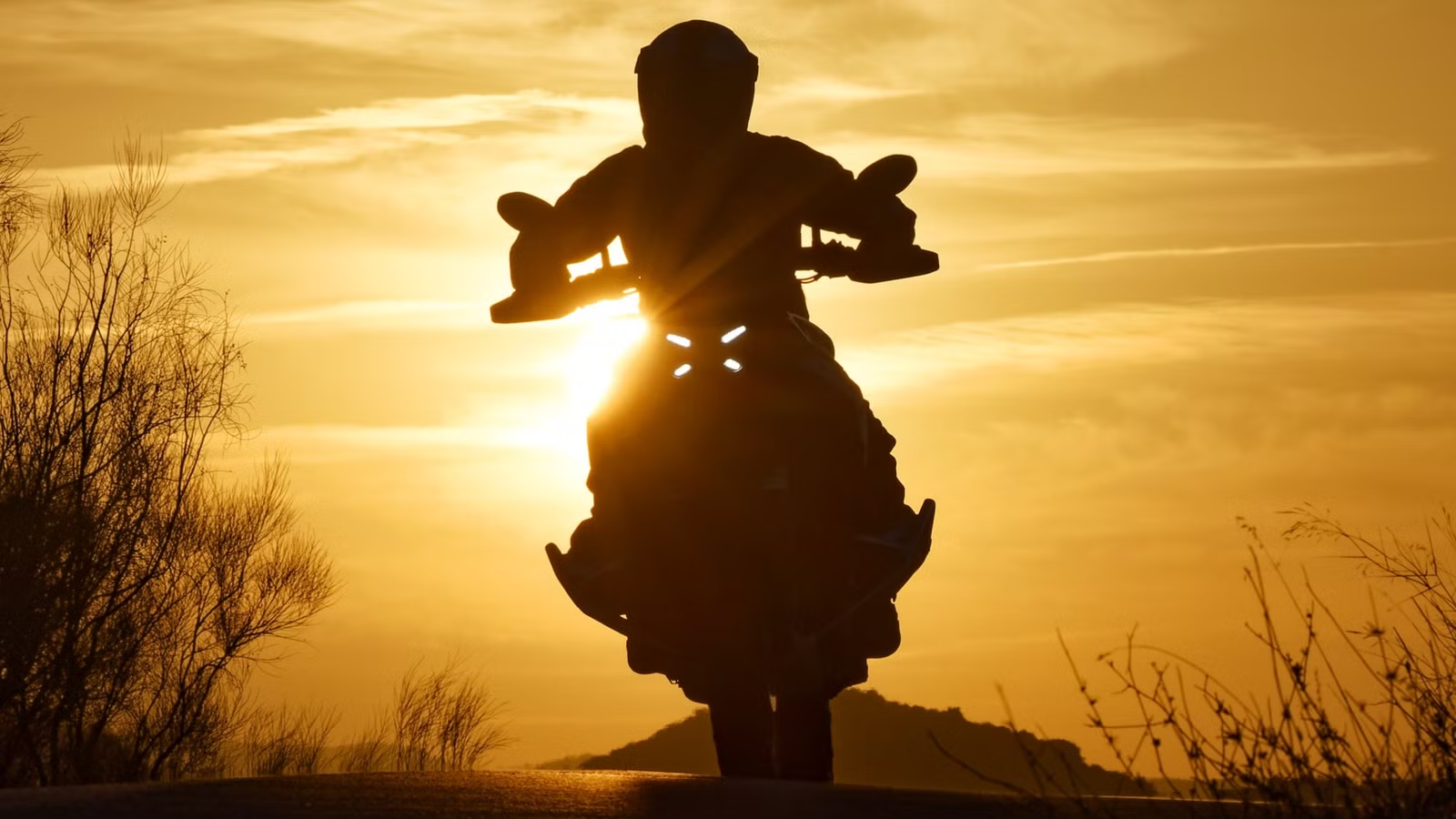
Every adventure touring bike makes the same promise: commute during the week, carve a canyon pass on Saturday, then point the front wheel down a gravel road and keep going. Almost none of them actually deliver on all of it. Something usually gives — the highway ride gets tiring, the off-road manners get clumsy, or the tech gets so deep you spend more time on menus than in the saddle. However, one machine has quietly become the class benchmark precisely because it refuses to make you choose.
The Adventure Touring Class’ Toughest Balancing Act

Big adventure bikes are hard to get right because the goals fight each other. Highway comfort wants a heavier bike with a bigger fairing and a plush seat; off-road agility wants the opposite — light, narrow, and forgiving when things get sideways.
Add more tech to help with one problem, and you often add weight and complexity that hurts the other. It’s a genuinely difficult segment to nail, and it’s only gotten more crowded: every major manufacturer now fields at least one big-bore adventure bike chasing the same buyer. Most of them are good. Very few are good at everything — and one bike has taken a radically different engineering approach to prove it.
The BMW R 1300 GS: A Clean-Sheet Redesign Built Around One Radical Idea
Starting At $20,395 With A Warranty That Outlasts Most Competitors


That name is the BMW R 1300 GS, and calling it a facelift of the outgoing R 1250 GS is a gross understatement. The R 1300 GS is a clean-sheet redesign, from the frame up. New engine, new chassis, new electronic architecture, all built around one goal: stop asking the rider to pick a lane.
In the US, the base R 1300 GS starts at $20,395, plus a $1,095 destination charge — call it about $21,500 out the door before tax and title. Load one up with the Trophy off-road package, the Dynamic package, and the automatic gearbox, and BMW’s own configurator shows the price climbing to roughly $28,090. Every R 1300 GS also comes with a three-year/36,000-mile warranty and a complimentary break-in service, a longer safety net than a lot of competitors bother to offer.
The Most Powerful Production BMW Boxer Engine Yet
A Boxer Twin Built For Effortless Miles

At the heart of the R 1300 GS is BMW’s biggest, strongest boxer twin yet — a 1,300cc air/liquid-cooled flat-twin making 145 horsepower at 7,750 rpm and 110 pound-feet of torque at 6,500 rpm. That alone would be a headline number, but the more interesting change is buried in the engineering.
BMW moved the six-speed transmission underneath the engine instead of behind it, shortening the whole powertrain and pulling mass toward the bike’s center — a change that pays off every time you’re paddling the bike around a gas station rather than actually riding it. The ShiftCam variable valve timing keeps the engine flexible across the rev range, and standard ride modes (Rain, Road, Eco, and Enduro) let the character shift with the terrain; add the optional Dynamic package and Pro modes unlock sharper throttle response for pavement and dirt alike.
The Clutch-Free Gearbox That Makes Technical Terrain Less Intimidating

The bigger news for a lot of riders is what BMW calls the Automated Shift Assistant, or ASA. A new addition for this generation, the automatic clutch and gearshift system does away with the clutch lever entirely, while still letting you shift manually with your foot if you’d rather. It’s not a twist-and-go scooter gearbox; it’s closer to a dual-clutch transmission on a sportbike, just applied to something meant to cross a continent. For riders intimidated by clutch work in slow, technical terrain, or anyone who’s ever dropped a bike at a stoplight over a fumbled gear change, ASA quietly changes how approachable this whole platform is, without dumbing down what the bike can do once you’re rolling.
Chassis Tech That Rewrites What “Big Adventure Bike” Means
BMW’s Proprietary Suspension That Keeps Both Wheels Planted On Any Surface

The chassis got just as thorough a rework. BMW replaced the old tubular frame with a new two-part design: a sheet metal main frame paired with a cast-aluminum, monocoque rear subframe. Up front sits the new EVO Telelever, and out back the EVO Paralever now runs a single-sided swingarm, both aimed at sharper, more predictable handling whether the surface underneath is asphalt or washboard gravel. At a 523-pound curb weight, BMW claims that the R 1300 GS is genuinely light for a machine in this class, and unexpectedly manageable at parking-lot speeds for something built to swallow a thousand highway miles in a weekend.
Dynamic Suspension Adjustment And Adaptive Vehicle Height Control

Two optional systems push the “any road” idea even further. Dynamic Suspension Adjustment (DSA)electronically manages damping and preload on the fly, adapting to load and riding style without the rider reaching for a dial. Adaptive Vehicle Height Control goes a step further, automatically lowering the bike as it slows to a stop and raising it back up once you’re moving again, so a tall-standing adventure bike doesn’t leave a shorter rider tiptoeing at every red light. It’s a direct, literal answer to the whole premise of this article: the bike adapts to the road, not the other way around.
Next-Gen Radar Safety And Comfort For Long-Distance Rides
Everything Adjustable Before You Touch The Accessories Catalog

The cockpit is built around a standard 6.5-inch full-color TFT display, controlled through BMW’s Multi Controller wheel instead of a maze of handlebar buttons. Heated grips come standard, heated seat options are available for rider and passenger, and an adjustable windshield helps dial in wind protection for the conditions.
There’s a smartphone charging compartment tucked behind the bars with an integrated USB port, genuinely useful on any ride long enough to need it. Standard seat height adjusts from 31.5 to 35 inches, and between that range and Keyless Ride, the bike handles a lot of the ergonomic customization before a rider even opens the accessories catalog.
Radar-Based Collision And Lane Warnings — Safety Tech Borrowed From Cars

BMW ditched the GS’s long-running asymmetric headlight for a new symmetrical light signature, and the optional Headlight Pro adds matrix cornering lights that illuminate into a turn rather than just straight ahead. The tank-to-seat design line now runs continuously instead of stepping, giving the bike a leaner silhouette than its predecessor.
For riders planning real distance, the optional ConnectedRide Navigator adds another layer of route planning on top of the standard display. And on the electronic-aid side, the available Riding Assistant package brings Active Cruise Control, Front Collision Warning, and Lane Change Warning — radar-based safety tech that you’d expect only in cars, until fairly recently.
Three Distinct Trims: Trophy, Triple Black, And Option 719 Biscaya

BMW sells the R 1300 GS in three distinct personalities. The GS Trophy leans into off-road capability, with spoked wheels and hardware aimed at riders who actually plan to leave pavement behind. Triple Black is the comfort-focused all-rounder, built for riders who want most of their miles on tarmac with the option to wander. And the Option 719 Biscaya trim is the platform’s premium expression — gold accents, milled aluminum components, and the kind of finish that is about individualization as much as capability.
How It Stacks Up Against The Competition

The R 1300 GS doesn’t compete in a vacuum. Ducati’s Multistrada V4 starts near $19,995 and can climb well past $29,995 for the V4 S, trading some of the BMW’s easy manageability for a faster, more sport-oriented V4 engine. KTM’s 1390 Super Adventure R — which replaced the long-running 1290 for 2026 — starts at $21,649 and throws down 171 horsepower for riders who want the most off-road-focused, hard-charging version of this formula.
Triumph’s Tiger 1200 lineup runs from around $19,500 to the low $20,000s depending on trim, built around a distinctive T-plane triple engine. And Harley-Davidson’s Pan America 1250 Special starts at $19,999 with 150 horsepower and its own take on adaptive ride height. Every one of those bikes is genuinely good at something specific. The BMW’s case is that it’s genuinely good at nearly everything, which, in a class built entirely around not having to choose, makes it such an attractive proposition.
Source: BMW Motorrad

Related posts


Latest Post


No Comments