
The Honda Motorcycle That Does More Than Most Riders Will Ever Ask
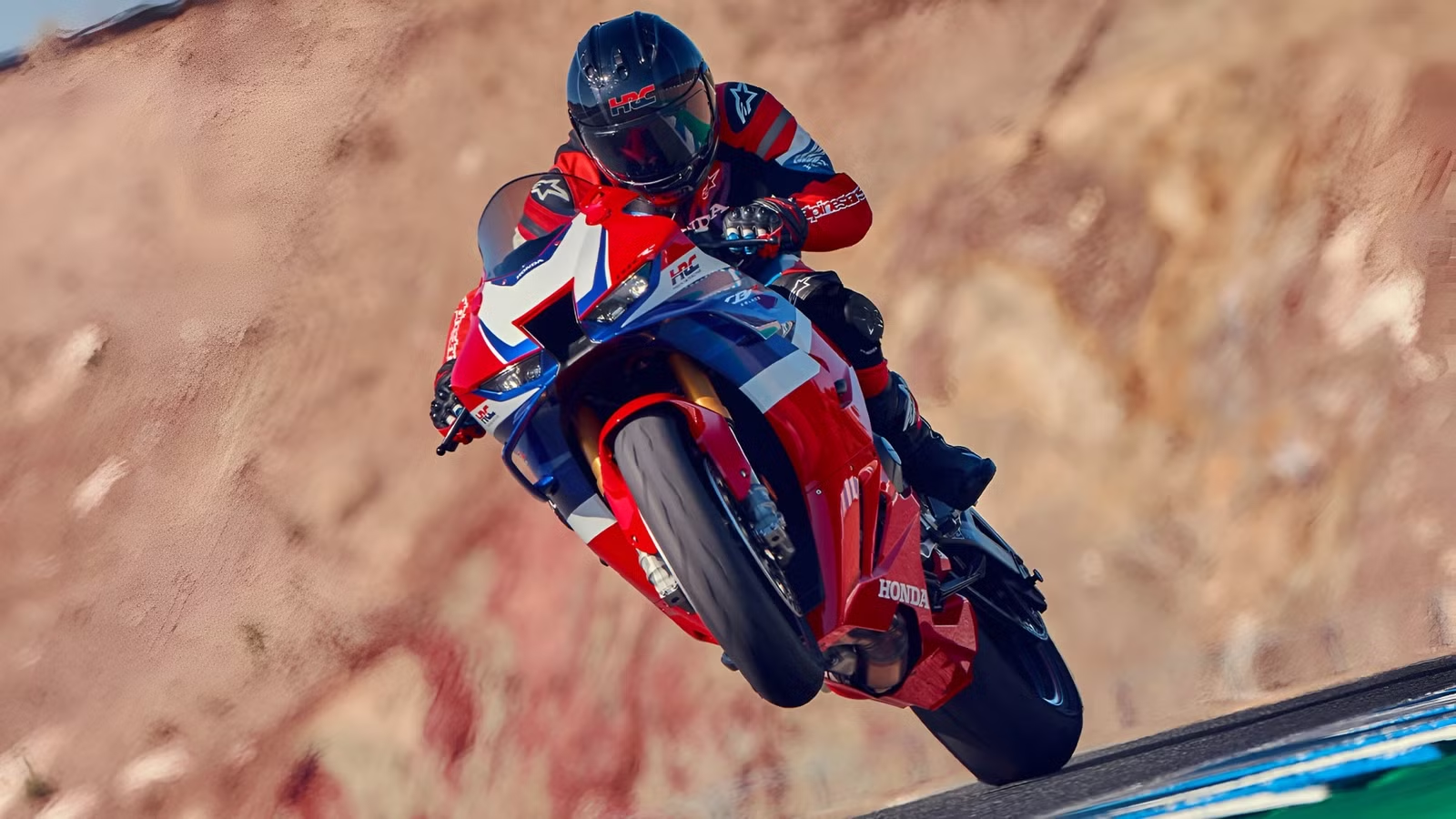
Modern motorcycles are easier to ride, more dependable, and more polished than ever, but that didn’t happen by accident. Over decades, manufacturers learned that performance mattered just as much as predictability, refinement, and everyday usability. Honda played a huge role in setting that benchmark globally, proving that serious motorcycles didn’t need to be temperamental, intimidating, or exhausting to own. Other brands followed that formula, then eventually pushed beyond it with sharper technology, more exotic hardware, and increasingly aggressive performance.
Honda Has Always Made Serious Motorcycles Easier To Live With

Honda’s greatest strength has rarely been building the most intimidating motorcycle in the room. Instead, the company has spent decades making complicated machines seem approachable, whether that means smoothing out a powerful engine, creating predictable handling, or giving riders controls that make sense within the first few miles. Even Honda’s fastest and most ambitious motorcycles usually carry a layer of friendliness beneath the serious hardware.
That approach has helped Honda build a very wide audience. Beginners appreciate motorcycles that don’t punish clumsy inputs, while experienced riders value machines that remain composed when the pace increases. A Honda can be technically advanced without making every ride feel like an audition for a factory racing contract, and that balance has become one of the brand’s most recognizable characteristics.
The CBR Family Was Built Around Speed Riders Could Actually Use

Honda carried that philosophy directly into the CBR lineup. From middleweight sports bikes to liter-class flagships, CBRs became known for combining genuine performance with manageable power delivery, neutral handling, and ergonomics that didn’t always require a chiropractor on standby. They could handle track days, canyon roads, commuting, and longer rides without forcing owners to accept every traditional superbike compromise.

That usability made CBRs easy to recommend, but it also changed how enthusiasts perceived them. A motorcycle that behaves predictably can seem less dramatic beside rivals built around explosive acceleration, razor-edged steering, and uncompromising racetrack intent. Honda’s sports bikes remained fast, but their polish sometimes made them appear less exciting than motorcycles that demanded more from their riders.
Honda’s Usability Focus Let Its Rivals Steal The Spotlight, Though

As the superbike category became increasingly competitive, European manufacturers pushed harder into exotic hardware, aggressive electronics, aerodynamic development, and headline-grabbing horsepower. Nowadays, premium European superbikes define what a road-legal superbike should be, while Honda’s balanced approach can sometimes look conservative next to machines designed to resemble racing prototypes with license plates and turn signals.
That contrast is particularly noticeable in the US, where much of Honda’s CBR lineup now leans heavily toward street usability. The CBR300R, CBR500R, CBR650R, and CBR1000RR cover riders ranging from beginners to experienced enthusiasts, but the range doesn’t constantly reinvent itself around the latest racetrack technology. Even the CBR600RR dates back many years. That’s not to say that Honda has lost its edge when it comes to race-bred machinery. In fact, a certain motorcycle continues to occupy both racetrack paddocks and the walls of kids dreaming of one day hitting the road on two wheels.
The CBR1000RR-R Fireblade SP Is A Reminder Of Just How Capable Honda Is

That bike is none other than the CBR1000RR-R Fireblade SP, Honda’s flagship superbike and the closest thing the company builds to a street-legal race machine. Carrying an MSRP of $28,999, it isn’t designed to win spec-sheet arguments alone. Instead, it’s the culmination of decades of racing knowledge distilled into a production motorcycle that’s astonishingly capable whether it’s attacking apexes or simply carving through an empty back road.
Why Having More Motorcycle Than You Need Isn’t Always A Bad Thing

On paper, buying a motorcycle capable of far more than you’ll ever realistically use might sound excessive. After all, very few riders will exploit every ounce of the Fireblade SP’s performance, nor should they. But motorcycles aren’t always a logical purchase. They represent passion, aspiration, and an appreciation for exceptional engineering just as much as they provide transportation from one place to another. That’s ultimately what makes the Honda CBR1000RR-R Fireblade SP so compelling.
It isn’t simply a motorcycle built to chase lap records or dominate comparison tests. It’s a showcase of what happens when Honda’s engineers are given the freedom to pursue excellence with very few compromises. Most owners will never ask everything of it, and that’s perfectly fine. The satisfaction comes from knowing that every ride is backed by a machine with capabilities so far beyond everyday demands that almost any road, any corner, and any challenge becomes just another opportunity to appreciate how much motorcycle is waiting beneath the rider.
Race-Derived, Engineered For The Real World

Diving deeper, at its heart sits a 999cc liquid-cooled DOHC inline-four producing 214 horsepower and 83 pound-feet of torque. The engine breathes through finger-follower valve actuation inspired by Honda’s RC213V MotoGP machine, while titanium connecting rods, forged aluminum pistons, and an extremely oversquare bore and stroke allow it to spin eagerly toward its lofty redline. Power reaches the rear wheel through a six-speed transmission equipped with a slipper clutch and a standard quick shifter for clutchless upshifts and downshifts.

The chassis is every bit as serious as the engine. Honda pairs a lightweight aluminum twin-spar frame with a longer aluminum swingarm to maximize stability under acceleration. Fully electronic Öhlins Smart-EC 3.0 suspension continuously adjusts damping as conditions change, while Brembo Stylema R front calipers grip twin 330 mm discs backed by a 220 mm rear rotor. Aerodynamic winglets integrated into the bodywork generate meaningful downforce at speed without overwhelming the motorcycle’s clean silhouette.

Honda also equips the ‘Blade with a five-inch full-color TFT display that serves as the command center for its extensive electronics suite. Riders can customize power delivery, engine braking, wheelie control, Honda Selectable Torque Control, cornering ABS, and suspension settings through multiple riding modes, while cruise control adds a surprising touch of practicality for longer highway stretches. Fully fueled, the motorcycle weighs just 443 pounds, while its 32.8-inch seat height, 16.1-liter fuel tank, and aggressive ergonomics reinforce its race-focused mission.
A Motorcycle Engineered To Solve Problems You’ll Probably Never Encounter

Looking closely at the Fireblade SP reveals countless examples of Honda solving challenges that most owners will never face. The aerodynamic package wasn’t designed for flexing at stoplights. It was shaped to improve stability during high-speed acceleration and heavy braking. The semi-active suspension isn’t there because everyday roads demand constant damping adjustments, but because changing conditions can benefit from suspension that reacts faster than any rider possibly could.
The same thinking extends throughout the motorcycle. The electronics constantly process data from the six-axis IMU to coordinate braking, throttle response, traction control, and wheelie control into one seamless system instead of treating each function separately. Even details like the lightweight wheels, premium suspension components, and carefully optimized chassis geometry exist to create consistency rather than drama. Most riders will never fully exploit those capabilities, yet they’ll appreciate the confidence those engineering decisions provide every time they throw a leg over the bike.
Its Greatest Achievement Isn’t How Fast It Is
It’s tempting to judge a motorcycle like the Fireblade SP by numbers alone. A top speed well beyond anything legally usable, acceleration that borders on violent, and enough horsepower to embarrass most supercars certainly make for impressive headlines. Yet those figures only tell part of the story. The real accomplishment is how effortlessly the motorcycle carries all of that potential without constantly demanding that the rider prove worthy of it.
Source: Honda Powersports

Related posts


Latest Post


No Comments