
The Honda Motorcycle Owners Keep For Decades
When it comes to lifelong motorcycles, Japanese manufacturers have cracked the formula. They prove that refinement, reliability, and precision engineering matter as much as performance, riding dynamics, and even exotic appeal. Furthermore, the trend of Japanese marques refining decade-old engineering designs, rather than opting for the latest technology, plays a vital role in creating these lifelong motorcycles.

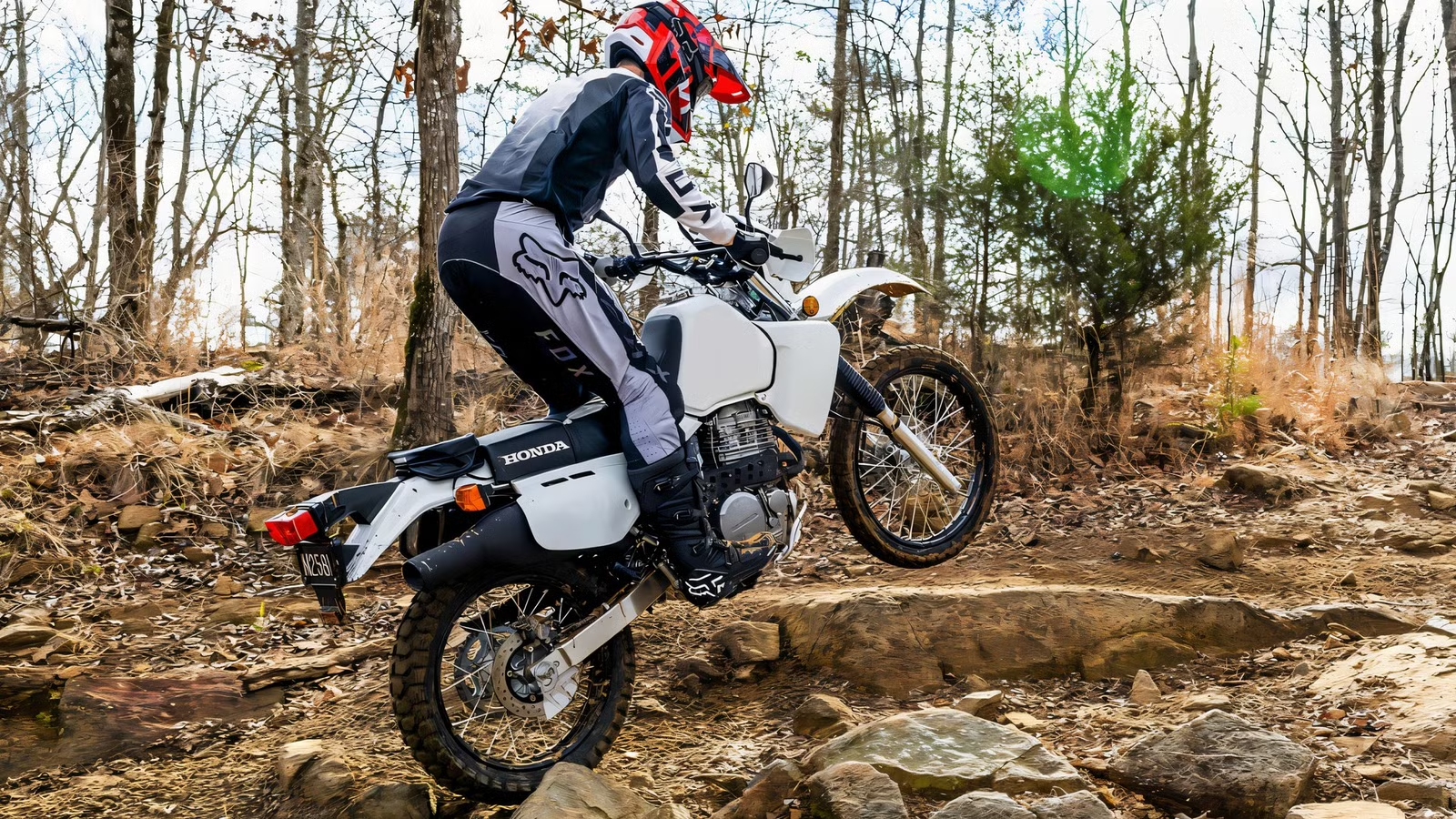
All four big Japanese motorcycle makers have legacy-rich specimens in this arena. Here we focus on a forgotten dual-sport from Honda—a sleeper motorcycle that doesn’t compromise on any front, despite being over three decades old. It is also one of the few motorcycles with a 600+ cc single-cylinder engine on sale today.
Here’s Why Most Honda Motorcycles Rank High On The Lifelong Motorcycles’ List
As mentioned earlier, Japanese motorcycle makers place a lot of emphasis on refinement and reliability, honing mechanical components over years to minimize failures. Honda stands out by diversifying this quality without keeping things ‘boring’. Beyond Honda’s daily-ridable, conservatively powered, and less tech-heavy motorcycles, its lasting appeal also extends to high-revving, track-ready sportbikes and even top-spec luxury touring bikes.
Honda’s Most Sophisticated Bikes Prove Reliability Scales Up Too


Playing it safe with analog machines that have seen few updates over decades is an easy way to build a long-lasting motorcycle, given Honda’s focus on refinement and reliability. But it gets even more impressive when the outcome is the same with bikes like the Honda Gold Wing. It is powered by a unique flat-six engine and underpinned by complex hardware loaded with technology features.
Then there’s the high-revving bunch of hardcore track bikes. Prime examples of lifelong Honda sportbikes include the CBR600RR and the urban-friendly CBR650R. The former is a sportbike that will outlive its owner, built in an era when supersport bikes were hugely popular. This remnant from the golden age of 600cc sportbikes is a unique proposition in 2026 that doesn’t compromise on performance or riding appeal.

The CBR650R is the polar opposite of the 600RR in its approach to technology, as it is the only middleweight sportbike with an easy-to-use electronic clutch system. This unlocks a new level of rideability, making it a grin-worthy yet daily-ridable sportbike, even through tight urban traffic. Pricing is also aggressive, with the CBR650R priced at $9,199 and the sportier 600RR priced at $11,499.
Then there’s the Honda Shadow cruiser, which fuses reliability and refinement with Harley-grade visual appeal. The best part is that it gets better with age and can last forever with basic care. Some Honda motorcycle riders keep them for years, and some for decades.

This near-immortal Honda dual-sport takes the spotlight as a motorcycle that riders keep for decades. Its combination of an analog engine and chassis setup, along with robust, simplified engineering and minimal electronics, has helped it stay relevant for over three decades. This makes it one of Honda’s last analog dual-sport models, and its only arch-rival with similar vintage charm is the Suzuki DR650S.
The Honda XR650L Makes Long-Term Ownership Effortless
At $6,999, The XR650L Undercuts Every Rival It Outlasts

After more than three decades in production and on the road, Honda has refined the XR650L to its maximum. With few to no mechanical updates over the years, Honda has also helped build a widespread parts and service network for the XR650L. In other words, being stranded on the XR650L without assistance is nearly impossible.
The XR650L has been around since 1993, and this long life cycle has given it an old-school charm unlike any other dual-sport today. It also adds an undeniable level of simplicity that makes it one of the most reliable motorcycles on sale today. This dual-sport has the life expectancy of a diesel truck. Its owners swear by its longevity, and some even claim it lasts nearly 80 years. Clearly, it’s an exaggeration, but this shows the trust that the XR650L builds.
No TFT Screen, No Ride Modes, No Problem: Why Less Tech Means More Miles

Its low-stress single-cylinder engine, robust, go-anywhere underpinnings, and minimal electronic intrusion deliver a breezy, affordable ownership experience. Look at any used motorcycle website, and you will find many high-mileage XR650Ls that still sell out without a hitch. Even after years of ownership and over 100,000 miles on the odometer, the XR650L can easily go another 100,000 miles with yearly maintenance and preventive care.
The only extra work needed would be a carb clean-up, new lighting, and a new battery. That’s the most “complex” repair any XR650L will demand, which also highlights how easy it is to own this classic-vibing Honda dual-sport. The feature list is as bare-bones as it gets. Notable bits include an electric starter, a sealed battery, and a minimal instrument cluster. But how does a carbureted engine from the 1990s — unchanged for over three decades — actually perform against modern dual-sports?
A Workhorse-Grade Single-Cylinder Engine With Clever Features

The XR650L packs Honda’s biggest dual-sport motorcycle engine. The air-cooled 644 cc single-cylinder engine is a proper relic, but that’s also its strength: unmatched reliability and durability. Unchanged since the 1990s, this engine is a true time capsule for many experienced riders.
This short-stroke mill produces approximately 40 horsepower and 47 pound-feet of torque. The spread-out power and torque curve across the rev band makes it truly versatile for both on- and off-road duties. Peak power comes in at just over 6,000 RPM, and peak torque arrives under 5,500 RPM.

Induction comes from a 42.5 mm constant-velocity carburetor that delivers crisp throttle response, added rideability, and maximum use of available power. A gear-driven counter-balancer elevates refinement. Additionally, this mill uses a clever dry-sump system that routes oil through the frame tubes.
The lubrication system filler cap sits on the chassis backbone ahead of the fuel tank. This offbeat setup saves weight and space. Power is sent to the rear wheel via a five-speed manual gearbox with a final sealed chain drive system.
Complemented With Equally Robust Underpinnings

The XR650L sits on a semi-double-cradle steel frame designed to balance weight and rigidity. This supports its flexible character, which aces both tarmac and trail rides. The main frame pairs an aluminum box-section swingarm with a quick-detachable rear wheel for easy access and repair.
The chassis is suspended on 43 mm Showa telescopic forks with damping adjustment and 11.6 inches of travel. The rear gets a fully adjustable Pro-Link Showa monoshock with 11.0 inches of travel. Braking duties are courtesy of a single 256 mm disc coupled to a two-piston caliper up front. The rear gets a single 220 mm disc coupled to a single-piston caliper. Adding to its on-road and off-road balance are dual-purpose tires wrapped around 21-inch front and 18-inch rear laced wheels.
Classic Styling Adds To Its Old-School Charm

Not updated for over three decades, the XR650L stands out with its retro design language. It beautifully showcases the essence of the 1990s dual-sport era with an enduro-style headlamp and a motocross-style seat design. Without disrupting the overall proportions, Honda has extended the seat length to make the XR650L a capable two-up runabout.
The pillion footpegs are frame-mounted. Larger, durable fenders, a tubular engine guard, and plastic knuckle guards further enhance its rugged appeal. For 2026, it comes in a single shade of white, with red and blue vinyl on the fuel tank and headlamp casing.
The Honda XR650L Shows Us Why Simplicity Still Matters

This dual-sport motorcycle proves that top-spec technology and sophisticated, adaptive underpinnings can be sacrificed for a simplified setup that pays off in refinement, reliability, durability, and nostalgia. The XR650L’s analog nature is rare in today’s tech-heavy era. It is one of the last surviving motorcycles that reminds us of simpler riding days when it was just the rider and the motorcycle, with nothing in between.
Source: Honda Powersports

Related posts


Latest Post


No Comments