
The Honda Cruiser That Makes Traditional American V-Twins Hard To Justify
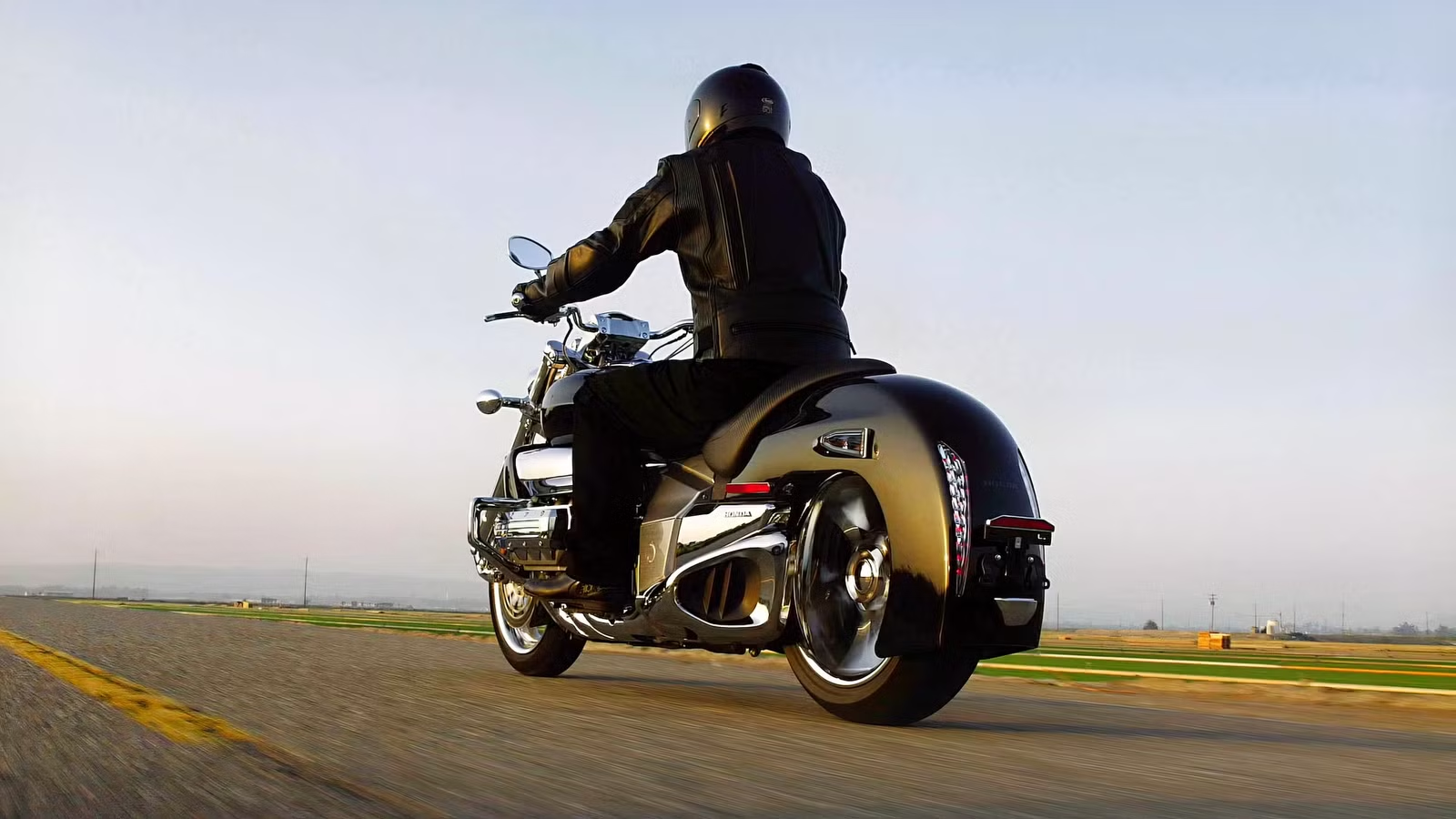
The innovative boffins at Honda never give up on trying something new and unusual. It’s what sets them apart and sparks the creation of new motorcycles and technologies that redefine the segment. The CB750 is a prime example of a game changer. When it comes to cruisers, however, Honda has been, well, a bit of a mixed bag in delivering on that front. The Fury is one such oddball of a cruiser that came out at the peak of the custom chopper era but had too many reasons turning it into a disappointment. Then, the bikemaker went back to the drawing board and whipped up something no one has topped even after two decades.
Honda Took The Cruiser Space Seriously And Came Up With A Better Solution

V-twins have long been the gold standard for American cruisers, so coming up with a Japanese equivalent would be an arduous task that Honda had attempted, and simply making the Fury look aggressive wasn’t the solution. In fact, long before the Fury even rolled out with its underwhelming V-twin, Honda gave its own engineers an unusual brief for one motorcycle, and it ditched the idea of a V engine entirely.

The idea traces back to the Zodia concept shown at the 1995 Tokyo Motor Show, and it then resurfaced in December 2000 when Honda wheeled out four T-series concepts at a Long Beach show and let the crowd pick a favorite. The T2 won decisively, and its shape survived almost untouched into production. What rolled off a limited line in Marysville, Ohio in 2004 borrowed its engine from the GL1800 Gold Wing. At the time, it had been only three years into its production, but it was already another future icon in the making that would eventually take the fight up to Harley’s flagships with its flat-six engine.
The Honda Rune Is The Cruiser That Makes Traditional American V-Twins Hard To Justify


Honda called the production bike the NRX1800 Valkyrie Rune, and it made sure nobody mistook it for a restrained interpretation of the concept. Six individual 32mm throttle bodies replaced the Gold Wing’s twin-body setup, sharpening throttle response on a flat-six. The Rune even boasted the longest wheelbase in the company’s history of making motorcycles, and the largest brakes Honda had ever bolted onto a production motorcycle.

One look at the Rune, and it’s easy to guess that it wouldn’t be cheap. Honda priced the 2004 Rune at $24,499 with Spec47 wheels or $26,999 in chrome; a sum of money asked at that time was simply as brave as the design itself. Honda never built another one after the 2005 model year, and the flat-six cruiser stayed a one-off rather than a lineup. So the exclusivity alone made it stand a cut above the traditional American V-twins from Harley-Davidson and Indian Motorcycles of the era.
The Flat-Six That Trades Thump For Smoothness

The Rune’s engine is a 1,832cc flat-six, with six cylinders where a Harley Heritage Classic or an Indian Chieftain runs a V-twin close to the same total displacement. Honda pulled the block from the Gold Wing platform rather than designing something new. Being the heart of the engine, cylinder count alone changes how the bike accelerates, how it sounds, and how reliable it is, and these differences are where a used Rune starts making a new V-twin harder to justify.
The Finer Details Of The 1,832cc Flat-Six Engine

The Rune was so unique in so many ways that it didn’t take much for it to break the internet at the time. Each of the cylinders and pistons in the Rune’s engine uses a 74mm bore and 71mm stroke, making for an oversquare layout that lets the motor spin up freely. This differentiates it from the way a big V-twin lugs at slower rpms even at the same displacement, since work is shared between two massive pistons. Compression sits at 9.8:1, modest enough to run comfortably on pump gas, with a single overhead cam working two valves per cylinder.

Programmed fuel injection with an automatic choke and a digital ignition system ran three-dimensional spark mapping, refinements that were layered onto the Gold Wing base engine. Even though Honda wouldn’t disclose the outputs, given that the Gold Wing back then produced 118 horsepower and 121 pound-feet, it’s safe to say that the Rune’s tune matched or possibly exceeded these numbers. The performance was as unique as the looks, and the Rune sure made Harley riders look twice.
A Distinct Sound Profile And A Service Interval That V-Twins Would Envy

A V-twin’s two cylinders fire in a lopsided rhythm that riders feel as individual pulses through the seat and bars, giving it the mechanical signature that translates as the engine’s character. The Rune’s six cylinders share that same workload across three times the ignition events, spacing the pulses close enough together that they blend into one continuous beat instead of a series of separate hits. Power reaches the rear wheel through a shaft final drive rather than a chain or belt, and the first valve check isn’t due until 32,000 miles.
Sculpted Bodywork, Lots Of Chrome, And A Limited Production Run

The Rune ran a six-into-two exhaust, three header pipes off three of the six cylinders feeding into each of two silencers, and both of those silencers started life as lost-wax castings. It’s the same process that foundries use for bronze sculptures, rather than the stamped and welded muffler cans most manufacturers use in production processes.

Chrome cylinder head covers and a pair of chrome-shrouded radiators gave the engine a hot-rod finish borrowed more from the custom car culture, and Honda ran a stainless-steel mesh over the throttle cables and brake hoses, a first for any production Honda. Traditional was a word that didn’t apply to the Rune, and no wonder that it ages better than any Harley. Nearly every external panel on the bike was cast and finished specifically for the Rune rather than shared across a platform to save tooling costs.

A single-sided swingarm added to the heavy rear end look, while the whole package sat on an aluminum diamond-shaped frame instead of steel tubing. Honda built somewhere between an estimated 2,500 and 3,000 of them across the 2004 and 2005 model years, though the company never released official production figures. And you may have guessed that the exquisite craftsmanship and production techniques were so unconventional that the development and production costs were astronomical.
Why Used Values Are Climbing While Traditional Cruisers Depreciate

Honda’s own economics on the Rune never really worked, and that’s ironically why it’s worth more today. Development alone reportedly ran into the hundreds of millions of dollars, and each bike is said to have cost Honda well over $100,000 to build and finish before it sold for a quarter of the amount. Typical listings for a 2004 Rune are around $21,015 and a 2005 at $18,795, going up to $26,500 for a low-mileage example in excellent shape. That’s within shouting distance of the original sticker price more than two decades later.

In comparison, a new 2026 Harley-Davidson Heritage Classic starts at $19,999 (one-up model), and a new Indian Chieftain starts at $23,999, both prices that will get you a well-kept used Rune. And neither offers the uniqueness of a machine with a production run measured in the low thousands instead of the tens of thousands that most modern cruisers see today. American cruisers offer the traditional recipe of two cylinders, but what the Rune offers is a recipe that nobody else has ever tried twice, and for the money, that’s a solid reason to overlook the traditional offerings.
Sources: Honda, KBB, Cycle Trader

Related posts

Latest Post


No Comments