
The Harley-Davidson Engine That Delivers The Lowest Ownership Stress
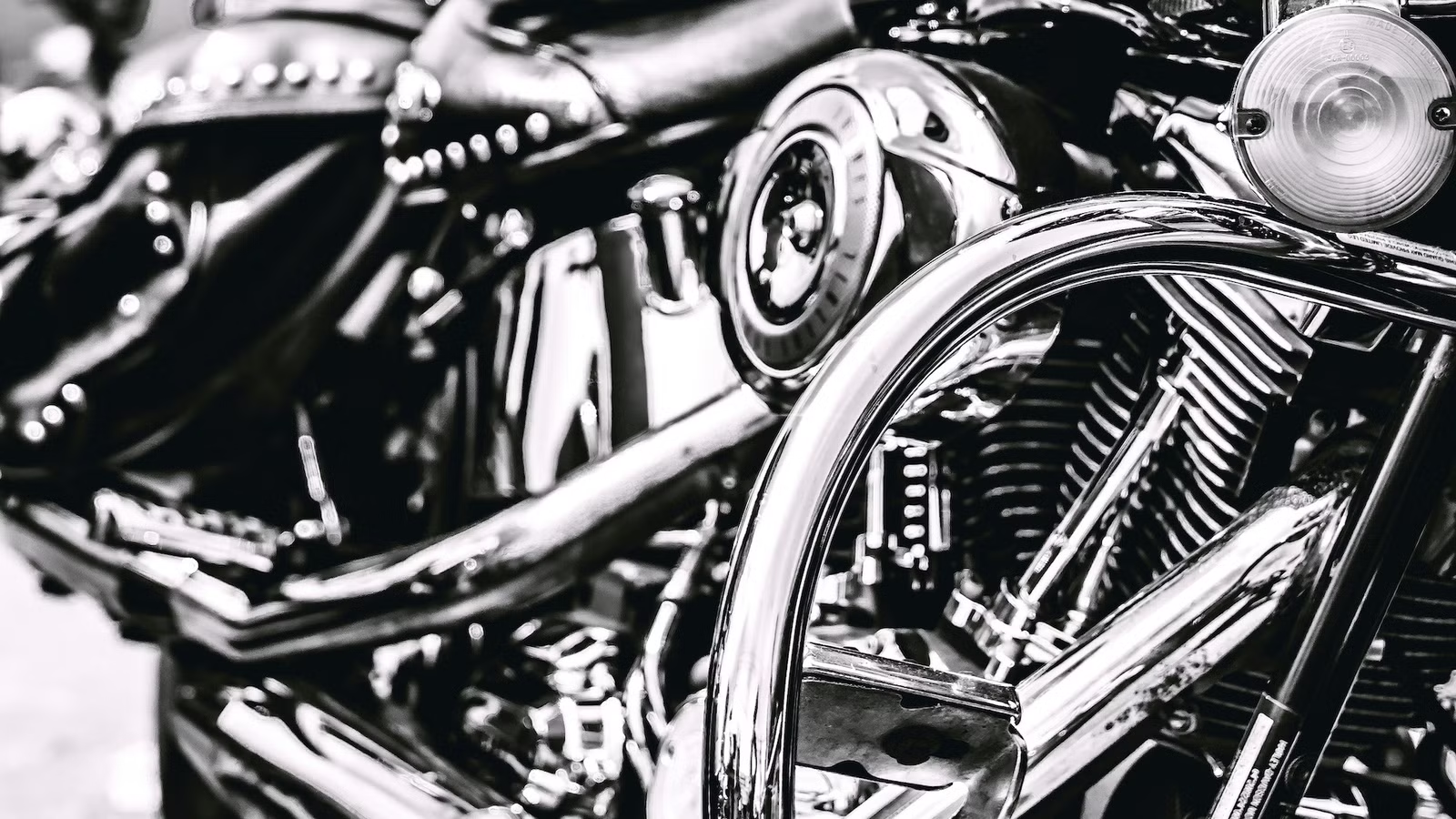
Owning an older Harley-Davidson can mean very different things depending on which engine sits in the frame. Some Harley engines bring historical appeal with equally historical maintenance headaches, while others gain performance through additional complexity. The newer generations of engines increasingly rely on electronics, sophisticated cooling, and tighter integration between the mechanical and electronic systems. So choosing the right one means looking for the point where Harley had already ironed out decades of issues through development, added the conveniences that actually matter, and then largely left the simplicity alone. It may not give you the most horsepower or the fanciest equipment list, but that’s precisely why it makes such a convincing case for low-stress Harley ownership.
The Simplest Harley Isn’t Necessarily The Oldest One

Mechanical simplicity sounds attractive until it includes carburetor tuning, more frequent adjustments, oil leaks attributed to the bike’s personality, or obsolete components that require some detective work to replace. So merely going backwards through Harley-Davidson’s history isn’t automatically the answer to the simplest to maintain engine. What you need is an engine produced a few decades earlier, when you wouldn’t have to resort to a dedicated YouTube playlist of maintenance guides.

The sweet spot usually comes with later Harley models, after electronic fuel injection had become dependable but before liquid cooling, variable valve timing, ride modes, and other increasingly sophisticated electronic controls entered the picture. Hydraulic valve lifters are another big advantage. They eliminate periodic valve-clearance adjustments, taking one recurring maintenance job off the list. That leaves a fairly traditional Harley engine for somebody who wants the old-school sound and feel without the additional Saturday morning maintenance routine.
The Sportster Evolution Is The Low-Stress Harley Engine Choice


The fuel-injected Harley-Davidson Sportster Evolution V-twin, specifically the 883cc and 1,202cc versions sold from 2007 through 2022, is one that falls into that perfect sweet spot. The Evolution-powered Sportster itself goes back to 1986, but 2007 is the useful dividing line because Harley-Davidson made Electronic Sequential Port Fuel Injection standard across the Sportster range that year. By then, the platform had already received another important update. Harley began rubber-mounting the Sportster engine for 2004, separating much of the traditional V-twin vibration from the rider while retaining the mechanical feel and familiarity of the 45-degree V-twin.

Adding EFI three years later meant that most of the compromises associated with considerably older Sportsters had disappeared. This basic combination subsequently appeared across everything from Iron 883s and SuperLows to the Forty-Eight, Roadster, Iron 1200, and various Custom models. Production longevity also matters here, because Harley spent years building large numbers of motorcycles around essentially the same core mechanical package, so parts availability isn’t an issue.
The Sportster 883 And 1200 Engine Have Much In Common

Both versions are air-cooled, pushrod-operated, two valves per cylinder V-twins with hydraulic self-adjusting lifters. They also share a 3.811-inch stroke. The smaller Sportster engine uses a 3.000-inch bore for 883cc, while the later 1200 uses a 3.500-inch bore and actually displaces 1,202cc. There are no overhead camshafts, complicated valve-adjustment procedures, variable valve timing mechanisms, or liquid-cooling circuits to maintain. A dry-sump lubrication system, five-speed transmission, primary chain, and belt final drive complete an extremely well-designed and understood drivetrain.
Fuel Injection Makes This The Evolution Generation To Buy

Carbureted Sportsters have their charms, but EFI removes a layer of involvement most riders won’t miss and probably don’t even have the patience for these days. Harley’s 2007 Evolution engine systems used oxygen feedback for each cylinder and electronically controlled fueling accordingly. This made for improved starting, throttle response, and low-speed drivability. The 883 also received revised cams and mapping as part of that change, with Harley claiming stronger midrange torque.
EFI does add sensors, injectors, a fuel pump, and an ECU, so it isn’t literally simpler than a carburetor, but for routine ownership, pressing the starter and letting the system compensate for temperature and operating conditions is considerably less demanding. Fifteen years of production also means these components are hardly obscure today.
An Understressed Engine Has Fewer Reasons To Make Trouble

The Evolution Sportster isn’t famous for squeezing enormous output from its displacement. Even toward the end of production, these engines carried relatively low compression ratios, with the 2022 Iron 883 at 9.0:1 and the 1200 models at 10.0:1. Performance moved at Harley pace rather than sport bike pace, and that modest state of tune is part of the attraction. This engine spent decades being refined rather than repeatedly reinvented. Long-term experiences regularly described the Evolution Sportster as mechanically durable, with the basic engine architecture earning a reputation for dependability even before EFI arrived.
Simple Service Intervals, But Watch For These Known Weak Points

Routine servicing is just as conventional. Harley specified engine oil and filter replacement at 5,000-mile intervals after the initial service, while transmission fluid was replaced every 10,000 miles on the EFI-era Sportsters. Hydraulic lifters mean there is no scheduled valve-clearance adjustment as well. The belt final drive was another boon, avoiding the regular cleaning, lubrication, and adjustment of a conventional chain.
But don’t mistake the Sportster for being maintenance-free, as it does have its own share of gripes. Age catches up with gaskets, electrical components, rubber parts, bearings, and fuel-system hardware regardless. Oil seepage around the cylinder heads is worth checking, as occasional leaks still plague the engine. But the important difference is that these minor problems generally surround a very familiar mechanical core, so they aren’t complicated or expensive to fix.
Parts Availability Is Where The Evolution Sportster Really Wins

Mechanical durability only helps if parts remain easy to source, and the Evolution Sportster has a major advantage here. Its long production run created a huge aftermarket and OEM support network that still covers everything from routine service items to major engine components as well as mods. Current U.S. parts catalogs list thousands of products for the EFI-era Sportsters, including gaskets, lifters, pushrods, oil pumps, pistons, rocker-box hardware, fuel-system components, and filters.
Many of these parts also fit broad year ranges, which makes sourcing replacements considerably easier than with lower-volume or short-lived models. That may not mean that every cosmetic or model-specific component will stay cheap forever, but it does make keeping the engine and drivetrain running generally straightforward, without requiring specialists or difficult-to-find hardware, which is a major advantage for aging motorcycle models.
The Best Sportster Is The Best-Kept One

A largely stock EFI Sportster with a clear service history remains the safest purchase for stress-free Harley ownership. Check for oil around the rocker boxes and crankcases, strong cold starts, stable charging voltage, excessive primary-drive noise, and poorly executed wiring modifications. Modified examples can still be excellent bikes, but electrical shortcuts deserve extra scrutiny and caution.
Between the two displacements, the 1200 is the stronger all-rounder because its added torque makes highway riding easier, and the 883 can still be the better buy if its condition, service history, and price are stronger, and city commutes dominate the majority of your riding. There are, of course, faster and more sophisticated Harley engines out there, but the 2007–2022 fuel-injected Evolution makes a dependable used-bike case through its simplicity, ease of maintenance, and broad parts support.
Source: Harley-Davidson

Related posts
Latest Post


No Comments