
The Harley-Davidson Engine That Aged Better Than Anyone Expected
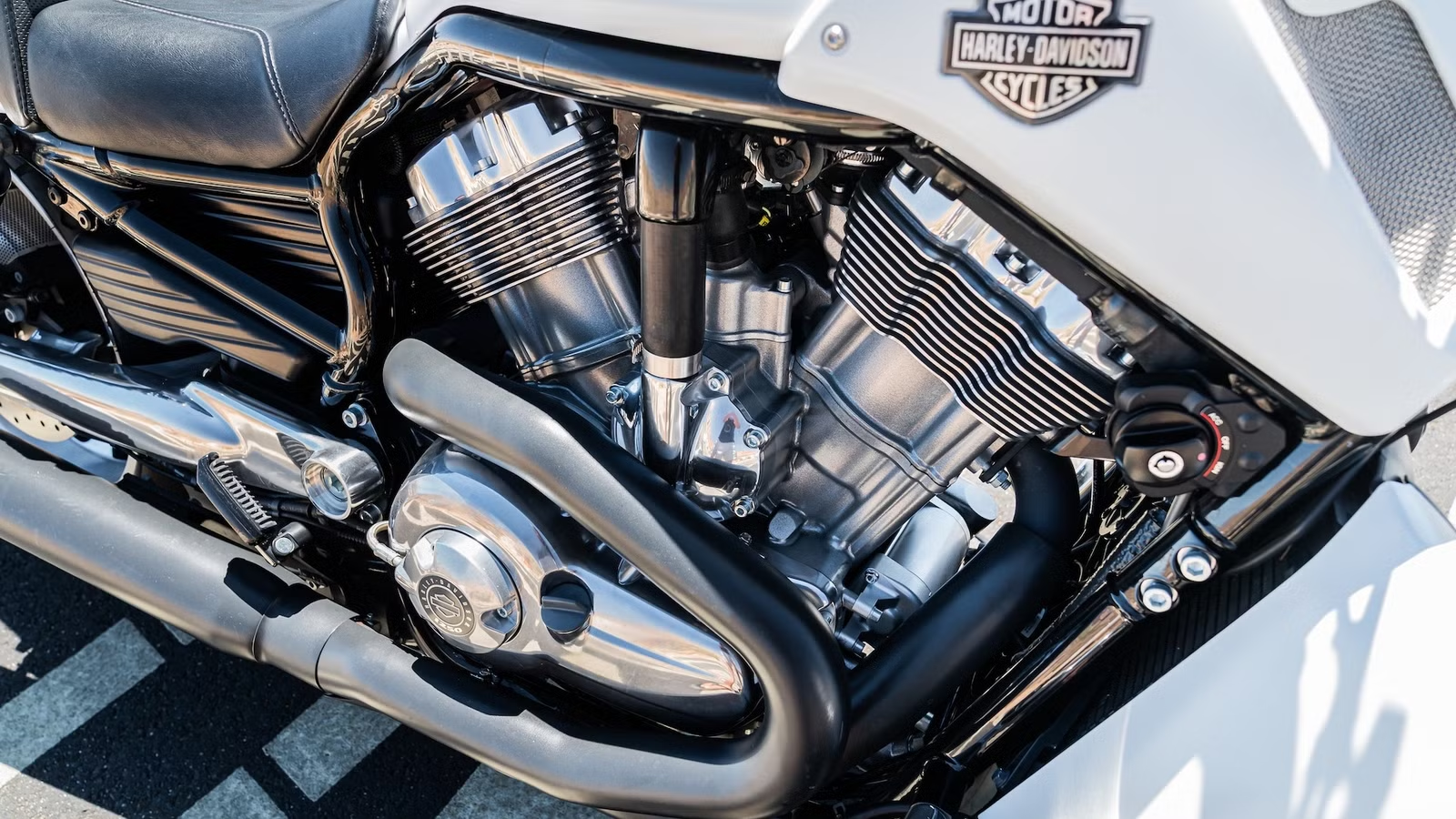
Harley-Davidson’s image is closely associated with torquey big-twin cruisers and grand American tourers, but the motor company is no stranger to making motorcycles that stray from that image. For example, the FXDR or the XR1200, but perhaps the best example is the radical V-Rod. Back when the V-Rod was new, a purist would’ve assumed it would fail and eventually be forgotten. However, the V-Rod would go on to develop a cult following of its own. And part of the reason for that is the engine that powers it.
The Engine So Un-Harley It Almost Killed the V-Rod — And Why That Didn’t Matter

Launched in 2002, the Harley-Davidson V-Rod is one of the company’s most recognizable motorcycles ever made. Designated VRSC, short for V-twin racing street custom, the V-Rod was a line of V-twin cruisers made through 2017, focused on straight-line performance and serving as a platform for drag-racing competition machines. To that end, it featured a low-slung design with a raked-out front, pulled-back handlebars, forward controls, and a massive rear wheel. It was produced at the Harley-Davidson Vehicle and Powertrain Operations Facility in Kansas City, Missouri.
Harley-Davidson built this radial cruiser to rival the slew of muscle cruisers coming from Japan and Europe. And it had all the right components to back up that persona, including hydroformed frame members that support the round-topped air cleaner cover. Even the fuel tank was located under the seat and the “tank” was a cover for the air box and coolant fill port. Yes, it had liquid cooling, too, along with dual overhead camshafts — the first production Harley-Davidson to feature these.

But what truly made the V-Rod special was the powerplant: the Revolution V-twin. Derived from Harley-Davidson’s first and only superbike, the VR1000, and developed in collaboration with Porsche, the V-Rod’s Revolution V-twin engine was unlike anything the MoCo had ever built. It powered the V-Rod lineup, offering 115 to 123 horsepower, depending on the exact model and displacement. And today, this engine has aged way better than anyone expected.


Back when it was new, the V-Rod was not light and agile enough to woo sports bike riders, and it was too radical for Harley’s customer base. Still, the V-Rod managed to sell well for almost two decades, and that’s partly due to this engine. Even today, the performance of this V-twin is what brings many riders into the fold, as they pick up old V-Rods despite the several compromises that come with its ownership. The Revolution engine played a major role in making the V-Rod such an icon on two wheels.
The Time Harley-Davidson Collaborated With Porsche

To understand how the V-Rod’s Revolution V-twin engine came to be, we have to turn back the clock to the early ’90s, when Harley introduced the VR1000. Built to knock Ducati off its AMA Superbike perch, the VR1000 was a homologation special with plenty of special bits all around. It featured Penske suspension, a Wilwood braking system, and of course, a 996cc 60-degree V-twin that made 135 horsepower and 100 pound-feet of torque.

This engine was developed by Harley-Davidson engineer Mark Miller, with design input from Erik Buell, Cosworth, and Jerry Branch of Branch Flowmetrics. Meanwhile, the cylinder heads and electronic fuel injection were designed by Roush Industries, which also built the series engines for the motor company. This VR1000 engine would go on to become the basis for the Revolution V-twin, co-developed by Harley and Porsche.
Why Harley Turned To Porsche Again — 20 Years After Their First Radical Collaboration Failed

Harley-Davidson had collaborated with Porsche in the ‘70s for Project Nova, a series of race engines. That project, too, was a radical departure from what Harley-Davidson was traditionally known for. However, it eventually got canceled in 1981 in favor of the Evolution project. Harley decided to revive that partnership with Porsche, only this time to develop a powerful V-twin engine for its upcoming muscle cruiser.
In many ways, Porsche was the ideal partner. The German automaker was dominating the charts, and it had just introduced the 996 sports car powered by its first water-cooled engine. The company was well-versed in developing water-cooled engines from scratch. So, both companies invested $10 million each into the joint venture, and the project started in 1997 with Harley engineers relocating to Stuttgart to begin working with the German engineers.
The Engineers Who Had To Make A Water-Cooled Engine Look (And Sound) Air-Cooled

So, the Revolution V-twin was based on the VR1000’s engine and jointly developed by Harley-Davidson and Porsche. However, it wasn’t an easy engine to build. Reportedly, one of the issues Porsche engineers had to overcome was meeting Harley’s demand to make the 60-degree Vee sound like their 45-degree powerplants. Another hurdle was hiding the plumbing and incorporating faux cooling fins to make the engine look air-cooled and old-school.

The engineers had to keep in mind the engine’s use case in America, too, where overheating was a common problem. Remember, Harley owners often cruise on their bikes, use them in parades, or get stuck in slow-moving US traffic in scorching desert heat. The engine also had to pass the rigorous Düsseldorf Test that requires an engine to run for 500 hours without failure. Once built, however, the Revolution V-twin was truly a revolution for the American motor company.
Among The Most Powerful Harley V-Twins Ever

The result: the Revolution V-twin was an insane powerplant for the time. In its first application on the VRSC, it displaced 1,131cc, at a time when other Harleys featured the 1,450cc V-twin making 88 horsepower and 95.5 pound-feet of torque. It also featured liquid cooling, which was a game-changer for the company that had previously relied solely on air to cool its bikes. That made the VRSC the first Harley to feature liquid-cooling as well as overhead camshafts. It also had electronic fuel injection and internal counterbalances.
All of this combined to make the Revolution engine a powerhouse, producing 115 horsepower at 8,250 RPM, with a heady (for a Harley) redline of 9,000 RPM. It was first introduced on the VRSCA model, but over the years it saw performance improvements. For example, a 1,247cc Screamin’ Eagle version was introduced in 2005, making 123 horsepower at 8,000 RPM, which eventually became standard for the entire VRSC line. There was even the VRXSE Destroyer, with a stroker Screamin’ Eagle 1,300cc producing 165 horsepower.
The Revolution Left A Lasting Impression Unlike Any Other Harley V-Twin

As good as the VRSC was, it wasn’t free from fault. In fact, owning it was more akin to tolerating the bike most of the time, so you could enjoy quick bursts of acceleration whenever the situation allowed. The bike’s raked-out front end and massive rear wheel made it a pain to steer, and its limited ground clearance meant cornering it wasn’t for the faint of heart. It was strictly a straight-line machine, which only attracted a small group of sports bike riders moving to the Harley fold.
That, however, wasn’t why the V-Rod was discontinued after almost 20 years. It turned out that the emission standards eventually killed this bike. By 2018, Euro-4 emission standards were kicking in, and the money and resources needed to meet those demands were not in the cards for the V-Rod. And so, the iconic V-Rod was discontinued. Fortunately, you can still experience this bike as there are plenty of them on sale in the used market. Though we’d go for the VRSCR Street Rod, as it offers more comfort and higher cornering clearance.
The Revolution V-Twin Lives On, Though

The V-Rod may have been discontinued, but the Revolution V-twin continued to combust. It saw applications outside Harley-Davidson, starting with Campagna. The three-wheeler manufacturer used the Revolution engine in its T-Rex and V13R models for some years. Eventually, the V13R was discontinued in 2019, and the T-Rex moved to a BMW K 1600 powerplant.

Remember the notorious Street 750 and Street Bob, which were introduced in 2014 and 2017, respectively? They featured a 60-degree, SOHC, water-cooled V-twin displacing 749cc and making around 68 horsepower and 48 pound-feet of torque. Dubbed the Revolution X, the powerplant was a derivative of the Revolution engine that powered the V-Rod. Unfortunately for the bikes, they never received a good reception and were eventually discontinued.
But Harley wasn’t about to give up on the Revolution yet. It just had to find the right application, and it came in the form of the new Sportster series and the MoCo’s first-ever adventure bike, the Pan America. Enter the Revolution Max 1250, a 60-degree V-twin with liquid cooling, DOHC, and even VVT, designed to offer flexible and engaging performance across a broad powerband without sacrificing top-end rush.
The Revolution Max 1250’s standard version powers the Pan America, producing 150 horsepower at 8,750 RPM and 94 pound-feet of torque at 6,750 RPM. Its 1250T variant is used in the Sportster S, making 121 horsepower at 7,500 RPM and 93 pound-feet of torque at 6,000 RPM. A smaller derivation of the same, the Revolution Max 975T, powers the Nightster, offering 91 horsepower and 72 pound-feet of torque.

The Revolution Max 1250 is the most powerful V-twin engine Harley has ever made, and it’s also its most advanced powerplant to date. This proves that the original Revolution wasn’t the wrong decision for Harley; it was simply ahead of its time. Today, its derivative is helping the motor company produce the sportiest Sportster ever and an adventure bike that’s taking the fight to established players, like the Ducati Multistrada V4 and BMW R 1300 GS.
Source: Harley-Davidson, Porsche

Related posts
Latest Post


No Comments