
The GM V6 Still Outlasting Modern Turbo-Fours At 400,000 Miles
Remember when the 2009 Cash for Clunkers program destroyed countless affordable cars that could have kept running for decades? The aftereffects of this sad moment in American history persist today. In retrospect, it is clear that the federal government’s intentions with this program were good, but its execution was not.

In 2026, there are Buick LeSabres and Pontiac Grand Prix still running at 400,000 miles on the original engine. In contrast, the modern turbocharged engines that power most new cars demonstrate that increased complexity does not lead to long-term durability. One inexpensive, overlooked GM V-6 continues to reach mileages most modern engines can’t match. This engine is never mentioned among the greatest or most legendary power units of all time. Yet, its continued longevity is proof that simple engineering often ages better than sophisticated technology.
Most shoppers assume that newer means better, but countless high-mileage American sedans from a bygone era suggest the opposite. To understand why, consider the ownership pattern that keeps repeating across hundreds of thousands of miles.
A Common Occurrence Among Buicks, Pontiacs, And Oldsmobiles


If you take a look at any owner forums or social media groups related to 1990s and 2000s General Motors vehicles, you quickly see a common pattern emerge. 250,000 miles is not considered an achievement but rather an expectation. Even 400,000-mile examples are not unusual, and many of these engines have never been rebuilt—the original long blocks still turning over after decades of service. The vehicles in question are never the most glamorous and are far from collector’s cars.
We are talking about cars that were never the center of attention, like the Chevrolet Impala, Oldsmobile LSS, and Pontiac Bonneville. Despite this, their longevity has earned them a cult following among shoppers who want inexpensive and dependable transportation. Indeed, these cars excel at commuting and operating under steady loads, because that is precisely what they were built for. However, reaching 400,000 miles consistently takes more than just good design; it requires exceptional engineering.
The Underrated Strength Of Simplicity

Nowadays, automakers are expected to provide cutting-edge performance along with world-class efficiency in bulletproof construction. As amazing as that fantasy sounds, achieving such standards is impossible. Engineering is about managing compromises, and trade-offs are ever-present. Yet, the cars filling America’s roads during the late 1990s followed a very different philosophy when compared to new cars today. The last thing on most automakers’ minds was optimizing horsepower per liter or fuel economy down to the last fraction of a percentage.
Instead, engineers prioritized moderate output figures, generous safety margins, and components designed to operate well below their mechanical limits. This formula rarely resulted in fun and high-performing engines, but it did produce engines that could easily handle the stresses of everyday driving. Fewer moving parts mean fewer opportunities for failure. Less output means lower combustion pressures placed on the critical engine internals.

Without the complexity of turbocharging or high-pressure direct injection systems, routine maintenance was simple. The conservatism may have felt underwhelming when these cars were new, but time has proven the engineers made the right call. These cars were never marketed as revolutionary, but the engineering behind them would produce one of the most respected American engines ever built.
The Engineering Decisions That Made The Difference

Once we start talking about long-term reliability in terms of decades, that level of success can’t be attributed to luck. It is usually the result of dozens of engineering decisions that individually seem insignificant but collectively make the difference between a 150,000-mile engine and one that can reach twice that figure.
How GM Quietly Overbuilt A Conventional Platform

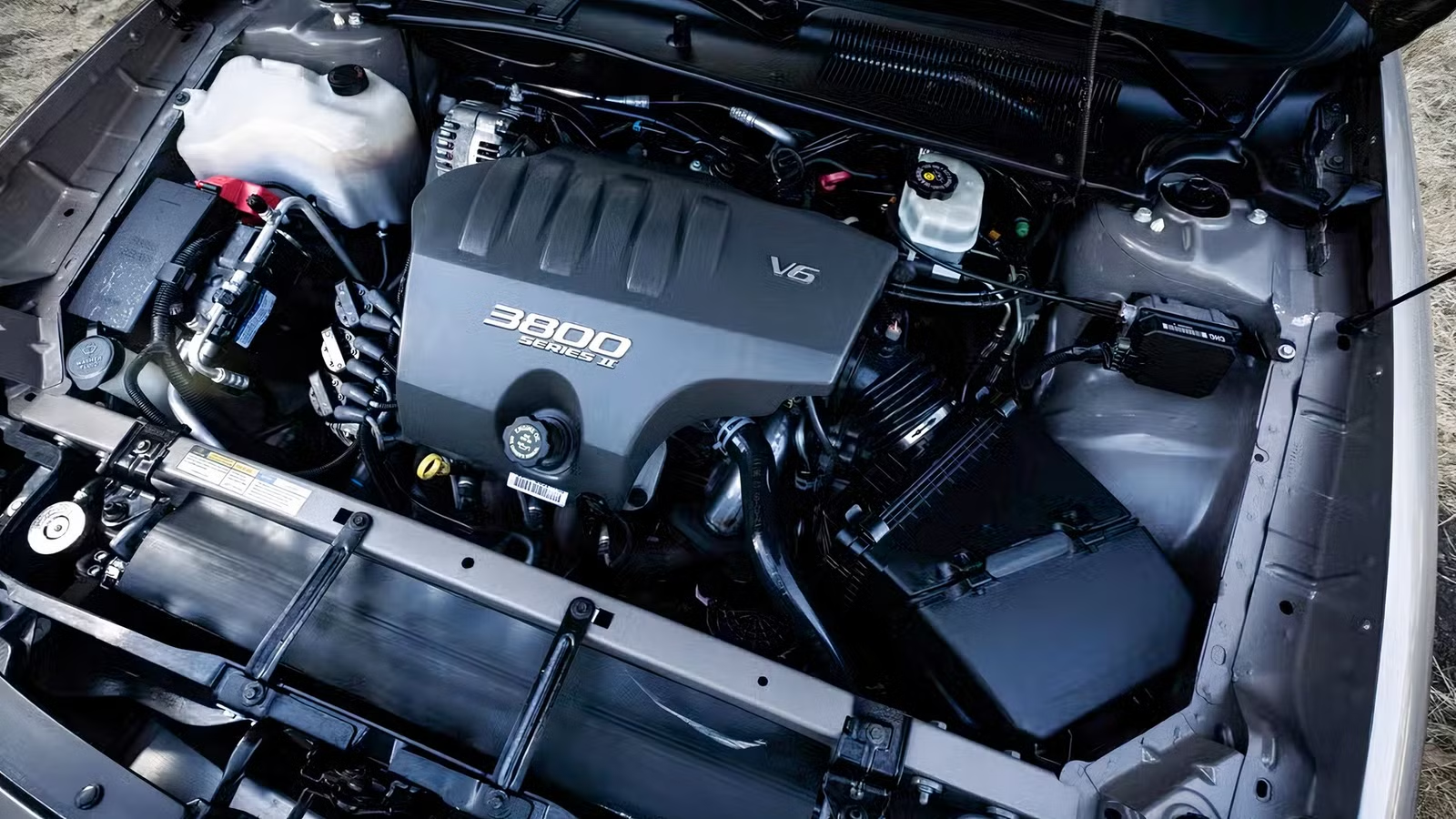
When General Motors introduced the second-generation version of this V-6 engine for the 1995 model year, it represented more of a revolution than an evolution compared with its predecessor. Improvements fundamentally changed the internal design, including a shorter deck height, cross-bolted main bearing caps, and an upgraded balance shaft. Each of these upgrades provided a substantial increase in the overall durability of the platform, but never once were they mentioned in flashy marketing headlines when the engine was new.
However, the automotive industry did take notice, with this engine earning a place on Ward’s 10 Best Engines list for three consecutive years in the mid-1990s. Compared to its contemporaries, this platform demonstrated a strong balance between performance, efficiency, and durability. While it may not seem impressive by today’s standards, its restraint and simplicity ultimately became one of its greatest strengths.
The GM 3800 Series II Is One Of America’s Toughest V-6 Engines

The engine in question is GM’s Series II and Series III 3800 V-6: the power source of countless high-mileage Buicks, Chevys, Pontiacs, and Oldsmobiles. By the time production ended in 2008, GM had produced more than 25 million units of the 3800 V-6 across multiple generations, cementing it as one of history’s most successful V-6 engines. The Series II, introduced in 1995, is often considered the perfect middle ground, offering strong refinement, fuel economy, and durability. The Series III, introduced in 2004, provided incremental changes such as electronic throttle control, enlarged intake and exhaust valves, and, in the final variants of the engine, forged connecting rods.
One of the most impressive aspects of the 3800 V-6 was that its longevity was not exclusive to naturally aspirated models. The Series II supercharged L67 variant that produced 240 horsepower shared the same fundamental design with significant strengthening to internal components. In 2004, the Series III L32 supercharged variant increased output to 260 horsepower while preserving the same durability that made its predecessor so impressive.

As a result, these affordable and responsive supercharged variants are known for their aftermarket tuning and modification capabilities, provided the supercharger oil reservoir is properly maintained. The 3800 V-6 was a great engine, but calling it bulletproof would be untrue. Just like all engines, it had known weaknesses, but most were inexpensive and well understood before they threatened the engine’s durable foundation.
The 3800 V-6 Had Minimal Fundamental Issues

Perfection is a fleeting pursuit, and the Series II and Series III 3800 V-6 engines were, by no means, perfect. Most of the platform’s shortcomings are all well-documented, and none of them are fatal flaws.
The Intake Manifold Gasket And Other Concerns

The primary concern with the Series II 3800 engines was related to leaky gaskets—not an uncommon issue even with engines that have garnered a reputation for legendary levels of durability. The Series II 3800’s intake manifold gasket was notorious for degrading around 60,000 miles. This leak could lead to overheating, and in the worst cases, could result in bearing damage if coolant leaks into the crankcase. However, GM revised the design of the gasket back in 2004, and repeated failures became much less common.
Later in 2009, GM recalled 1.5 million vehicles equipped with the 3800 V-6 due to a fire risk from engine oil leaking under the valve cover gaskets onto the exhaust manifold. The fire could then spread to nearby areas, leading GM to install redesigned spark plug wire retainers. There have even been multiple documented cases of engines surviving hydrolock due to the plastic upper intake manifold cracking near the EGR passage. Once the issue was addressed, the engines continued to operate as before.
Most Other Details Were Routine Maintenance Items

The 3800 V-6 did suffer from some other more minor issues, such as faulty crankshaft position sensors or faulty ignition control modules, but these issues were relatively rare occurrences. Once the major gasket concerns were addressed, the 3800 proved as solid as an engine can get. Replacing the plastic coolant elbows on FWD models is a requirement to prevent persistent coolant leaks, and aftermarket aluminum replacements are a common upgrade.
Even the more powerful supercharged variants were impressively dependable. The only key requirement was that the dedicated supercharger oil reservoir was properly serviced. Unlike turbochargers that require complex plumbing and lubrication to function properly, the belt-driven supercharger setup is as simple as it gets. The 3800 V-6 may not have been the best-performing engine of its era, but its mechanical simplicity directly led to its extraordinary longevity.
Why The 3800 Still Competes With Modern Turbo-Fours

A lot has happened in terms of automotive innovation in the three decades since the debut of the Series II 3800 V-6. Never before have engines been more impressive, but the simple foundations that defined engines like the 3800 V-6 are long gone, demonstrating that engineering priorities have changed.
Modern Engines Chase Performance, The 3800 Chased Longevity

A modern DOHC turbocharged inline-four couldn’t be more fundamentally different from a naturally aspirated 3.8-liter pushrod V-6. Current turbo-four engines are packed with engineering to deliver the same power as a 3.8-liter V-6 from decades ago while using a 2.0-liter inline-four platform. To achieve these spectacular results, these engines depend on forced induction, direct fuel injection, variable valve timing, electric water pumps, variable oiling systems, and much more. Yet, in engineering, every decision comes with a compromise.
As a result of all these added components, routine maintenance on a modern engine is certainly more involved than it was a few decades ago. This doesn’t inherently make modern turbo-four engines unreliable, and many platforms have already proven reliable in the last decade. However, it will take years before any of these turbo-fours establish the same historical record as engines like the 3800 V-6. The reality is these two platforms from different eras were built to meet different engineering priorities. The 3800 V-6’s focus was less on cutting-edge optimization and more about generous durability margins. It’s no secret why the latter pays dividends when considering overall longevity.
The Supercharged L67 Proved Durability Didn’t Mean Sacrificing Performance

The naturally-aspirated Series II 3800 was certainly the more prevalent power unit when compared to the supercharged Series II L67 3800. Yet, what was impressive was its ability to deliver a significant boost in output without sacrificing the platform’s core durability principles. 240 horsepower and 280 pound-feet of torque for a FWD family sedan in 1996 was a lot of power once you consider that the 3.0-liter 1MZ-FE V-6-equipped 1996 Toyota Camry V-6 from the same year only produced 188 horsepower and 203 pound-feet.
The later Series III L32 supercharged 3800, introduced in 2004, would further boost output to 260 horsepower with improved components. With a pulley upgrade, exhaust, and tuning, that figure could jump significantly higher. This helped cars like the Pontiac Grand Prix GTP become popular among enthusiasts, and that enthusiasm still hasn’t faded. The 3800 V-6 proved that conservative engineering and thoughtful design often result in outlasting expectations, even decades later.
Sources: OEMs, Ward’s Auto

Related posts



Latest Post


No Comments