
The Forgotten Yamaha Two-Stroke That Invented The Modern Naked Bike
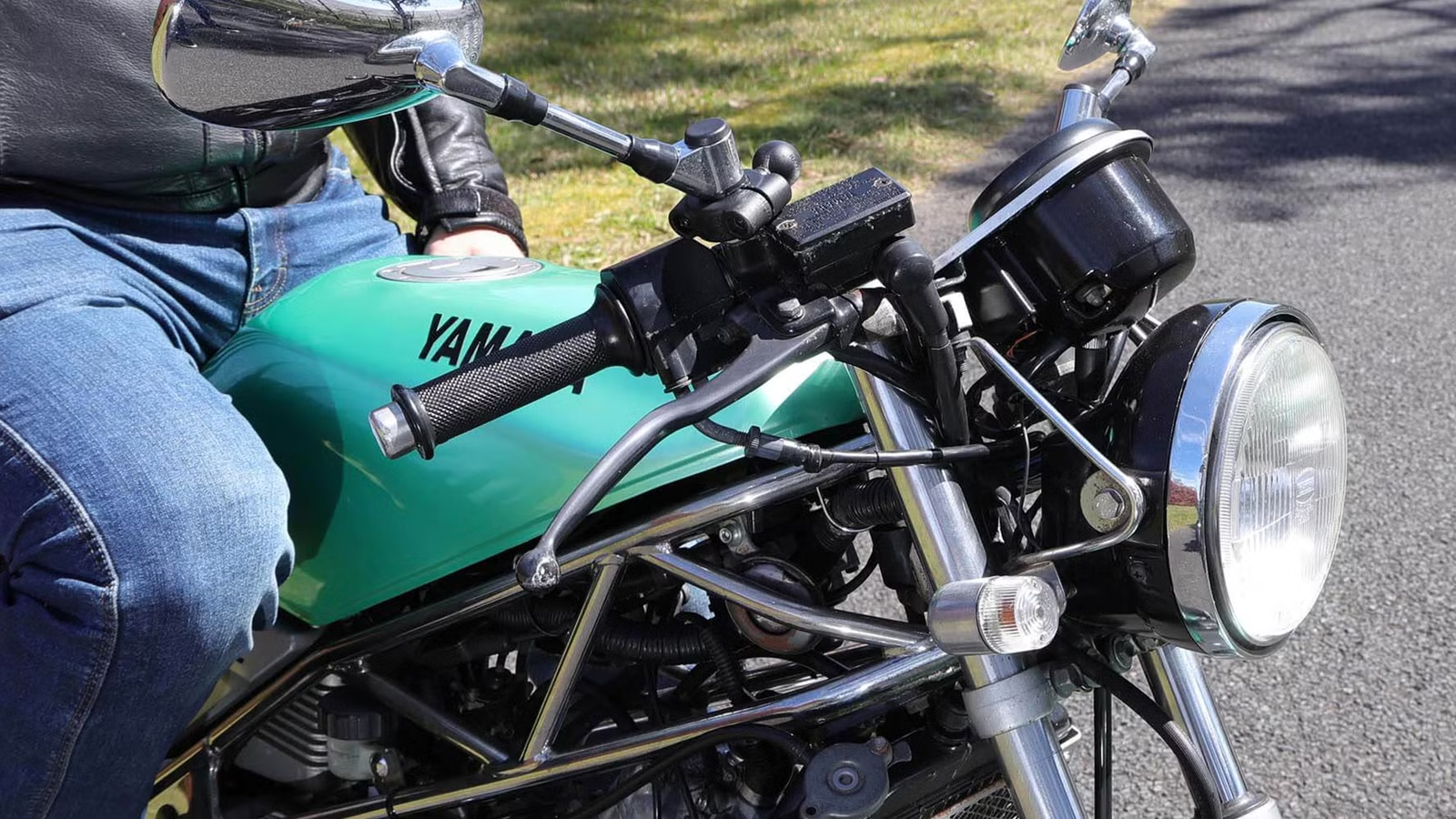
Modern naked motorcycles are often viewed as a product of the 1990s and 2000s, when manufacturers began embracing exposed frames, minimalist bodywork, and lightweight engineering as a new approach to performance. However, the foundations of this formula appeared earlier than many enthusiasts realize.

Before the category became a global success, one overlooked Japanese motorcycle quietly combined the essential elements that would later define the naked bike movement. Despite its forward-thinking design and sporting character, it remained largely forgotten as newer generations took the spotlight.
It Looked Like A Modern Naked Bike Years Before The Segment Existed
During the late 1980s, motorcycle manufacturers were locked in an arms race inspired by Grand Prix racing. Fully faired sport bikes dominated showroom floors, with machines such as Yamaha’s own TZR and FZR series placing aerodynamic bodywork and race replica styling ahead of exposed mechanical components. Riders expected sharp fairings, bold graphics, and hidden frames.

Yet one little-known Japanese machine completely ignored those trends. Instead of concealing its chassis beneath plastic bodywork, it proudly showcased its frame as the centerpiece of its design. That philosophy would later become synonymous with the Ducati Monster when it debuted in 1993, but this forgotten motorcycle had already embraced the exposed frame, minimalist styling, and lightweight engineering roughly six to seven years earlier.
Yamaha Built The Trellis Frame Before Ducati Made It Famous

The motorcycle responsible for challenging conventional styling was the Yamaha SDR200, a Japanese Domestic Market exclusive that debuted in 1987. At a time when manufacturers were hiding their engineering beneath layers of plastic bodywork, Yamaha instead made the chassis the bike’s defining visual feature. Its chrome-plated molybdenum steel trellis frame was finished using an advanced Nickel Tin Cobalt (TC) triple composite plating process, giving it a distinctive bright metallic finish while providing excellent corrosion resistance. Rather than serving as a structural component alone, the frame became the centerpiece of the motorcycle’s identity.
That bold engineering was complemented by an equally radical minimalist philosophy. The SDR200 dispensed with anything considered unnecessary, including a pillion seat and even a tachometer, while its compact proportions, a 9.5-liter fuel tank, and exposed mechanical components gave it a clean, purposeful appearance unlike anything else in Yamaha’s lineup. Decades before minimalist naked bikes became fashionable, the SDR200 demonstrated that reducing complexity could create a motorcycle that looked every bit as exciting as it was unconventional.
Ultimate Subtraction Defined Every Part Of Its Design

Rather than adding more features in pursuit of showroom appeal, Yamaha kept this motorcycle as plain and simple as possible. Every component was questioned, and anything that did not contribute directly to the riding experience was removed. Even more ingenious was the airbox, which doubled as the under seat side panels, eliminating the need for additional bodywork while maintaining a clean, integrated appearance. This approach reflected a level of packaging efficiency rarely seen on production motorcycles of the era.
The benefits extended well beyond aesthetics. By stripping away unnecessary parts and simplifying the overall design, Yamaha achieved an exceptionally low dry weight. The exposed frame, uncluttered bodywork, and minimalist silhouette created a motorcycle that looked remarkably modern decades before naked bikes embraced the same philosophy. Today, manufacturers still rely on the same principle of reducing visual and physical bulk to emphasize lightweight performance and mechanical honesty.
Just 231 lbs Made “The Whippet” Feel Like A Street Legal Race Bike
Long before lightweight became a marketing buzzword, the Yamaha SDR200 demonstrated just how transformative shedding mass could be. Tipping the scales at an impressive 105 kg (231 lbs) dry, it was dramatically lighter than most road bikes of its era and even undercut many modern entry-level motorcycles. That featherweight construction earned it the affectionate nickname “The Whippet,” a fitting reference to the lean, agile dog breed known for its speed and nimble handling.
The low weight fundamentally shaped the riding experience. While its 195-cc two-stroke single produced modest power, the SDR200 did not rely on outright horsepower to entertain. Instead, the minimal mass allowed the engine to deliver lively acceleration, razor-sharp steering, and effortless changes of direction that made every corner feel engaging. Riders could carry more speed through bends, brake later, and exploit the bike’s full performance without needing superbike levels of power. Decades later, its philosophy remains relevant, proving that intelligent weight reduction can be just as rewarding as chasing ever bigger engine outputs.
A Small Two-Stroke Engine Delivered Surprisingly Big Performance

Beneath the minimalist styling was an engine that perfectly matched the SDR200’s lightweight philosophy. Power came from a 195-cc liquid-cooled, two-stroke single-cylinder engine derived from Yamaha’s DT200R off-road motorcycle. Equipped with Yamaha’s YPVS (Yamaha Power Valve System) exhaust valve technology, it produced approximately 34 brake horsepower at 9,000 rpm, giving the small-capacity motorcycle a surprisingly energetic character.
While those figures may appear modest by modern standards, the SDR200’s 231-pound dry weight transformed how the performance was delivered. The lightweight chassis allowed the two-stroke engine to feel far more responsive than its displacement suggested, with quick acceleration, sharp throttle response, and an engaging riding experience that rewarded momentum and rider involvement. Rather than chasing outright horsepower, Yamaha created a machine where the engine, chassis, and weight worked together as a complete package. The result was a motorcycle that delivered the excitement of a much larger performance machine while remaining accessible and incredibly agile.
It Failed Because Buyers Wanted Fully Faired Sport Bikes

The Yamaha SDR200’s biggest problem was not its engineering but its timing. When it arrived in 1986, the motorcycle industry was in the grip of the race replica craze. With their aggressive styling and clear sporting credentials, race replica bikes overshadowed the SDR200, whose stripped-back appearance and minimalist philosophy seemed unconventional rather than aspirational. As a result, many riders overlooked a motorcycle that would later prove remarkably forward-thinking.
The market’s indifference meant the SDR200 enjoyed only a short production run, with approximately 1,500 units built between 1986 and 1987. What was once considered a commercial disappointment has since become one of the SDR200’s greatest strengths. Its rarity has made surviving examples highly desirable among collectors, while enthusiasts increasingly recognize that Yamaha’s forgotten experiment anticipated many of the ideas that would later define the modern naked motorcycle. In hindsight, the SDR200 did not fail because it was a poor motorcycle. It failed because the market simply was not ready for it.
The Forgotten Blueprint For Every Modern Hyper Naked

Looking at the Yamaha SDR200 today, it is remarkable how closely its design philosophy mirrors that of modern naked motorcycles. Its exposed chrome-plated trellis frame and featherweight construction all foreshadowed machines that would later define the segment, including the Ducati Monster, KTM Duke range, and even Yamaha’s own MT series. While these motorcycles differ dramatically in performance and displacement, they all embrace the same core principles: celebrate the chassis, minimize unnecessary bodywork, and prioritize agility over excess.
Ironically, buyers in the late 1980s largely ignored the SDR200 because it looked too unconventional during the height of the race replica era. Yet history has been far kinder to Yamaha’s bold experiment than the showroom ever was. Nearly four decades later, the qualities that once made the SDR200 difficult to sell have become the defining characteristics of one of motorcycling’s most popular categories.
Sources: Yamaha, Motorcyclespecs

Related posts




Latest Post



No Comments