The Hybrid Family Car That Makes The Most Sense In 2026
9 minutes reading
Tuesday, 7 Jul 2026 12:01 0 87 autotech
One three-row hybrid SUV sold 8,275 copies in March 2026. One month. One powertrain. By the end of the first quarter, that single hybrid variant had found 20,532 buyers, an 86.9 percent jump over the same stretch last year. Numbers like that don’t come from a facelift or a marketing blitz, because this vehicle got neither. It carries into 2026 completely unchanged. What it got instead was something far more valuable: word of mouth from families who figured out it’s the three-row that finally does the job without a catch.
The thing is, it isn’t a dramatic car. It has no party trick, no headline gimmick. It just answers the question American families have been asking for a decade, and it answers it more convincingly than anything else on sale. To understand why it’s selling like this, you have to understand the gap it was built to fill.
Front 3/4 shot of red 2026 Toyota RAV4 PHEV parked in parking lotToyota
Here’s the gap nobody at a dealership will spell out for you. A RAV4 runs out of room the moment your second kid arrives. The Toyota Highlander has a third row, technically, but it’s the kind you offer to people you don’t like. And the Sequoia at the other end is a body-on-frame truck that starts more than $20,000 higher, drinks fuel accordingly, and drives like the tow rig it fundamentally is. Between the cramped and the colossal sits a hole that the market has wanted filled for years.
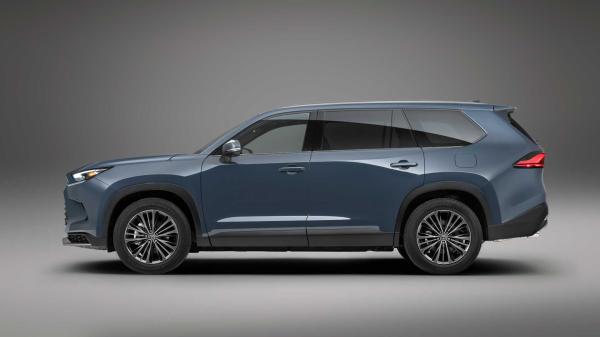
Today’s focus model lands square in the middle on purpose. It’s 6.5 inches longer, two inches taller, and 2.3 inches wider than the regular Highlander, and every one of those inches went where families need it: the third row and the cargo bay behind it. It rides on a car platform, so it steers, stops, and parks like a tall sedan rather than a shrunken truck. This is the unibody sweet spot, and Toyota built it deliberately.
The Three-Row Japanese Hybrid SUV With The Highest Fuel Cost Savings
There are only a handful of 3-row hybrid SUVs; four are Japanese, all from the same company, with this one standing out for space and cost-savings.
The Toyota Grand Highlander Hybrid Is The Hybrid Family Car That Makes The Most Sense In 2026
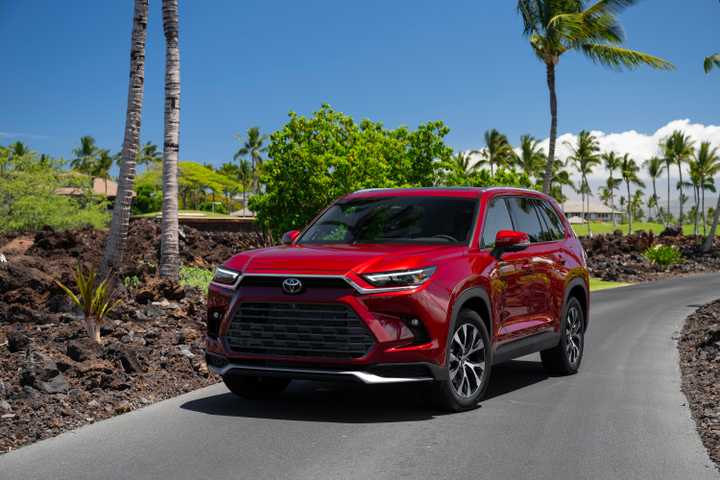
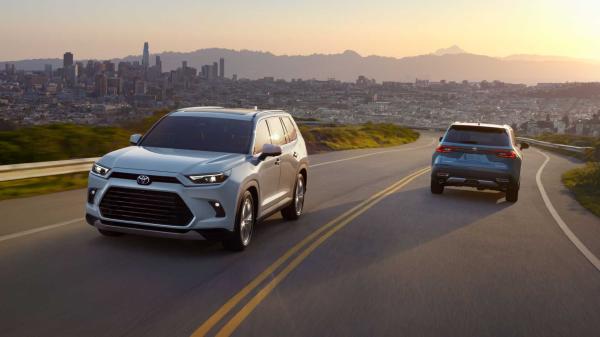
Front 3/4 action shot of 2026 Toyota Grand Highlander Hybrid driving on roadToyota
For years, the deal with three-row SUVs was simple: you got the space, you paid at the pump. Pick your poison. The Grand Highlander Hybrid breaks that trade. It returns up to 36 mpg city, 32 highway, and 34 combined, with the front-wheel-drive version touching 37 mpg in town. In a vehicle that seats eight.
That’s not a small improvement over the segment norm; it’s a different category of running cost. And the buy-in is almost insultingly reasonable. The hybrid powertrain costs $3,350 over the equivalent gas model. That’s it. No drastic leap, no stripped equipment list, no compromise on seating. Buyers have done the math, which is exactly why the hybrid’s sales curve looks the way it does.
Two Powertrains, One Clear Winner
2025 Toyota Grand Highlander Hybrid engineToyota
The volume seller pairs a naturally aspirated 2.5-liter four-cylinder with electric motors for a combined 245 horsepower, driving through a CVT in either front or all-wheel-drive form. On paper, 245 horsepower in a vehicle this size sounds modest. In practice, the electric torque fills in exactly where family driving happens: pulling away from lights, crawling through school-run traffic, merging at suburban speeds. It’s quiet, it’s smooth, and it sips fuel while doing it. This is the one to buy. Toyota has been refining this hybrid system for over 25 years, and it shows. There’s no learning curve, no charging cable, no range anxiety. You fill it with gas, and it simply uses far less of it.
Base Trim Engine
2.5L Inline-4 Hybrid
Base Trim Transmission
8-speed Automatic
Base Trim Drivetrain
Front-Wheel Drive
Base Trim Horsepower
245 hp
Base Trim Torque
175 lb-ft @ 4400 rpm
Fuel Economy
37/34 mpg
Make
Toyota
Model
Grand Highlander Hybrid
Segment
Midsize SUV
The Hybrid MAX: When 362 Horsepower In A Family Car Makes Sense
Detail shot of a red 2024 Toyota Grand Highlander Hybrid Max Platinum showing the liftgate badgeToyota
The Hybrid MAX is the more interesting argument. It pairs a turbocharged 2.4-liter four with an electric motor for 362 horsepower and 400 pound-feet of torque, runs a proper six-speed automatic instead of a CVT, and comes with all-wheel drive as standard. The result is a three-row family SUV that genuinely shoves when you ask it to, with a tow rating of 5,000 pounds, matching the gas model and beating the standard hybrid’s 3,500 pounds.
Here’s the honest part: the MAX won’t save you money. At 26/27/27 mpg, it’s thirstier than the standard hybrid by a wide margin, and the EPA estimates it actually costs about $500 more in fuel over five years than the average new vehicle. Real-world testing in heavy city use has returned figures in the low 20s. So the MAX case isn’t economy. It’s this: if you were going to buy the 265-horsepower gas Grand Highlander anyway, the MAX gives you nearly 100 more horsepower, 90 more pound-feet, and better combined fuel economy than the gas car returns. As an upgrade over the turbo-gas model, it makes complete sense. As a substitute for the standard hybrid, it doesn’t. Which settles it. For nine out of ten driveways, the 245-horsepower hybrid is the clear winner. The MAX is for the family that tows a boat to the lake and refuses to be slow doing it.
How Much You’ll Save In Fuel Costs Driving The Toyota Grand Highlander Hybrid
Regardless of how your family uses the Toyota Grand Highlander, there are powertrain choices to help you save on fuel costs, including two hybrids.
Living With It: Space, Comfort, And The Details That Matter
Shot of 2026 Toyota Grand Highlander Hybrid second and third row seatsToyota
Most three-row SUVs treat the back row as a legal disclaimer. The Grand Highlander treats it as a destination. Adults fit back there. Not for a dash across town, but for an actual highway trip, with headroom and knee room that embarrass vehicles a class above. Toyota claims more interior space than the Sequoia, and having a usable cargo area behind a usable third row is the detail that separates this from nearly everything at its price.
Seating for eight is standard, and every trim above the base LE offers second-row captain’s chairs for the seven-seat layout. Between the two rear rows, the cabin is filled with cupholders, USB ports, and the kind of storage cubbies that suggest the designers actually have children.
The Tech and Safety Suite That Earns Its Keep
Every Grand Highlander Hybrid gets a 12.3-inch touchscreen with wireless Apple CarPlay and Android Auto, tri-zone automatic climate control, and a power liftgate as standard. No haggling for the basics. The interface is quick, the physical climate controls survived the touchscreen purge, and the wireless phone charger arrives at XLE level along with heated front seats and synthetic leather.
The safety story matters more in this segment than any other, and Toyota Safety Sense comes standard across the range: pre-collision braking with pedestrian detection, full-speed adaptive cruise, lane tracing, and blind-spot monitoring. For a vehicle whose entire purpose is carrying the people you care about most, that’s not a feature list. That’s the point.
The Japanese Hybrid SUV With The Highest Driving Range In 2026
With over 600 miles of range on a full tank, this is the Japanese HEV SUV you need to consider if you don’t like stopping for fuel.
The Numbers That Justify The Price Tag
Front action shot of 2026 Toyota Grand Highlander Hybrid driving at nightToyota
The 2026 Grand Highlander Hybrid starts at $46,705 including the $1,495 destination charge, a $3,350 premium over the equivalent turbo-gas model. Now the part the window sticker won’t do for you. The gas Grand Highlander returns 24 mpg combined. The hybrid returns 34. Over 15,000 miles a year, that’s roughly 625 gallons against 441, a savings of about 184 gallons annually. Even at a conservative $3 per gallon, you’re keeping around $550 a year in your pocket. Hold the car for the typical six to eight years of family ownership and the hybrid isn’t a cost. It’s a discount.
The EPA’s own five-year estimate backs this up, pegging the standard hybrid at $1,750 in fuel savings compared to the average new vehicle. And unlike a plug-in, none of this depends on your charging habits, your commute profile, or a home charger you may not have. The savings show up no matter how you drive it.
Resale, Reliability, And The Long Game
Front 3/4 action shot of 2026 Toyota Grand Highlander Hybrid towing jet skiToyota
The quiet half of the value equation is what happens at the other end of ownership. Toyota hybrids hold their value better than nearly anything in the mainstream market, partly on reputation and partly on hard mechanics: the hybrid system has no conventional alternator or starter motor, the regenerative braking spares the pads, and the battery carries a 10-year, 150,000-mile warranty. These powertrains are the same fundamental architecture that has racked up taxi-fleet mileages around the world for two decades.
Add in demand that’s currently running ahead of supply, with sales nearly doubling year-on-year, and the residual picture takes care of itself. A vehicle this sought-after on the new lot doesn’t suddenly become unwanted on the used one.
Why This Toyota Hybrid Is One Of The Most Practical And Balanced Choices
This is the perfect choice if you’re in search of a spacious and well-rounded hybrid SUV.
TopSpeed’s Take
Rear 3/4 action shot of 2026 Toyota Grand Highlander Hybrid driving on roadToyota
The 2026 Grand Highlander Hybrid isn’t the most exciting car you can buy for $46,000. It’s something rarer: the most correct one. It carries eight people in genuine comfort, returns economy-car fuel figures, tows when asked, and wraps it all in the most bankable reliability reputation in the business. American families have spent years choosing between space, efficiency, and sanity. The sales chart says they’ve stopped choosing. Toyota finally built the car that gives them all three, and 20,532 buyers in three months is what it looks like when the market notices.















No Comments