
The Forgotten SUV That’s Aging Like Fine Wine
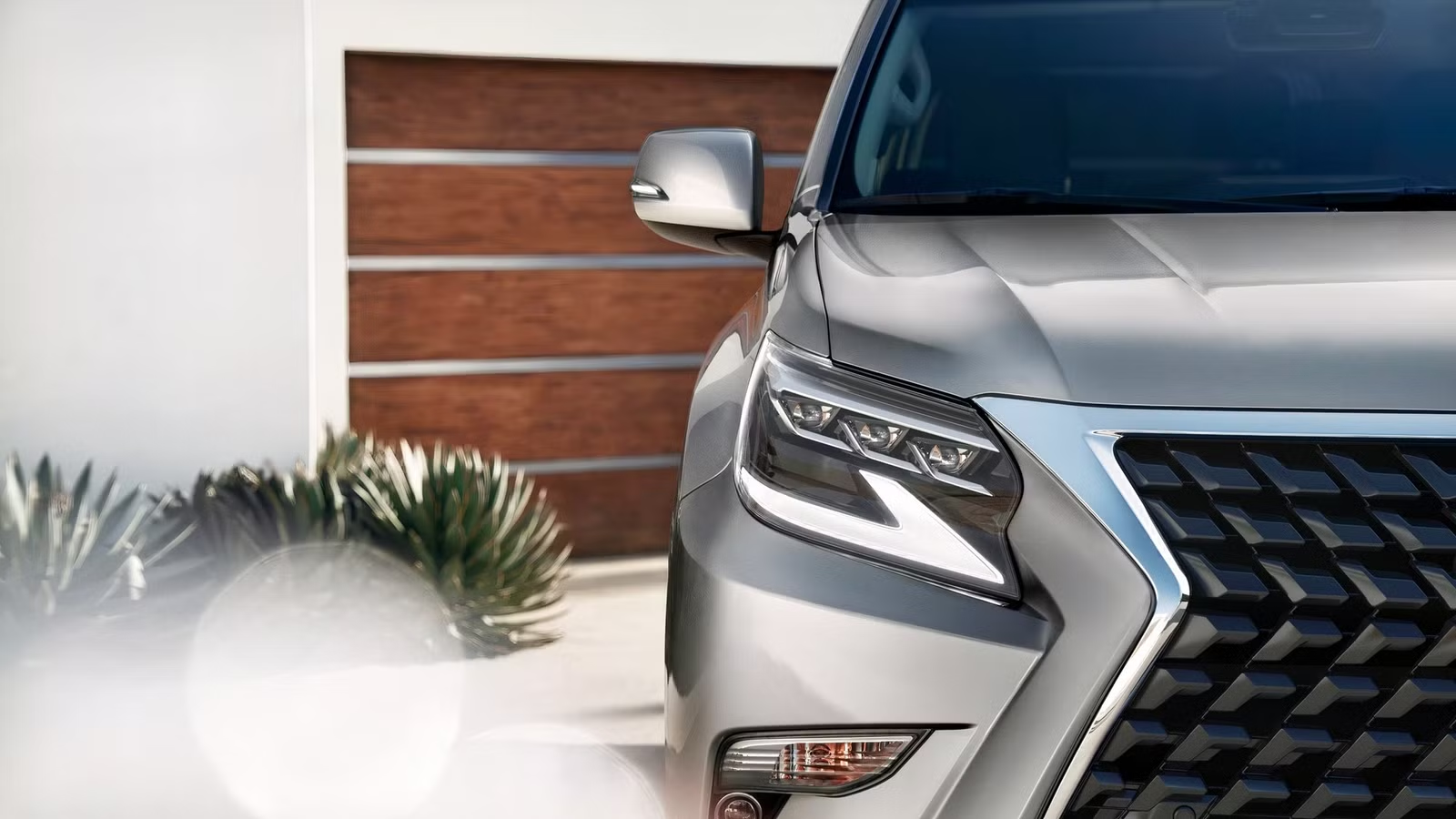
It isn’t hard to forget some SUVs. There are so many good makes and models that some are bound to be overlooked when the likes of the Jeep Wrangler, Land Rover Defender, Toyota 4Runner, and G-Wagen are fondly remembered and fawned over. However, just because some are forgotten doesn’t mean they should be.

Lexus is one of the leading luxury SUV makers in the U.S. market, and while its newer models tend to steal the limelight (think the new Lexus GX), older models that ruled the roads a few years back are aging exceptionally well and should still be considered as your next used SUV buy. This storied used Lexus SUV is a prime example of that.
Some SUVs Get Old; Others Get Better
The auto market has been moving faster than ever in recent years, especially the luxury SUV segment. New generations arrive every five years or so, bringing bigger touchscreens, more advanced tech, and plusher cabins. Manufacturers market each upgrade as a huge leap forward into the future, making last year’s flagships outdated almost overnight.

In a market driven by innovation and posh features, many high-end SUVs today are judged by how well they keep up with changing technology rather than how well they stand the test of time. However, not every luxury SUV follows this pattern. Some models quietly become better with age, thanks to their mechanical prowess and cabins that never tried to chase trends.
Time Hasn’t Been Kind To Most Luxury SUVs

We all love a luxury SUV for the comfort, tech, badge appeal, and generally powerful engines they offer. However, they tend to age far more dramatically than their mainstream counterparts because they are usually packed with technology that will inevitably become outdated or expensive to repair. Features that once justified the high price tags, like air suspension, active anti-roll bars, adaptive headlights, and complex infotainment systems, can quickly become headaches once warranties expire.
Then there is depreciation. While waiting a few years to buy a full-size luxury SUV can pay dividends due to its generally high rate of depreciation, if you buy one new (unless you buy something exceptionally rare and sought-after), you are likely to lose money on the used market.

CarEdge says that luxury SUVs, on average, lose 60 to 70 percent of their residual value over the first five years. The mainstream market’s average value loss is around 45 to 50 percent. Plus, generally higher starting prices mean losing more money on the used market. Take the BMW X5 as an example; CarEdge estimates that it loses around 59 percent of its value over the first five years of ownership.
With 2026 X5 starting prices of $68,300, in five years, if the market continues the way it is, that means the typical resale value will be just over $28,000. On the other hand, models like the Honda CR-V are estimated to lose just 29 percent in five years.
The Best Ones Earn Their Reputation Slowly

The SUVs that become true long-term heroes rarely rely on flashy launches or headline-grabbing specs. Instead, they earn their reputation through years of consistent reliability, decent resale values, and owner love. As more high-mileage examples continue running with relatively few issues, our view of these once-overlooked luxury SUVs becomes a lot more appealing.
Models like the newer generations of the Land Cruiser, Acura MDX, and certain years of the Lexus RX have stuck to this. None of them were the most exciting luxury SUVs in their respective segments, but they each built a loyal following because they deliver dependable performance year after year, while some of their flashier competitors struggle with complex systems.

That’s what separates an SUV that’s merely old from one that has aged well. The best examples prove that well-thought-out engineering, proven mechanics, and genuine durability often matter a lot more than being the first to introduce the latest features.
The Second-Gen Lexus GX 460 Was Built To Last

Built from 2010 to 2023, the second-generation Lexus GX 460 is one of those luxury SUVs that have aged exceptionally well, even the ones built back in 2010. They combine Lexus-grade dependability, a calm cabin design, features that don’t go out of date, and, perhaps most importantly for some, a naturally aspirated V8 under the hood.
Today, the average used price for a GX 460 ranges from $13,900 to $53,300, with the last model year, the 2023 GX 460, costing the most. The GX nameplate has carried on, and carried on well, but there is no longer a V8 option, and the 2024-onward models (GX 550) get a 3.4-liter twin-turbocharged V6.
The 2013 to 2019 models are viewed as pre-facelift models, while the 2020 to 2023 models are the facelifted ones. The average used price range for the 2010–2019 Lexus GX 460, pre-facelift models, is as follows.
|
Model Year |
Average Used Price Range |
|---|---|
|
2010 GX 460 |
$13,900 – $16,400 |
|
2011 GX 460 |
$15,250 – $15,300 |
|
2012 GX 460 |
$16,650 – $16,850 |
|
2013 GX 460 |
$17,450 – $18,200 |
|
2014 GX 460 |
$21,300 – $21,700 |
|
2015 GX 460 |
$21,700 – $22,500 |
|
2016 GX 460 |
$22,800 – $25,000 |
|
2017 GX 460 |
$24,700 – $27,200 |
|
2018 GX 460 |
$27,100 – $30,100 |
|
2019 GX 460 |
$27,500 – $33,700 |
The facelifted models have the following average used price range.
|
Model Year |
Average Used Price Range |
|---|---|
|
2020 GX 460 |
$36,000 – $36,800 |
|
2021 GX 460 |
$38,400 – $40,900 |
|
2022 GX 460 |
$44,900 – $46,500 |
|
2023 GX 460 |
$51,000 – $53,900 |
A V8 Powertrain We Can No Longer Get New

At the heart of why the GX 460 is such a wonderful luxury SUV is because of the 1UR-FE V8 that sits beneath the hood. Many consider the V8 to be the best engine configuration, and today, even in the luxury market, where power and excess tend to go a long way, they are becoming very rare. Where the GX differs, though, is that it does have a sizable V8 under the hood, but power and speed are not what it was designed for. It has the following specifications.
|
Spec |
Second-Generation Lexus GX 460 |
|---|---|
|
Engine |
4.6-Liter Naturally Aspirated V8 |
|
Transmission |
Six-Speed Automatic |
|
Horsepower |
301 hp |
|
Torque |
329 lb-ft |
Full-time four-wheel drive is standard, and you can tow up to 6,500 pounds, but 0–60 mph times have been clocked at between 7.1 and 7.8 seconds. Yes, it may be pedestrian compared to the likes of the BMW XM, but that is exactly why it is aging so well: the low-stress engine keeps going smoothly.
Rugged Underpinnings Give It Unusual Staying Power

While the GX 460 is a luxury SUV, it is a luxury SUV that can take some punishment in the dirt. Unlike most luxury SUVs that switched to a unibody years ago, the second-gen GX retains a traditional body-on-frame foundation shared with the Toyota Land Cruiser Prado, an SUV that is well-proven to be bulletproof. Separating the body from the ladder frame creates a chassis that’s more resistant to the twisting forces generated by towing, off-roading, and years of rough-road use.
Over the years, that means less fatigue and fewer squeaks and rattles than many unibody rivals get as mileage climbs. Toyota and Lexus also resisted the temptation to overcomplicate the platform. The GX has an independent double wishbone front suspension paired with a solid rear axle, so you get durability over sharp handling.

The Land Cruiser Prado DNA also goes further than the frame itself. A two-speed transfer case and a Torsen limited-slip differential come as standard, while available features like Crawl Control and Kinetic Dynamic Suspension System mean it can genuinely be used off-road; add in the understressed and torquey V8, and you have something more than just a good-looking luxury SUV.
If you are looking for a luxury SUV that can be used in the mud, the 2014–2020 models are the sweet spot, because they get the most in the way of features. From the 2020 model year onward, you can find used examples that have already been fitted with the Off-Road Package, which includes Crawl Control, a transmission oil cooler, fuel-tank protection, and a panoramic Multi-Terrain Monitor. It all just depends on budget, though.
Why You Should Rediscover The GX 460

The new guard may have taken over with their hybrid efficiency, massive screens, an abundance of driver technology, and sound systems fit for stadium tours, but if you consider buying a used second-generation GX 460, you still get some of that, with many more proven miles behind it.
At the forefront of why a GX 460 would make for a good used luxury SUV buy is because of how little it is estimated to cost for maintenance. As a benchmark, the average annual maintenance cost for a Land Rover Defender, according to RepairPal, is $1,174. RepairPal says the GX 460 will cost you $770. Relatively expensive against the rest of the market, but for a highly capable, luxury SUV, that is not bad at all.
It Has Become One Of The Most Trusted Used Luxury SUVs

Then there is how its owners rate it. As we have found with many Lexus SUVs, their ability to blend trustworthiness and luxury fittings is nearly unmatched. According to the 2026 Vehicle Dependability Study (VDS), Lexus has done it again and is the number-one brand for the lowest problems per 100 vehicles (PP100). Lexus recorded 151 PP100 compared to the market average of 204 PP100. Older, used Lexus GX 460 models also fare exceptionally well in terms of reliability, with the following J.D. Power reliability ratings.
|
Lexus GX 460 Model Year |
J.D. Power Reliability Rating |
|---|---|
|
2010 |
83/100 |
|
2011 |
89/100 |
|
2012 |
89/100 |
|
2013 |
88/100 |
|
2014 |
85/100 |
|
2015 |
86/100 |
|
2016 |
87/100 |
|
2017 |
85/100 |
|
2018 |
91/100 |
|
2019 |
77/100 |
|
2020 |
87/100 |
|
2021 |
85/100 |
|
2022 |
88/100 |
|
2023 |
89/100 |
Except for the 2019 model, which dropped below the 80 out of 100 mark, the second-gen GX 460 is unbelievably stable when it comes to dependability. We tend not to see any SUVs, luxury or not, rate this highly so consistently through the model years. iSeeCars rates it 8 out of 10 for reliability, and estimates that GX 460 models have an average lifespan of 142,700 miles. This places it first among the most reliable luxury seven-seat SUVs under $60,000, first among the most reliable three-row luxury SUVs under $60,000, and second among the most reliable mid-size luxury SUVs under $60,000.

A lot of this is due to Lexus’ measured approach to builds, but then there is the engine. No turbochargers are generating extra heat and pressure, and the engine gives power in a predictable, linear way. Peak torque arrives at around 3,500 rpm, while maximum power comes at 5,500 rpm, well below engine speeds where relatively large V8s start feeling stressed.
You get a broad, usable torque band across the rev range, and the long-stroke, understressed V8 spends most of its life below 3,000 rpm. Plus, the Toyota UR engine family is one of the brand’s most exceptional pieces of work, with many, many models boasting it, hitting hundreds of thousands of miles before needing a full rebuild.
The Market Finally Appreciates What Lexus Built

There has always been a quiet admiration for the GX 460, especially thanks to the naturally aspirated V8 under the hood and its tough build, but with the likes of super SUVs, performance SUVs that can outrun sports cars, and legendary nameplates like the G-Wagen making a comeback, the GX 460 tends to get overlooked by buyers who want a luxury SUV to scream opulence.
That is not the point of a GX; they are made for controlled, long-lasting, and measured poshness. As we find with some Volvo SUVs, it is usually the understated and refined ones that earn the most appreciation over time.

While reaching over 250,000 miles would take considerable maintenance dedication over the years and the replacement of known parts that fail at high mileage (for example, the radiator, rear suspension airbags on higher trims, and control arms and bushings), it has been done, and it would be worth it for the quiet comfort and well-aged luxury on offer.
The Second-Generation Lexus GX 460 Is Aging Better Than Its Rivals

Aside from the reliability and proven powertrain, the second-gen GX 460 has aged exceptionally well because, throughout its lineage, the design was never trying to be the fanciest or most ostentatious, but rather graceful and usable. As an SUV should be, the GX 460 is also a genuinely versatile vehicle.
The total passenger volume is a substantial 129.7 cubic feet; there is seating for seven; the maximum cargo capacity is 64.7 cubic feet; and you get a reasonable amount of room across all three rows, with the following dimensions.
|
Headroom |
Shoulder Room |
Hip Room |
Legroom |
|
|---|---|---|---|---|
|
Front Row |
38 Inches |
55.4 Inches |
56.5 Inches |
41.7 Inches |
|
Second Row |
40.4 Inches |
57.3 Inches |
55.2 Inches |
34.1 Inches |
|
Third Row |
35.2 Inches |
54.5 Inches |
43.1 Inches |
29.3 Inches |
The third row may be a little cramped for taller passengers, and you will have to overlook the fuel economy (FuelEconomy.gov says the 2023 GX 460 can achieve just 16 combined mpg), but the level of finery inside still looks as good as it did when it was first released.

Early models feature plenty of physical buttons, chunky switchgear, and real wood trim, delivering intuitive functionality and a quality feel in the cabin. While the 2010–2019 eight-inch infotainment may feel dated today, its simplicity means that it is still relatively reliable. The 2022 refresh addressed that, and you get a 10.3-inch touchscreen with wireless phone connectivity, but crucially, without abandoning the physical controls completely.
Material quality and design have also stood the test of time. Soft-touch surfaces, durable leather upholstery, and a solid finish mean even high-mileage models often still feel very well put together, compared to some newer luxury SUVs that are chasing trends or cramming in the flashiest interiors, which will likely look dated within a few years.

This philosophy ultimately defines the second-generation Lexus GX 460. While its rivals chase the newest and flashiest designs, Lexus concentrated on timeless ones, quality materials, and proven engineering. From the earliest model years through to the most recent second-generation models, it is that measured approach that has allowed the Lexus GX 460 to age so much more gracefully than many of its competitors.
Sources: Lexus, J.D. Power, CarEdge, iSeecars, FuelEconomy.gov, and Classic.com.

Related posts






Latest Post


No Comments